Chile's centrist candidates were completely shut out in Sunday's first-round vote, which now heads to a runoff election between a far-right and a far-left candidate.
Why it matters: The outcome of the second round of voting on Dec. 19 will have repercussions for an increasingly polarized Chile and how the country's economy, which is supported by key natural resources such as copper, is handled.
General Motors' expanding electric vehicles' business left dry land Monday when the auto giant announced it's acquiring a 25% stake in the electric boating company Pure Watercraft.
Why it matters: "The investment in Pure Watercraft represents the first time GM will commercialize all-electric marine products and applications," Mark Lubin, a GM spokesman, tells Axios.
The Federal Reserve is poised to increase its climate focus even as President Biden's nomination of Chairman Jerome Powell to a second term disappointed advocates of policies to tilt the economy away from fossil fuels.
Catch up fast: Biden on Monday announced Powell's nod and said he's tapping Lael Brainard — a Fed board member who's outspoken on climate — as vice chair.
President Biden directed the Department of Energy on Tuesday to release 50 million barrels of oil from the U.S. Strategic Petroleum Reserve to help lower fuel prices.
Why it matters: It's the Biden administration's most direct effort yet to tamp down on high gasoline prices that have become a political headache for the White House amid wider inflation.
A new analysis casts doubt on whether scientists can precisely estimate how much nations' combined emissions-cutting pledges will stem global warming, instead showing a wide range of potential outcomes.
Why it matters: World leaders need to know if emissions targets currently on the table would meet the Paris Agreement's temperature goals or if more stringent commitments are needed. The new study shows they may be placing too much faith in temperature projections.
New EPA data on U.S. vehicle fuel economy paints a mixed picture, showing record average efficiency in model year 2020 that's nonetheless far short of what policymakers hope to see ahead.
Driving the news: The annual report shows that average overall fuel economy for cars, SUVs and light trucks sold in the U.S. reached 25.4 miles per gallon (mpg) in model year 2020 in real-world conditions, a 0.5 mpg increase over 2019.
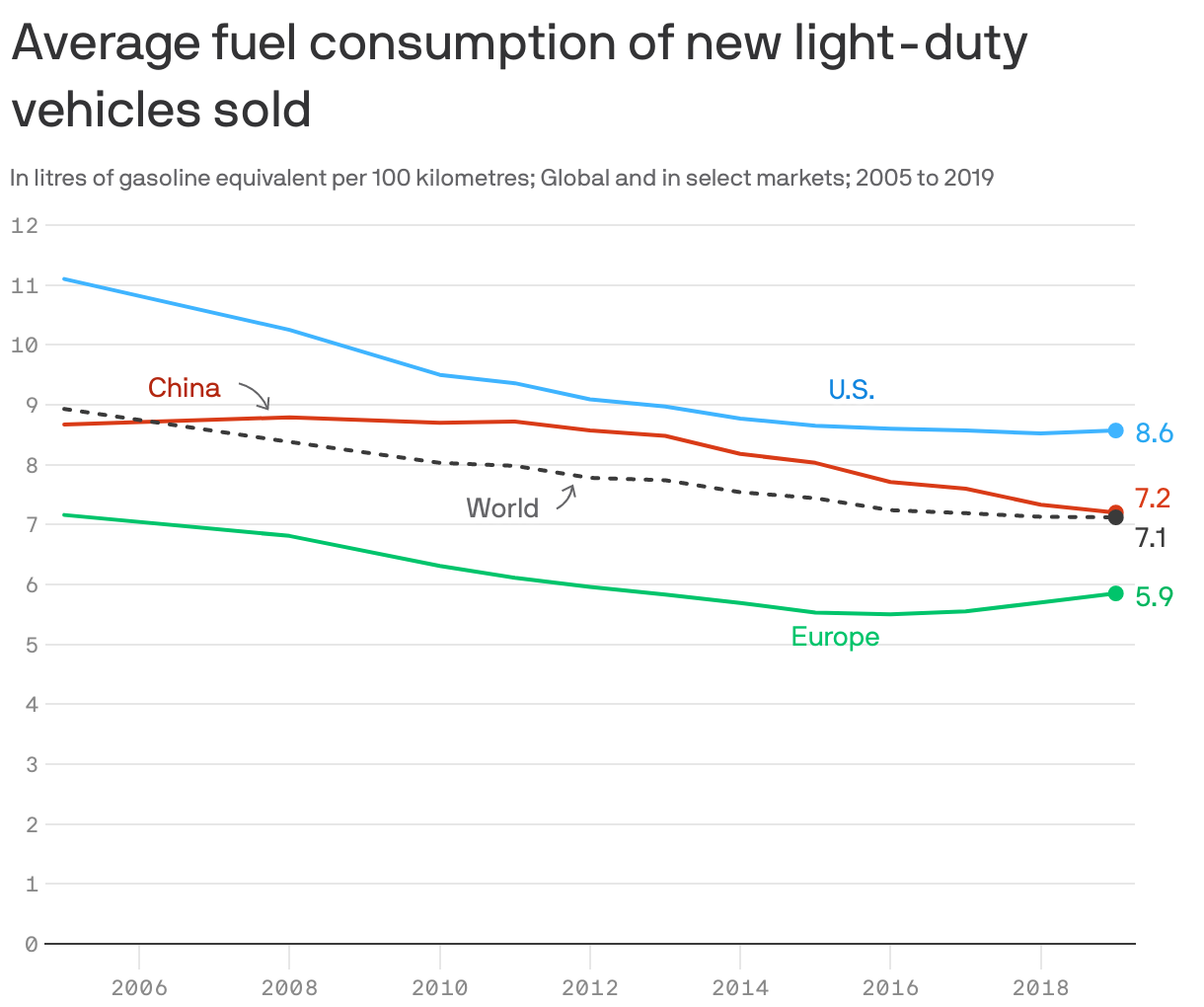
Data: Global Fuel Economy Initiative/IEA; Chart: Jacque Schrag/Axios
A new(ish) analysis shows that "fuel economy progress is stalling" amid the growing global popularity of SUVs and light trucks.
Driving the news: The joint report from the Global Fuel Economy Initiative (GFEI) and the International Energy Agency takes stock of where things stand through 2019, the last year with comparative data.