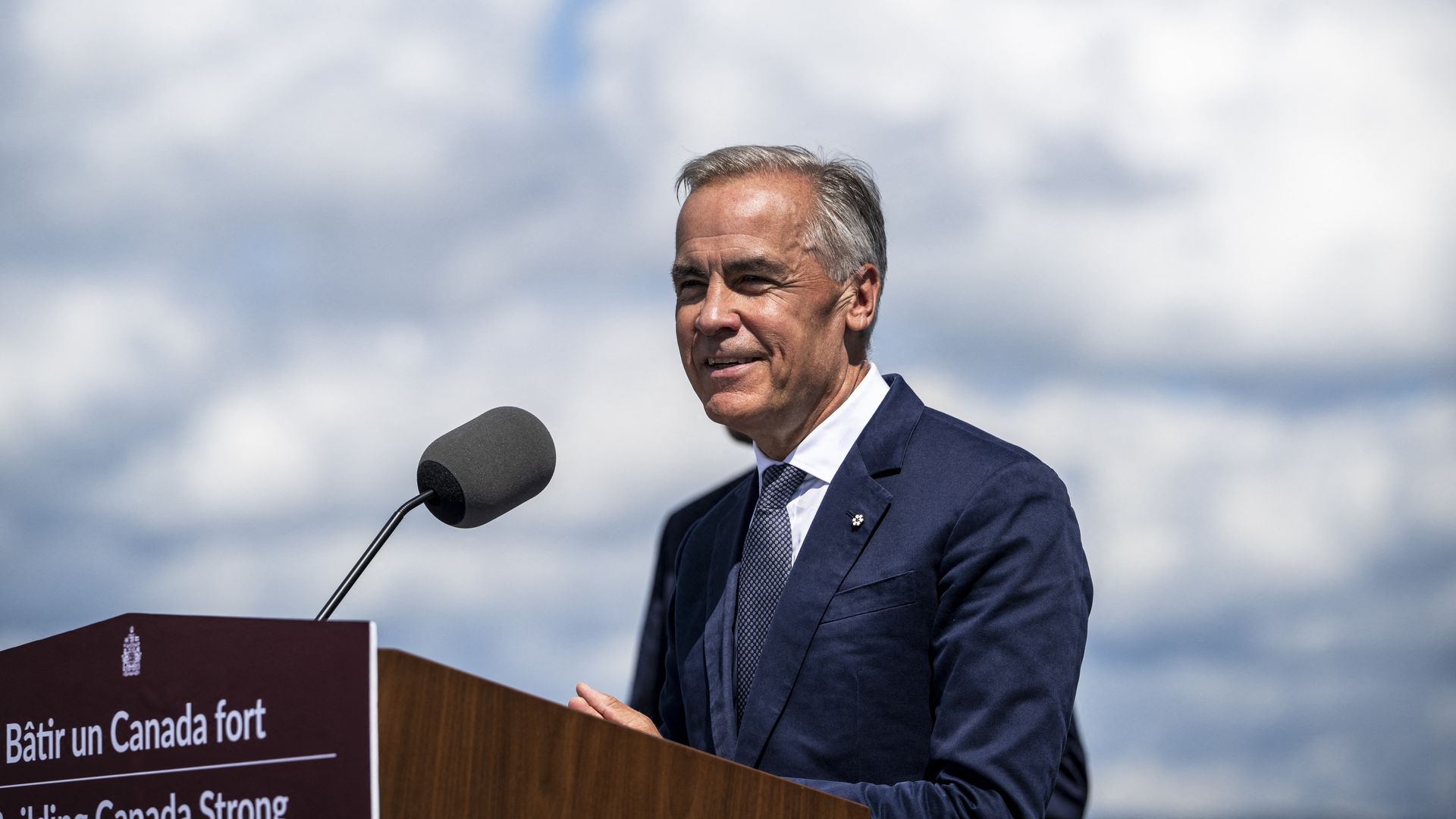
Canadian Prime Minister Mark Carney has turned his decision to hold firm against President Trump's tariff threats into a rallying point for Canadians as their trade clash escalates.
Why it matters: The mild-mannered former Bank of Canada and Bank of England governor is holding firm against Trump despite the threat of further economic pain for Canadians.
The UAW and Deere are barreling toward a contract clash as Big Labor seeks to capture some of the immense wealth being created by the AI boom.
Why it matters: Old-school equipment makers like Deere and Caterpillar suddenly find themselves swept up in a sales-and-stock boom tied to AI, as data center developers gobble up bulldozers, excavators and other construction machines.
America's path to lower inflation depends in part on trade wars and actual wars becoming less economically disruptive. In recent days, both have taken turns that threaten the opposite.
Why it matters: A period of relative calm on those fronts is now giving way to renewed tensions, with Canada, China and Iran all posing fresh economic risks.
The Treasury Department intervened in the bond market last week, looking to lower long-term rates by buying back longer-term debt and effectively swapping it for shorter-term debt. There are new hints of how that effort might escalate from here.
Driving the news: CNBC's Steve Liesman reported that the Treasury could use its $950 billion account with the Federal Reserve — essentially the U.S. government's checking account — to fund further repurchases of longer-term bonds.
It amounts to a bigger stash of financial ammunition than the planned $4 billion Treasury intervention that was announced last week.
California Attorney General Rob Bonta reportedly canceled Monday's planned meeting with Paramount Skydance CEO David Ellison, accusing Paramount of leaking details of a prior meeting.
State of play: The pair had been expected to negotiate a settlement to the multi-state antitrust lawsuit that seeks to block Paramount's proposed $81 billion takeover of Warner Bros. Discovery.
Chinese fast-fashion giant Shein plans to raise up to around US$1.8 billion in its Hong Kong IPO. At the high end of its proposed range, the company would have a $26.8 billion market cap.
Why it matters: This would establish Shein as one of the world's most valuable public clothing companies, but it's still a massive disappointment for many of its VC backers.
A long-predicted energy shock is finally showing up in sky-high prices for diesel fuel.
Why it matters: Diesel fuel is a key input for virtually anything grown or transported throughout the U.S., making it a potentially inflationary force.
The U.S. is experiencing one of the steepest and most widespread crime declines in modern history. Researchers aren't exactly sure why — but they have theories:
Early research points to a mix of factors — declining alcohol and drug use since the COVID pandemic, AI-fueled policing technology that's making it easier for cops to catch suspects, an aging population, tougher prosecutions, and more.
Why it matters: Knowing more about what's driving the violent-crime decline could help cities decide what to preserve as pandemic-era federal money fades away — and how to distinguish policies that reduce violence from merely benefiting from the historic drop in crime.
By the numbers: The U.S. violent-crime rate plunged 9.7% in 2025, the largest annual decline since FBI national estimates began 90 years ago.
The murder rate fell 18.5% to 4.1 per 100,000 people, tying 1955 and 1956 for the lowest rate since national estimates began.
And the decline hasn't stopped: An Axios analysis shows violent crime in big cities fell in the first half of 2026.
Criminologists describe a complicated picture of why crime is down. No one's sure, but several overlapping forces seem to be driving the drop:
Vice consumption cooled: Pandemic-era spikes in alcohol consumption, illicit drug use and firearm purchases — three factors linked to the 2020-2021 homicide surge — have receded.
A return to routine: COVID lockdowns disrupted community guardrails and displaced young men and teens. Employment and social routines have since stabilized.
A law enforcement tech boom: Police departments are using more AI tools, predictive analytics and platforms such as Palantir's Gotham to deploy resources and identify crime hotspots.
Under-the-radar demographic and health trends are also quietly reshaping public safety:
The proportion of young people in America is declining, shrinking the demographic most historically linked to street crime.
In a fascinating medical twist, the explosion of GLP-1 weight-loss drugs (like Ozempic) has been clinically linked to decreased alcohol abuse and improved impulse control — two major factors in violent offenses.
What they're saying: Leonard Adam Sipes Jr., a former Justice Department senior statistics specialist, tells Axios there's "no doubt" that less alcohol use has played a significant role in crime reduction.
Sipes agreed that the nation's aging and the shrinking share of younger people in the U.S. population are pushing down crime.
He said it's too early to know whether AI and other new technology have had a major effect. But some tools clearly help, he said: "Drones do work. License plate readers, yeah, they work."
The other side: Insha Rahman, president of the Vera Institute of Justice, tells Axios the decline isn't simply society reverting to normal after COVID. She argues that cities made investments that helped prevent violence.
Many cities expanded summer youth employment and workforce development programs, and increased mental health treatment as well as community violence intervention and crisis-response units, Rahman said.
She points to Newark, Chicago, Baltimore, Detroit, Los Angeles and Orlando as cities using "focused deterrence" — concentrating police, crisis teams and social services in targeted neighborhoods.
Yes, but: The Trump administration has credited National Guard deployments and other federal interventions in cities such as Washington, D.C., and Memphis with helping to reduce violent crime.
Reality check: There's little evidence that National Guard deployments or aggressive prosecutions drove the nationwide decline, Sipes and Rahman said.
Both noted that crime also fell in cities that didn't change prosecution tactics or see the National Guard deployed.
What we're watching: Pandemic-era federal money for local crime-fighting efforts expires at the end of the year, putting more pressure on already short-staffed police departments.
An economic downturn could create another headwind: Historically, worsening economic conditions mean more crime.
Frontier AI lab Anthropic has a culture interview that includes a question about prioritizing mission over futureshare price, according to people familiar with the process.
The big picture: CEO Dario Amodei has questioned whether newer employees are joining the AI lab for the right reasons, according to a source familiar. The interview process gets to the heart of that tension.