Volkswagen workers' victory represents rare union breakthrough for South

Add Axios as your preferred source to
see more of our stories on Google.
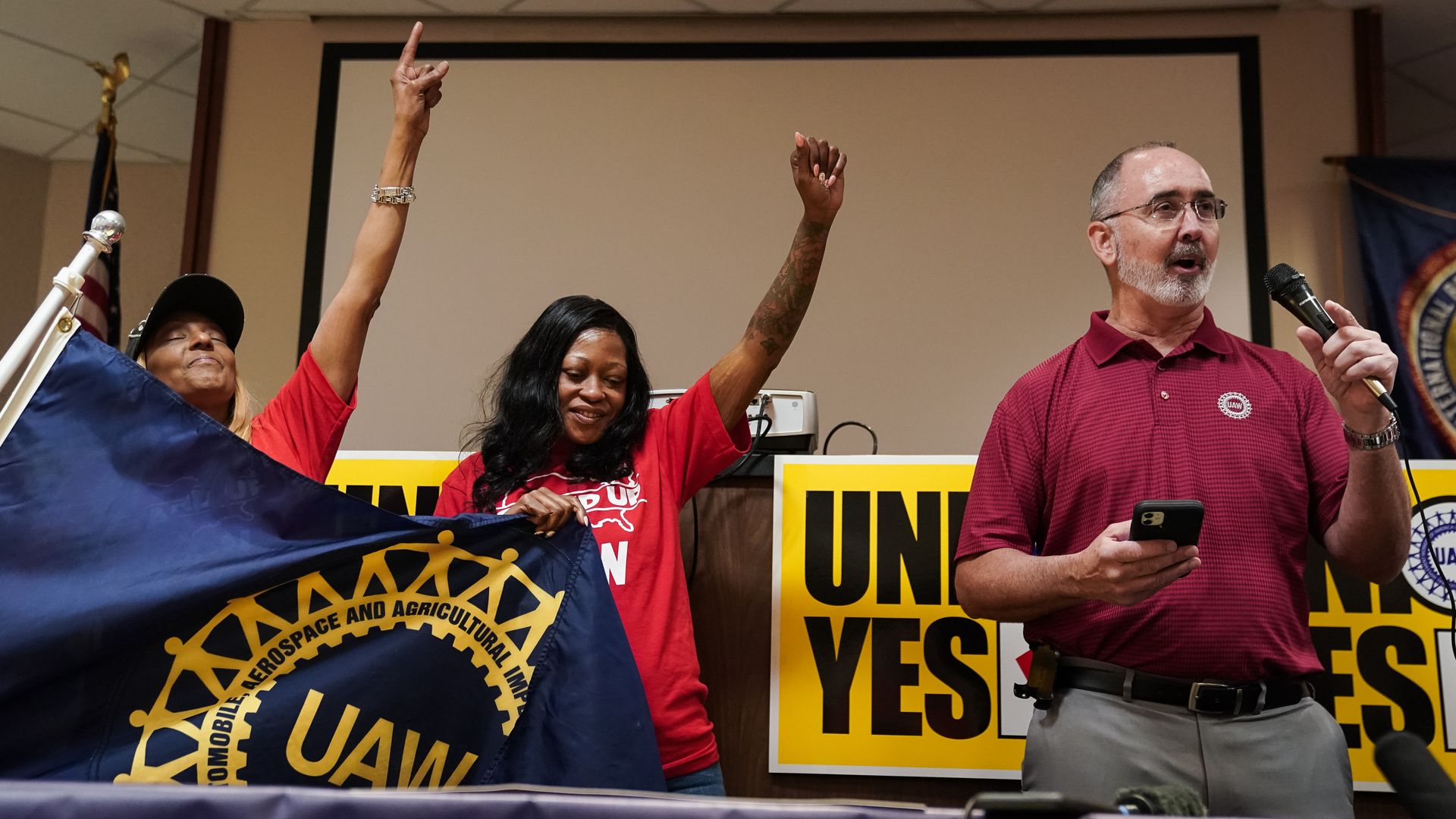
UAW President Shawn Fain speaks as local organizers raise their fists at a UAW vote watch party in April 2024 in Chattanooga, Tenn. Photo: Elijah Nouvelage/Getty Images
Workers at Volkswagen's Chattanooga, Tennessee, factory won 20% raises and lower health care costs in their first UAW contract after nearly two years of bargaining.
Why it matters: The agreement is being billed as a historic breakthrough in the UAW's decades-long effort to unionize foreign-owned auto plants in the South.
Catch up quick: The UAW has been trying to organize the so-called transplant factories — a group now including Nissan, Mercedes-Benz and others — for 40 years.
- They finally succeeded at Volkswagen in 2024, after previous failed votes in 2014 and 2019.
- Yes, but: Hashing out terms of the first contract proved difficult as the two sides battled over issues like job security amid allegations of bad-faith bargaining.
The big picture: The deal comes amid a precarious labor market, and as other companies such as Amazon and Starbucks have refused to negotiate with newly unionized workers, notes Sharon Block, executive director of the Center for Labor and a Just Economy at Harvard Law School.
- "If VW had gone that path ... that would have been a very negative signal about this moment," she tells Axios.
Follow the money: The 20% wage increase is spread over four years and comes on top of an 11% increase VW workers received in 2023, widely seen as an effort to keep union organizers at bay after a contentious UAW strike at GM, Ford and Stellantis.
- Workers will get a 5% raise upon ratification, followed by 3% raises in the next three years, and a 6% raise after four years.
- The UAW told workers they would pay less for health care, though it's unclear whether that reduction reflects changes to benefits.
- Also unclear is how workers' retirement benefits will be affected, another potentially big-ticket item.
Still, UAW President Shawn Fain hailed the contract as a historic moment, not just for VW workers, but for the union and the entire middle class.
- And he credited the 2023 strike at the Detroit Three automakers as a major catalyst.
"In 2023, when Big Three workers walked out, it did two things," Fain told members in a late-night video announcing the settlement.
- "One, it struck fear in the hearts of auto executives everywhere, because they knew autoworkers were done settling for less.
- "And the second thing it did is it inspired autoworkers to take action.
What they're saying: "This is a breakthrough win for autoworkers," Rebecca Kolins Givan, a labor professor at Rutgers University, tells Axios.
- "Achieving a contract demonstrates that workers in the South can and will win strong contracts. Workers at other foreign-owned automakers will now be able to see the material benefits that can be won in a union contract."
Reality check: The UAW still faces "grave difficulties" trying to organize non-union plants in the South, said Cornell University labor professor Harry Katz, citing the region's anti-union culture and strong management resistance among other factors.
- "It's notable that they finally got a contract, but I don't think it's going to solve all their problems," he said.
