Nvidia and a group of blue-chip Wall Street firms are collaborating to provide a half-trillion-dollar bankroll to the AI chipmaker's customers.
Why it matters: The gargantuan financing package illustrates the mushrooming scope and costs of the infrastructure needed to keep the AI economy humming.
If at first you don't succeed, someone may force you to try again.
That's the situation for Verisk, which on Friday was told by Delaware Chancery Court that it must proceed with a $2.35 billion merger that it had tried to terminate.
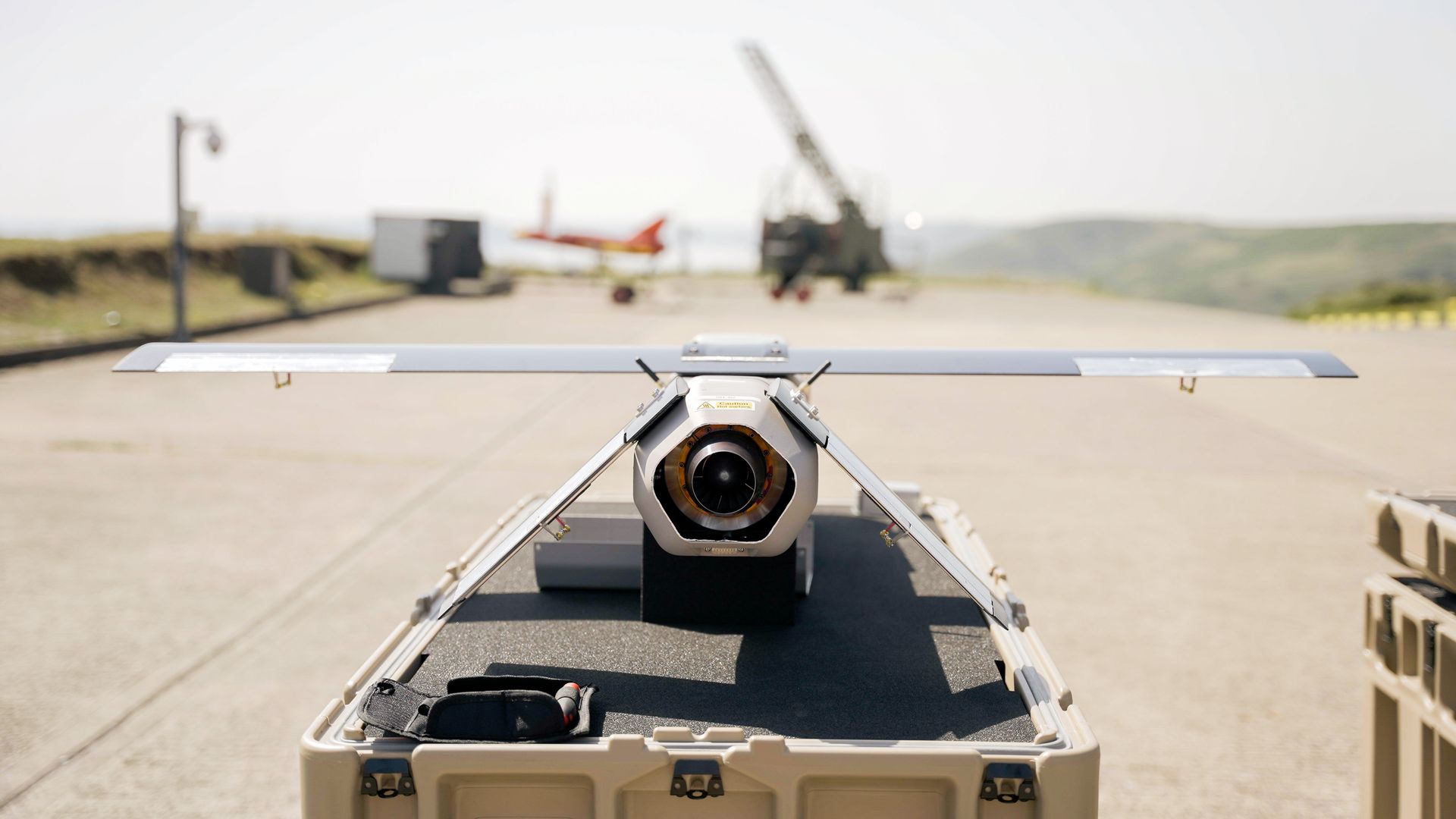
Cambridge Aerospace, a British air defense tech startup, raised $300 million in Series C funding at a $3.4 billion post-money valuation led by DFJ Growth.
Why it matters: Cheap drones have redefined war, as evidenced in both Ukraine and Iran, but legacy interceptor technology remains very expensive.
A flurry of federal investments in mining and mineral supply chains could help the electric vehicle industry that famously isn't President Trump's jam.
Why it matters: The White House emphasized the support as a way to diversify supply chains critical to defense, aerospace and other sectors.
America is less than three months away from ... say it with me ... the most important election of our lifetimes.
Yet the Democratic Party hasn't yet articulated its vision for artificial intelligence, a technology that promises to fundamentally transform our economy and society.
It's a failure of leadership, and also exacerbates investor uncertainty.
Retail investors took advantage of the volatility in the market last month to again be net buyers of stocks, new data from Charles Schwab shared exclusively with Axios shows.
Why it matters: The trade in AI stocks shows staying power, as retail investors repeatedly step in to buy following retreats.
Nearly four years into the AI boom, we still know little about what returns the tech giants could be making on their enormous bets on AI infrastructure.
Why it matters: The data center buildout — the engine driving markets and economic growth — hinges on the expectation that it will eventually enable the tech giants to generate big profits.
But earnings reports have yet to provide any confirmation.
When Mike Allen and I are curious about the "real economy," we talk to sources at big-box stores for a read on real-time sales trends, or friends at super-regional banks to gauge the mood and money movement.
To us, that's the real world and real data, imperfect but less imperfect than dated Bureau of Labor Statistics surveys built for a different time and economy.
Why it matters: Fed Chair Kevin Warsh will get scrutinized like hell for rate changes, his communication style, his vow of a "new chapter" at the Fed, and his relationship with President Trump.
We think the most interesting thing to watch long-term is the seemingly boring data task force he appointed last month to improve the "quality and timeliness of real economic signals that inform the Federal Reserve's policy judgments."
Federal Reserve chairman Kevin Warsh is attempting a high-wire act: He's trying to fundamentally rethink the central bank's approach to guiding the economy, while also using its standard policy toolkit to bring down stubbornly persistent inflation.
A market blowup late last month showed the perils of trying both at the same time.
The big picture: Markets sold off and the economic commentariat was sharply critical of a Warsh press conference on July 29, in which he was vague about the possibility of raising interest rates to combat inflation.