A global glut of lithium prompted a Chinese battery company to suspend production at a massive mine, triggering a rise in commodity prices and a jump in stock prices of lithium companies.
The Trump administration on Monday told a federal appellate court that overturning the president's tariffs could lead to a 1929-style depression that would endanger federal benefits like Social Security and Medicare.
Why it matters: The letter from Solicitor General D. John Sauer and assistant attorney general Brett Shumate claims the U.S. would be on the hook to repay trillions of dollars it hasn't actually been paid, from deals that haven't yet been fully signed.
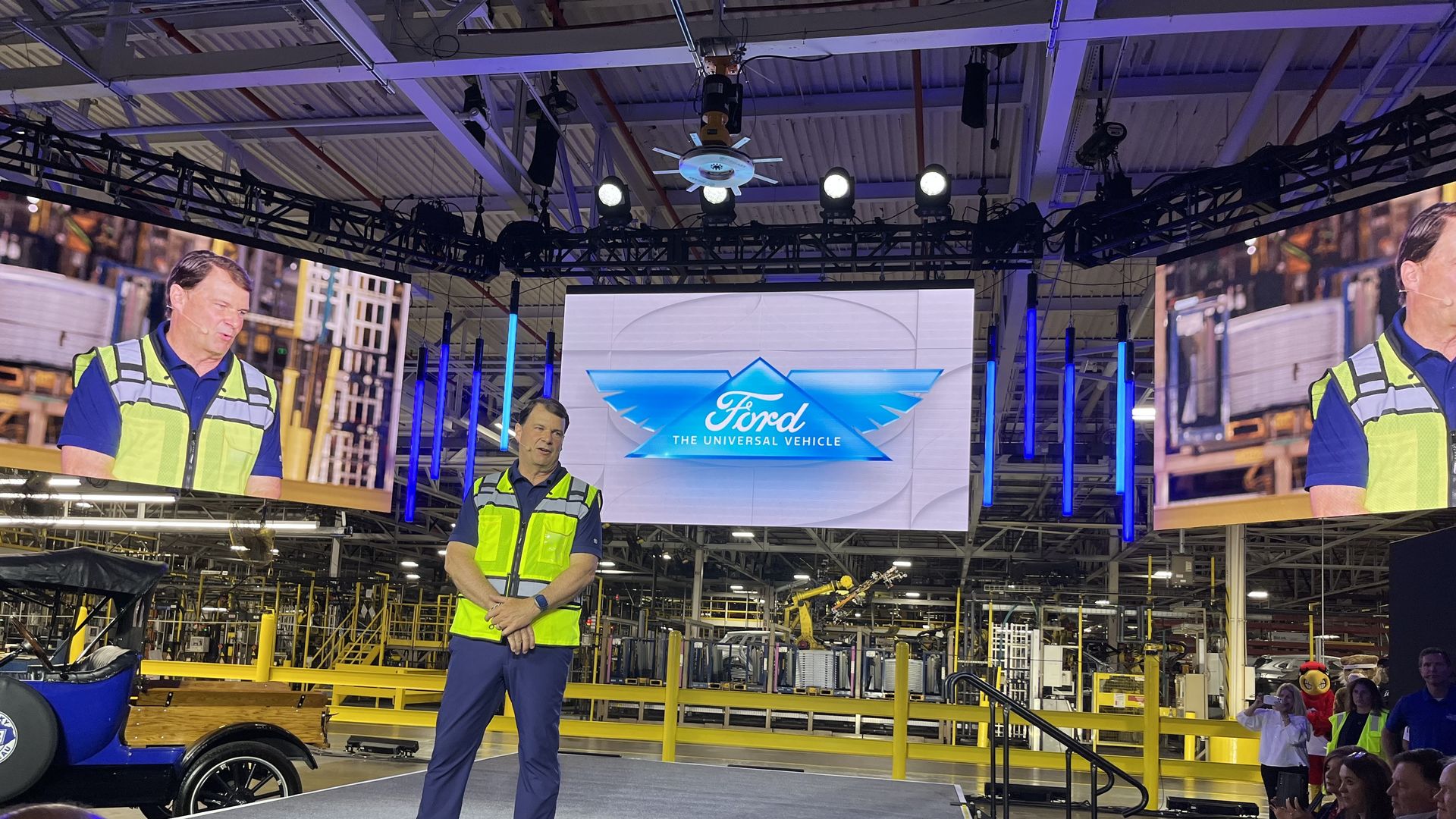
Ford is investing $5 billion across two factories to build a low-cost universal electric vehicle platform, which will underpin a family of affordable EVs it hopes will match China's costs and features.
Why it matters: The effort includes a complete rethinking of how vehicles are assembled — essentially throwing out the traditional assembly line Henry Ford invented — in order to overcome China's low-cost labor.
Vulcan Elements, a North Carolina-based maker of rare-earth magnets, has raised $65 million in Series A funding at a $250 million valuation.
Why it matters: The U.S. is pushing to onshore production of materials critical to its national defense, plus commercial needs, rather than relying on China.
OpenAI is raising money at a $300 billion valuation, in a SoftBank-led round that the company announced months ago but which isn't slated to close until year-end.
It's also working on a secondary share sale at a $500 billion valuation, as recently reported by Bloomberg and confirmed by Axios.
The big question: Why would investors buy shares at the much higher price?
President Trump is rushing toward a new style of economy, with deals that some worry don't look much like the red-blooded capitalism that defines America.
Why it matters: In the Trump 2.0 era, the White House routinely makes extraordinary — and in at least one case, unprecedented — interventions in the domestic and global economy, as well as in corporate America.
If materialized, the commitments might supercharge economic investment.
Longer-term consequences of such a pivot, however, are harder to predict.
Why it matters: President Trump's trade agenda is prioritizing American manufacturing, imposing tariffs to incentivize companies to make goods in the U.S.
The trade war is approaching the end of the beginning — but market watchers say there's still a long list of unanswered questions that investors and businesses need to be resolved.
Why it matters: After months of on-and-off-and-back-on, tariffs seem firmly in place now, but that's still not helping executives gain the certainty they crave.
A U.S. government agency ruled that gold bars from Switzerland would be subject to tariffs. Gold prices shot up. Then the administration announced it would issue a new policy to exempt the gold bars.
Why it matters: The snip-snap approach to tariffs roiled bullion prices, but investors say they are bullish with or without the tariffs.