The price of bitcoin began falling during last night's presidential debate, losing almost 4% by the time it hit its low this morning.
Why it matters: Bitcoin has been seen as a proxy bet on the election, with traders assuming a win for former President Trump would boost the price of the oldest cryptocurrency.
The price started falling almost as soon as the debate began.
As it did, so too did Trump's odds of winning the White House on the most popular blockchain-based prediction market, Polymarket.
The big picture: Bitcoin is one of several assets linked to the "Trump Trade," an evolving term used to describe bets that would benefit from the former president's economic policies — primarily deregulation and tax cuts.
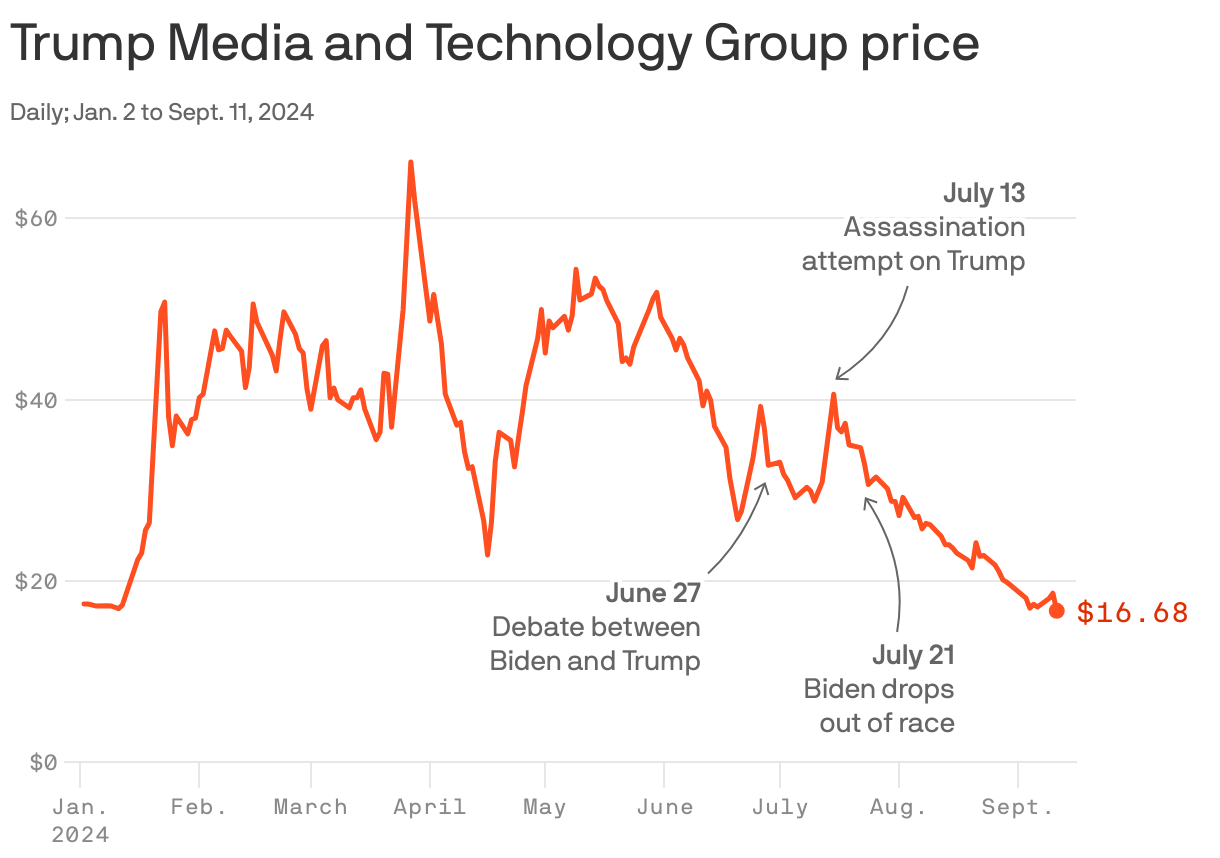
Trump Media and Technology Group, better known by its ticker DJT, is held by a disproportionate number of retail investors, who seem to buy or sell depending on the political winds.
The stock shed nearly $400 million in market value today as Trump's performance was perceived, generally, unfavorably.
In comparison, the stock soared more than 30% on the Monday following an attempted assassination of Trump in July, which analysts suggested at the time could make a second term more likely.
Between the lines: "Trump Media has said its business hinges at least partly on Trump's popularity, and analysts say the company's value will rise or fall based on his electoral prospects," CNBC noted today.
It's getting stressful out there for companies seeking AI chips.
"We probably have more emotional customers today. Deservedly so. It's tense," Nvidia CEO Jensen Huang said during a Goldman Sachs' tech investor conference in San Francisco today.
Context:Demand for Blackwell, the company's newest AI platform designed for training and running large language models for server providers and cloud data centers, "is well above supply," CFO Colette Kress said in late August.
The fervor is driven by companies intent on scaling up their compute power to launch generative AI services.
"They don't want to build any more general purpose computing infrastructure," Huang added at the time.
Orange will literally be the new black next spring, based on runway trends during New York Fashion Week, which ends today.
What they're wearing: Simkhai, Nanushka, Ulla Johnson and 3.1 Phillip Lim were among labels that featured orange hues, per the Zoe Report.
Bold patterns and silhouettes were also a common theme, particularly from Alaia and Diotima, as spotted by the New York Times' Vanessa Friedman.
The big picture: Yes, New York puts on a good show and is an iconic backdrop for designers, but all the buzz belies the reality of an industry in decline.
The number of people working in fashion-related fields in the city has fallen by nearly 30% from a decade ago as manufacturing moves abroad and costs to produce shows have skyrocketed.
The price of bitcoin began falling during the U.S. presidential debate Tuesday night, losing almost 4% by the time it hit a low Wednesday morning.
Why it matters: Bitcoin has been seen as a proxy bet on the election, with traders assuming a win for Former President Donald Trump would boost the price of the oldest cryptocurrency.
The war on inflation is mostly won — with one big exception. Without hot housing prices, the Consumer Price Index would look even better.
Why it matters: That is not enough to prevent the Federal Reserve from lowering interest rates next week. However, it is evidence there's still at least one strong inflationary force in the economy — which may be enough to quiet talk of an aggressive pace of rate cuts.
Inflation rose 0.2% in August, in line with expectations, while core CPI rose 0.3%. Year-over-year inflation was at its lowest level since February 2021. Go deeper.
Why it matters: The August data is the latest evidence that the inflation crisis is over, as the Federal Reserve looks to lower interest rates as soon as next week and take some pressure off the economy.
America's biggest banks are going to face tougher rules eventually, but not nearly as restrictive as regulators wanted.
Why it matters: After the biggest lobbying campaign in recent memory, legal threats, and surprising political allies, the industry defeated the initial slate of regulations known as Basel III Endgame.
The number of New York City Fire Department members who have died from 9/11-related illnesses in the decades since the attack now surpasses the number who died that day.
The big picture: The FDNY added the name of 32 individuals who died from health issues stemming from the rescue and recovery efforts at the World Trade Center to its memorial wall, bringing the total number who have died from Ground-Zero-related illnesses to over 360.