Boeing's troubles are starting to cause some turbulence for major airlines.
Why it matters: Carriers that were depending on new planes from Boeing to meet their growth plans are now scaling back expectations, or scrambling to find other options.
Gas prices are cheaper than this time last year, but they've been rising for the last several weeks — and that led to a higher-than-expected inflation jump in February, Nathan writes.
State of play: Gas prices were down 3.9% in February, compared with a year earlier, but up 3.8% from January.
Overall, the Consumer Price Index posted a 3.2% uptick over the last 12 months and a 0.4% jump over the previous month.
The big picture: For the second straight month, the CPI flashed signals that the 2023 disinflation trend may have stalled out at the start of 2024, our Axios Macro colleagues write.
The House bill requiring Chinese-owned ByteDance to sell TikTok — or face a U.S. ban — will be voted on tomorrow morning.
However that goes, it faces a murky path through the Senate, Axios' Stef W. Kight and Stephen Neukam write.
State of play: TikTok launched an aggressive lobbying effort this week that includes its CEO holding meetings in the Senate and a campaign urging users to call their representatives.
Republicans and Democrats alike want to address the national security and data concerns posed by the Chinese Communist Party's control over ByteDance. But opinions vary on how best to do that.
"Dry promotions" are worthy of a raised eyebrow, Nathan writes.
The big picture: This is apparently the phrase to describe a promotion that doesn't come with a pay increase, according to the Wall Street Journal.
Dry promotions "present a career dilemma," WSJ reports. "And some data suggest they're becoming more common as companies manage their talent with tighter budgets."
💭 Nathan's thought bubble: It's a risky endeavor for employers who don't want to lose people to the competition to give them a better title — which will make them more appealing to other companies — without the money to show for it.
"Most of them don't include adequate measures to prevent misuse and keep drivers from losing focus on what's happening on the road."
— David Harkey, president of the Insurance Institute for Highway Safety, on a new IIHS finding that only 1 of 14 partially automated driving systems it tested received an "acceptable" rating.
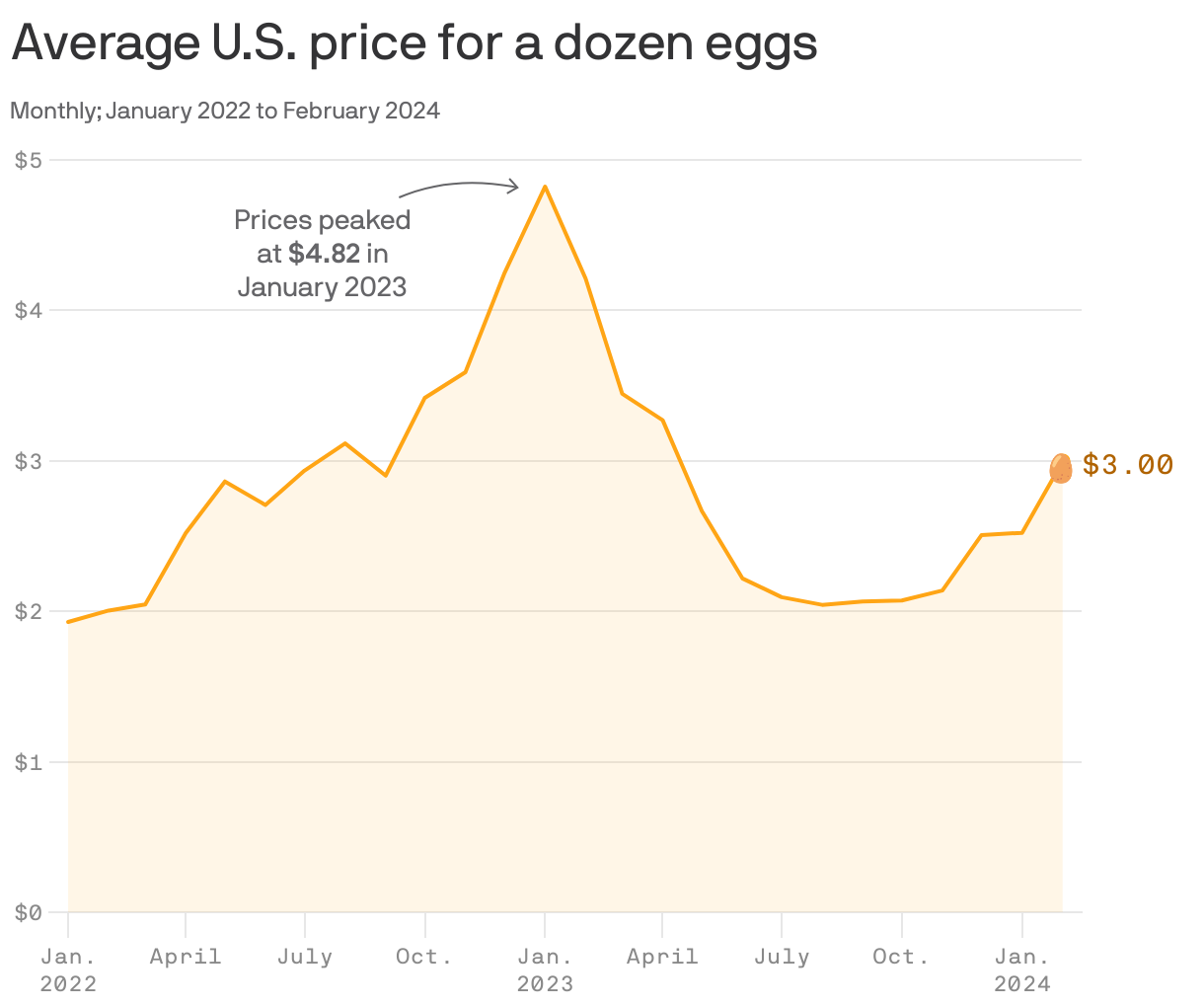
Egg prices are soaring again and increased 8.4% in February from January, according to the latest Consumer Price Index released Tuesday.
Why it matters: Elevated prices ahead of Easter are giving consumers flashbacks to the sky-high prices of 2023, which peaked at $4.82 for a dozen in January.
No one said getting inflation back to 2% would be easy. For the second straight month, the Consumer Price Index flashed signals that the 2023 disinflation trend may have stalled out at the start of 2024.
Why it matters: If elevated inflation readings in January and February persist through the spring, it will raise doubts about the economic narrative that has taken hold on Wall Street and in policymaking circles — that inflation has been quashed and interest rate cuts are on the near horizon.
The Consumer Price Index rose 0.4% in February, while the core measure that excludes food and energy prices increased by the same amount, the government said on Tuesday.
Why it matters: While inflation has plunged from its peak, the latest data shows that price increases, including for housing and insurance, remain difficult to stamp out.
A blockchain economist has proposed a more holistic way of thinking about what a token-powered community is really worth.
Why it matters: Open digital communities, including many gaming applications, are hopping again — but the current standard for measuring their value needs an upgrade.
Standing in line may be the most popular activity at SXSW, Hope writes from the annual film, music, tech and media conference in Austin, Texas.
Why it matters: Despite perennial debate over its relevance, the crowds I've seen this year (albeit my first) indicate that there are still many who love to attend.
Behind the scenes: A long line for Tide's experiential marketing events, which were open to the public, was the first one I spotted on Saturday.
Based on social media posts, it appears the brand gave away samples of its new Evo detergent — as well as free food and drinks.
Reality check: Longtime attendees told me, however, that the conference is about half the size that it was a decade ago.
That's also when SXSW was a popular time for apps like Twitter, Foursquare and Meerkat to launch... detergents, not so much.
President Biden's budget contains $3 trillion in deficit reduction, as administration officials are eager to tout. Large as that number may seem, though, the details show the limits of trying to reduce the United States' worrying fiscal situation on the backs of the ultra-rich.
Why it matters: The U.S. is facing a large deficit as a share of the economy — even if the Biden administration were to secure the tax increases on billionaires and large corporations it seeks.
There's a big focus on housing in the 2025 budget President Biden just sent Congress.
Why it matters: America's housing shortage plus record high mortgage rates, rising home prices and rents are a big worry for voters — and a key area for the president as he makes his pitch for a second term.