We should level with you: No one knows when, or if, cryptocurrency will really take off. It definitely has not found its killer application yet, and no one knows when that will happen.
But the highest and best uses for new technologies are only obvious in hindsight.
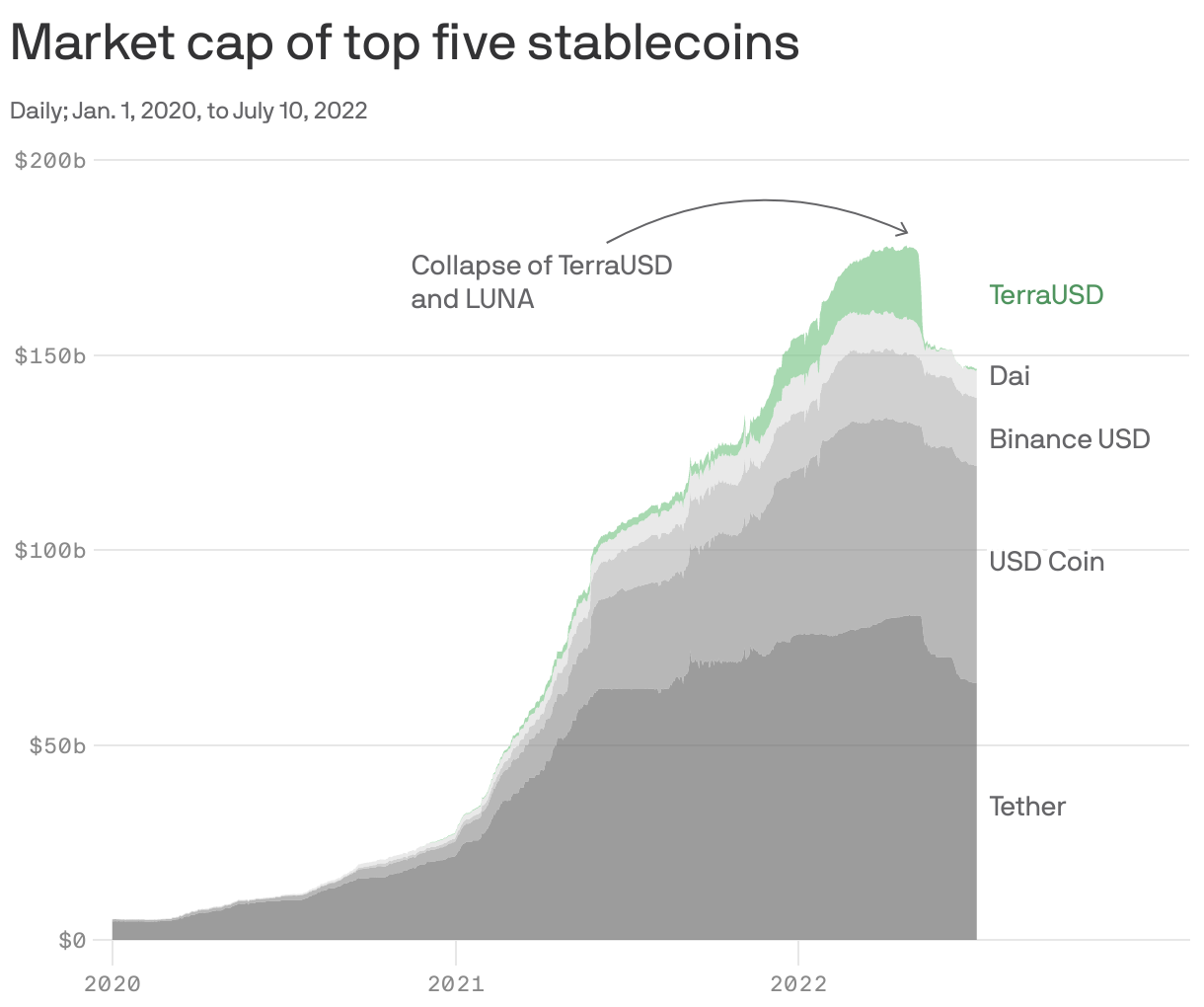
Data: Messari; Note: Top five stablecoins as of April 1, 2022; Chart: Simran Parwani/Axios
Stablecoins are designed to be, you know, stable. Yet one algorithmically-backed version from Terra proved to be rather unstable, and it shook the crypto market as a whole.
Why it matters: The emerging asset class is being increasingly used as an on-ramp into crypto. Because of this, central banks and governments around the world are expressing concern that stablecoins, which can be vulnerable to runs, pose financial risks.
Governments around the world are taking steps to launch their own versions of digital cash — a global race in which the United States is notably lagging.
Why it matters: Broad issuance of central bank digital currencies (known as CBDCs) could reshape how people and businesses use money, and may even expand access to the financial system.
The crypto winter has chilled the push to oversee digital assets.
The big picture: Momentum behind creating a national regulatory framework for the sector has slowed, with an industry-wide shakeout pushing multiple firms to the brink of collapse.
Bitcoin has been written off time and again, yet it — and its many cryptocurrency progeny — keep running. It helps to keep that in mind during a downturn that shows no sign of letting up anytime soon.
In 2021, more people bought cryptocurrency for the first time than in any prior year, and research from the crypto exchange Gemini found that crypto really does seem to be catching on in the developing world.
The big picture: The use cases for crypto — including trade, internet property, transparent finance, and even dodging the law— are broad and growing.
Good afternoon, and welcome to our Modern Money & Markets Deep Dive series. This edition is a guide to digital currency, led by Axios Crypto authors Brady Dale and Crystal Kim.
Disney is changing the name of its Bibbidi Bobbidi Boutique fairy godmothers in the U.S. to be gender-neutral, CNN reports.
Why it matters: It's the latest decision by Disney, which has historically stuck to a family-friendly and clean-cut image, to make its parks more inclusive.
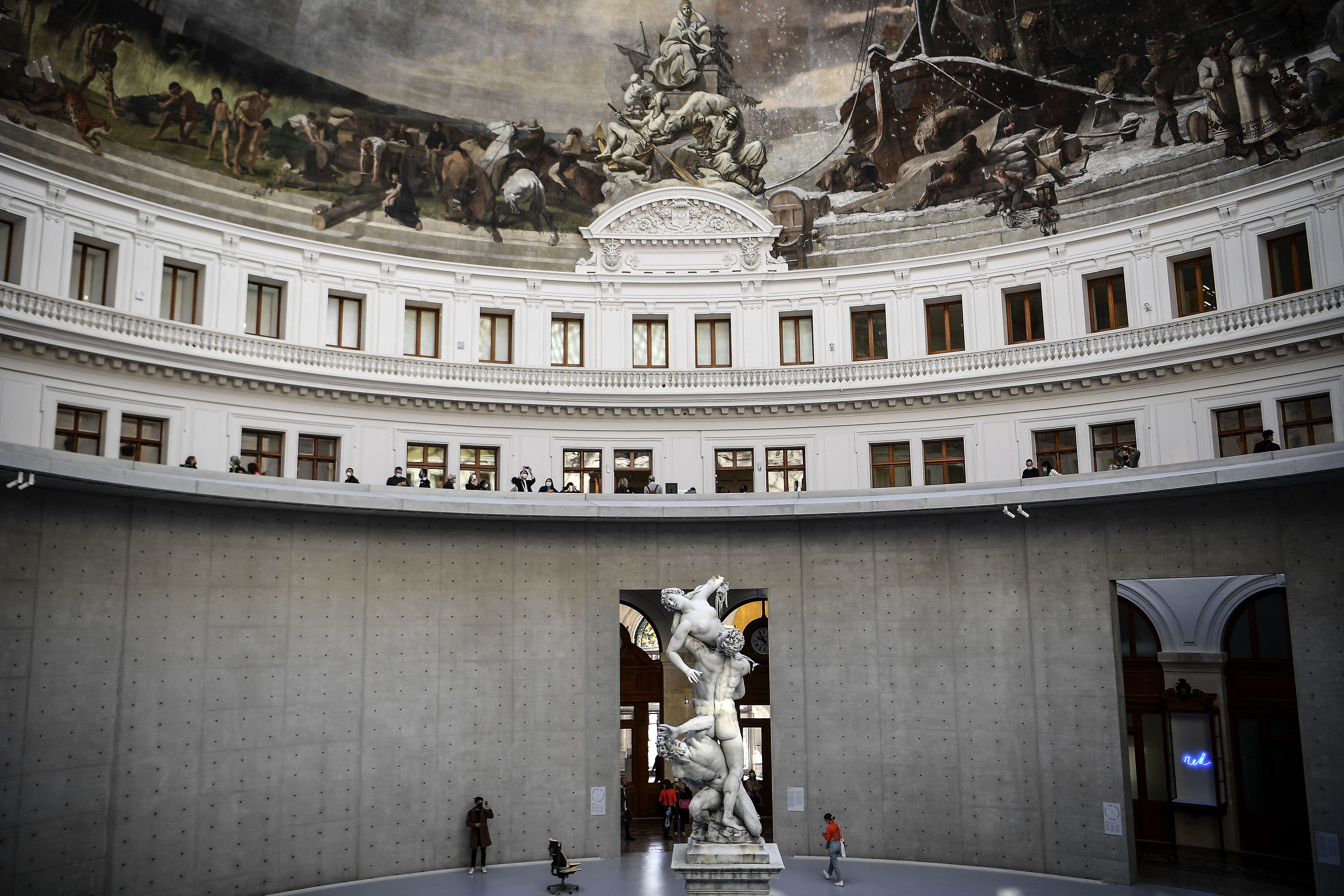
A partially-melted wax sculpture by Swiss artist Urs Fischer, displayed at the Bourse de Commerce - Pinault Collection in Paris. Photo: Christophe Archambault//AFP via Getty Images
Where should cities build museums and other cultural centers, if they're already full of buildings? Increasingly, the answer is: Don't build a museum from scratch. Instead, take the hermit-crab approach, and adopt an existing building's shell.
Why it matters: Adaptive reuse projects, as they're known, are generally much more environmentally friendly than new builds. They also preserve much-loved older buildings.
Inflation creates winners and losers, writes Axios' Emily Peck, and right now young Americans can declare victory. Amid all the rumbling about wage growth failing to keep up with resurgent inflation, they've been more than holding their own.
The big picture: Wages grew 12% for the youngest workers in June, more than twice the rate for those between 24 and 54, according to data from the Atlanta Fed's wage growth tracker.
The heat waves in Europe and the U.S. this week are a stark reminder that international cooperation has never been more important — or more uncertain.
Why it matters: Even as the number of summit-level gatheringscontinues to rise steadily, it's becoming increasingly difficult to envisage a world where China and the U.S. can align where necessary — or even, for that matter, a world where the White House can align with a majority of the Senate.