What happened: After Rivera called into question the intelligence that led to the start of the Iraq War in 2003, Kilmeade pushed back, saying that he would "cheer on" the Soleimani strike because the Iranian general had killed and targeted hundreds of Americans.
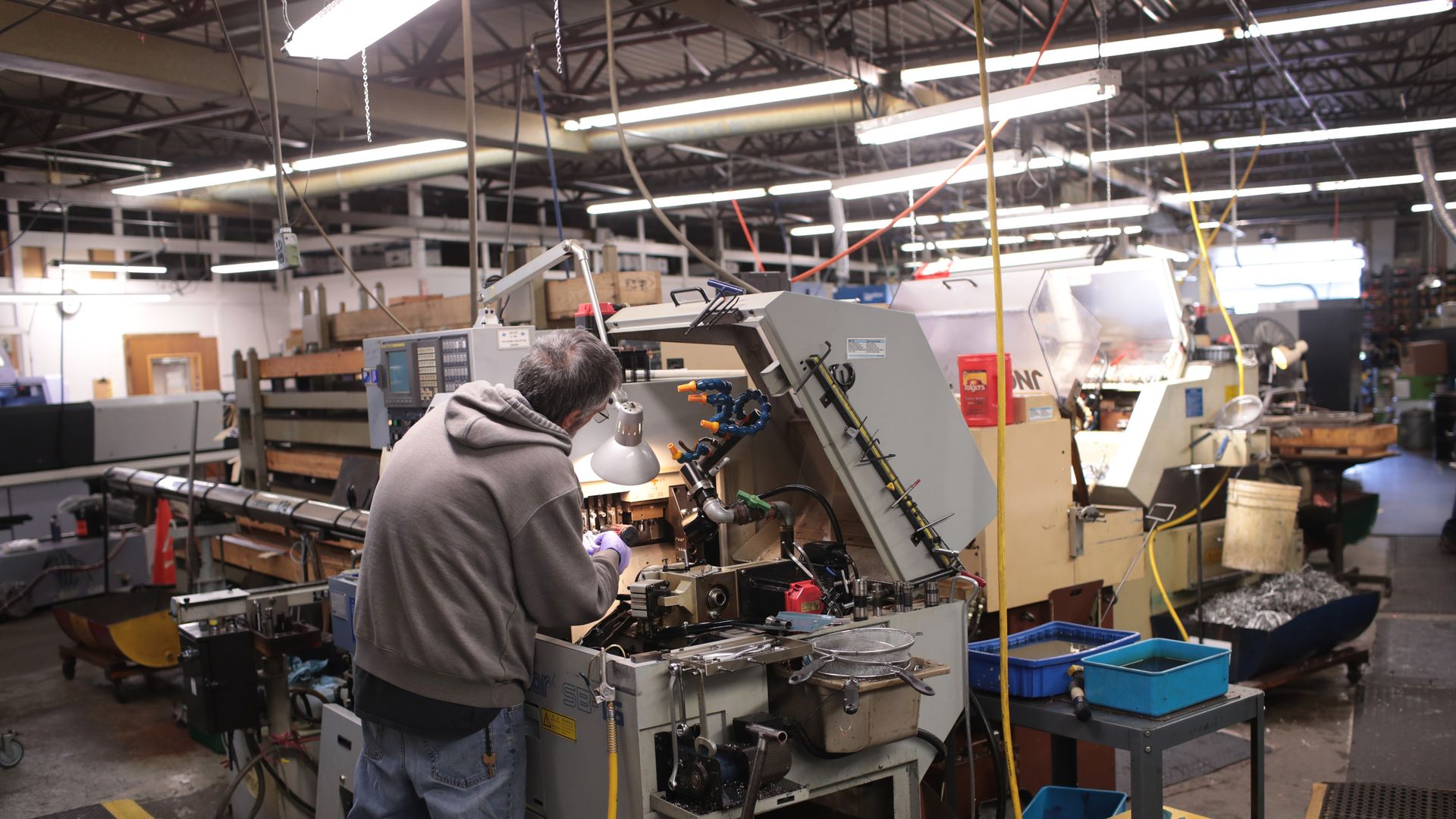
The Institute of Supply Management's index of manufacturing activity released Friday hit its lowest level since the end of the Great Recession in December.
Why it matters: It shows worsening conditions for the U.S. manufacturing sector, which has been in contraction for five straight months, and reignites concerns about the trade war's impact on the economy. Stocks, already in the red after a U.S. airstrike killed a top Iranian general, fell near the lowest levels of the day following the release of the data.
AMD was the best-performing stock on the S&P 500 in both 2018 and 2019, and it got off to a hot start in 2020, rising 7.1% on Thursday to touch a fresh all-time high.
The state of play: The stock rose nearly 80% in 2018, despite falling 40% during that year's disastrous fourth quarter, and it gained 148% in 2019, according to MarketWatch. The company's previous record high stock price was set June 21, 2000.
After a modest recovery over the past four months, manufacturing reports produced by IHS Markit from around the world almost all worsened in December, showing that the sector continues to face global challenges.
The latest: The U.S. saw little change from November to December, remaining just above contraction with a reading of 50.1, but the eurozone looked tortured with both Italy and the Netherlands posting their worst PMI reports in 80 months.
Life in the U.S. is increasingly divided into two realities — one in which things have almost never been better and another in which it's hard to imagine them being worse.
Driving the news: Bankruptcies led more companies to announce job cuts last year than at any time in more than a decade, WSJ's Aisha Al-Muslim reports (subscription), citing data from outplacement firm Challenger, Gray and Christmas.
Apple's new streaming service is only beginning to take shape, but already the tech giant has signaled that it's willing to spend big to lure Hollywood's top talent to be a part of it.
Why it matters: Analysts have for years predicted that Apple, with lots of free cash flow, would one day buy a content company like Netflix or HBO to fulfill its streaming ambitions. But Apple's recent investments in individual producers, actors and directors suggest the Silicon Valley titan is heading in a different direction.
When a CEO is forced out of a company, a lot of people hope and expect big changes. Much like Inigo Montoya in "The Princess Bride," those people are going to have to get used to disappointment.
Why it matters: It's big news when names like Dennis Muilenburg of Boeing and Travis Kalanick of Uber are forced out of their jobs. But that doesn't mean the company is going to change. The reality is that corporate cultures change slowly if at all.
The manufacturing industry in the Midwest continued to contract in December, but did exceed expectations and deliver the best reading in four months.
Why it matters: The Chicago PMI, which tracks manufacturing companies based in the Chicago region, continues to rebound from October's abysmal report that showed the weakest number in four years and the second lowest in a decade.
U-Haul will not hire people who use nicotine products in 21 states beginning Feb. 1 in an attempt "to establish one of the healthiest corporate cultures in the U.S. and Canada," the company announced Monday in a statement.
Why it matters: The ACLU considers anti-nicotine hiring policies "discriminatory" and a violation of worker privacy, but smokers are not a protected class under federal anti-discrimination laws, which allow states to create their own laws on smoker bans.
The Fed’s 180-degree turn was the story of 2019, asset managers and market analysts say.
What happened: Chairman Jerome Powell and the U.S. central bank went from raising interest rates for a fourth time at the close of 2018 and giving market watchers the explicit expectation this would continue in 2019, to doing the opposite. The Fed cut rates thrice and even began re-padding its balance sheet in the last quarter of the year, bringing it back above $4 trillion.
The tech industry's most consequential policy fights in 2020 will play out in the states, not Washington.
Why it matters: Momentum on a range of tech issues, from governing online privacy to regulating the gig economy, has stalled in D.C. as impeachment and election campaigns consume attention. State leaders and legislators are stepping in to fill the void.