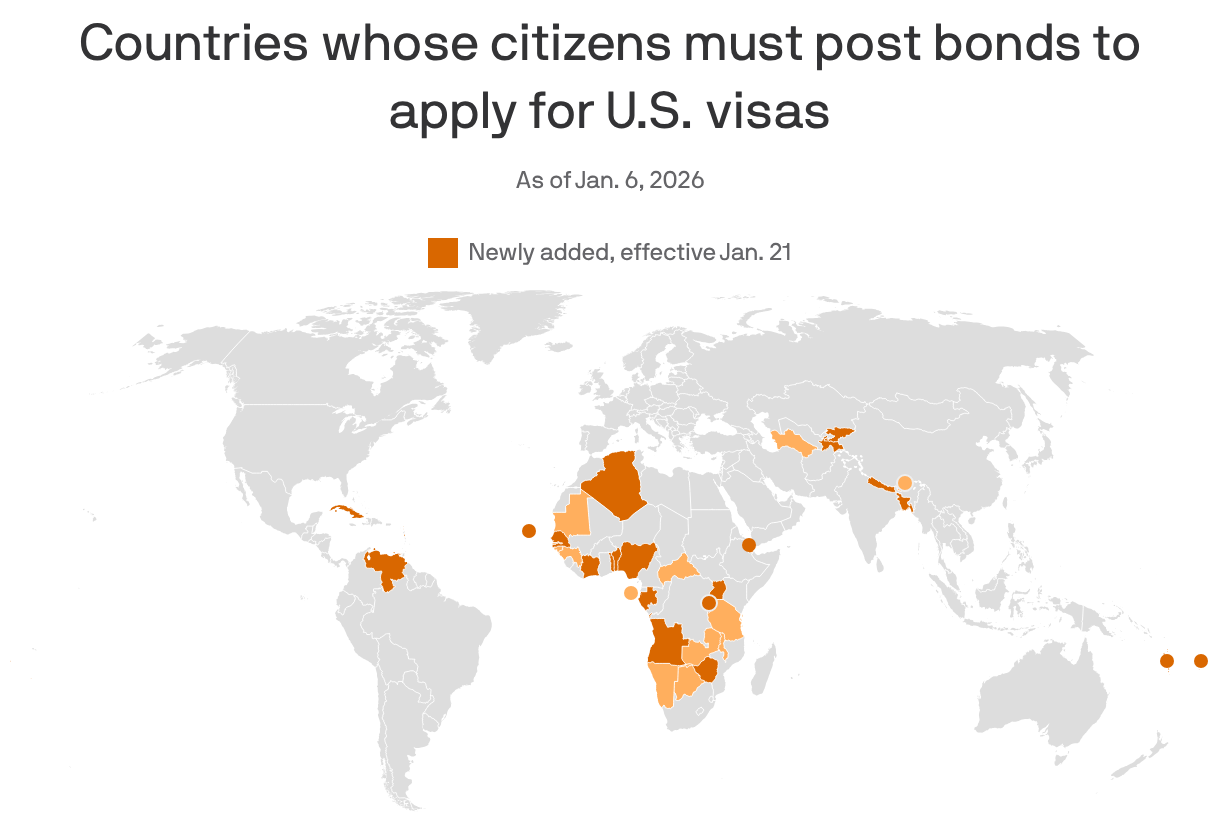
Data: U.S. State Department; Map: Erin Davis/Axios Visuals
The Trump administration on Tuesday added 25 countries to the State Department's list of nation's whose citizens may be required to post bonds of up to $15,000 to apply for U.S. entry.
The big picture: The additions bring the total to 38 countries, mostly in Africa, with in South America and Asia, whose travelers could face sharply higher costs to obtain U.S. visas, as part of the administration's broader strategy to curtail both legal and illegal immigration.
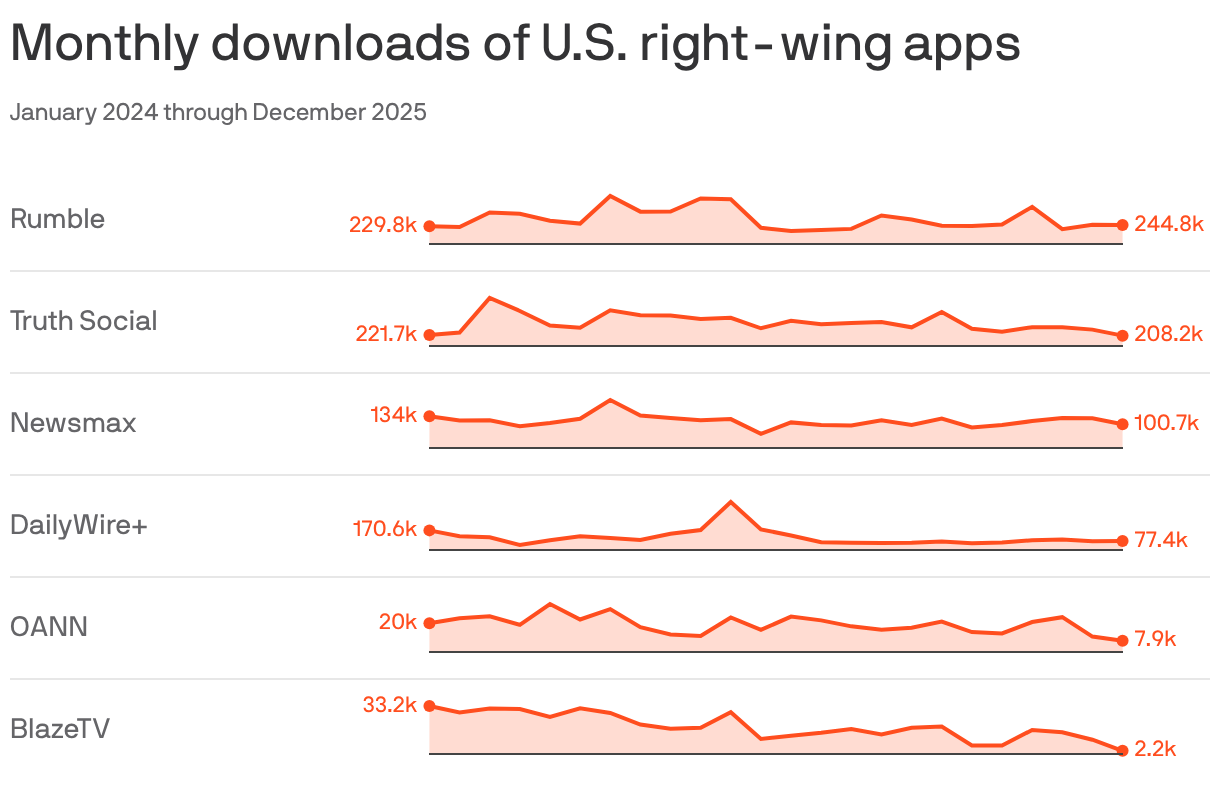
Most major conservative news apps have seen little to no growth in monthly traffic or app downloads over the past one to two years, according to data from Apptopia and Similarweb.
Why it matters: The splintering of the MAGA media movement — combined with broader media market challenges — has impacted the ability of many outlets within the once-unified coalition to grow.
Hilton Hotels started the year on defense after one of its franchisees was called out for cancelling the reservations of Department of Homeland Security agents.
Why it matters: This fallout highlights the reputational risk of operating a franchise model and brings in to question how much behavioral control a global brand actually has over its franchisees.
Meta CEO Mark Zuckerberg on Tuesday announced that C.J. Mahoney, formerly a senior legal executive at Microsoft and deputy U.S. trade representative during President Trump's first term, will join Meta as its new chief legal officer, according to an internal post seen by Axios.
State of play: Mahoney replaces Jennifer Newstead, who announced late last year that she would be leaving Meta after more than five years to become the general counsel at Apple.
Comcast on Monday completed the spinoff of its cable networks, now renamed Versant Media, and then watched the new company's stock plunge 13%.
Why it matters: Versant's value could impact the takeover battle for Warner Bros. Discovery, which later this week is expected to reiterate its preference for Netflix over Paramount, a source familiar with the situation told Axios.
A trio of companies including Nvidia announced Tuesday that they're using AI to accelerate the development of fusion that's eluded innovators for decades.
Why it matters: Fusion, the energy that powers stars, has long had unrealized potential to provide vast swaths of clean, stable electricity for the AI boom and to cut emissions.
Investors never let a crisis go to waste, one chief investment officer wrote following the seizure of Venezuelan President Nicolás Maduro.
Why it matters: Wall Street has already drafted a list of winners and losers, diving into energy stocks and oil before the companies themselves have said whether they are interested. That could lead to disappointment.
President Trump has offered a variety of reasons for his intense, pugilistic ambitions in Venezuela, Greenland and other hemispheric players.
But one tie binds them all: They hold many of the critical minerals essential to AI and defense technology — and therefore future global dominance.
Why it matters: Within two days of snatching Venezuela's leader, Trump administration officials and financial analysts began discussing that nation's vast array of mineral riches.
Nobody knows exactly how much it will cost to rebuild Venezuela's broken-down oilfields, but everyone agrees it's a lot — and there's no guarantee that U.S. companies will be chomping at the bit.
Why it matters: "There is no quick and easy solution to the problems that accumulated over a quarter century," Raymond James analyst Pavel Molchanov said in a note.
President Trump said Monday the U.S. may subsidize oil companies' efforts to rebuild Venezuela's energy infrastructure in a project he estimated could take less than 18 months.
Why it matters:Trump's comments in an interview with NBC signal a longer-term U.S. presence in the oil-rich South American country just days after the capture of Venezuelan leader Nicolás Maduro — and he's framing the effort as broadly supported.
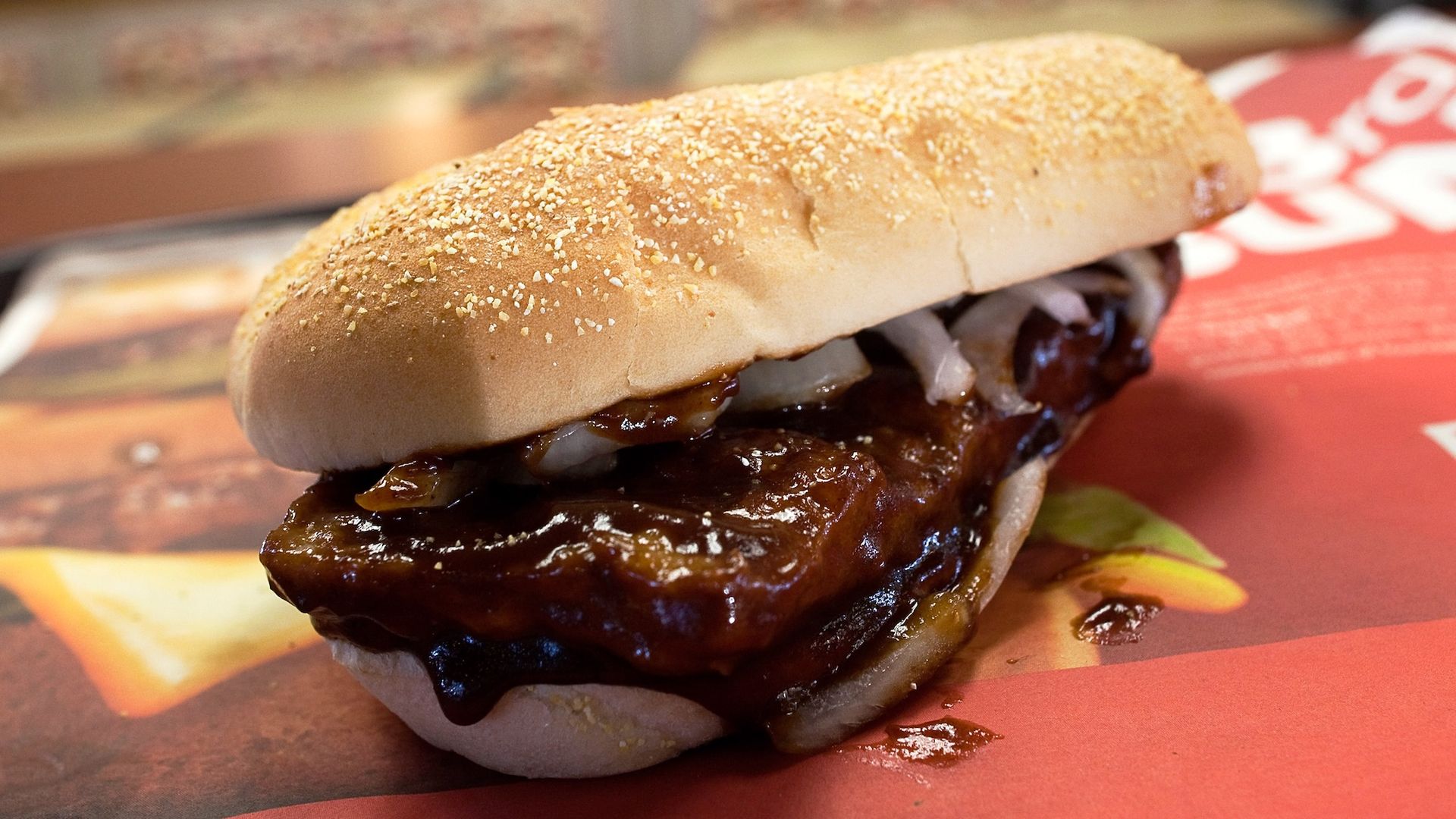
The popular McRib sandwich that pops up periodically on McDonald's menu is at the center of a new federal class action lawsuit filed in Illinois.
Why it matters: The global fast food giant continues to lean into "value and affordability" as inflation worries grow, but customers feeling misled could put both of those selling points at risk.