Scoop: Moms of Black men killed by police to attend Kamala Harris DNC speech

Add Axios as your preferred source to
see more of our stories on Google.
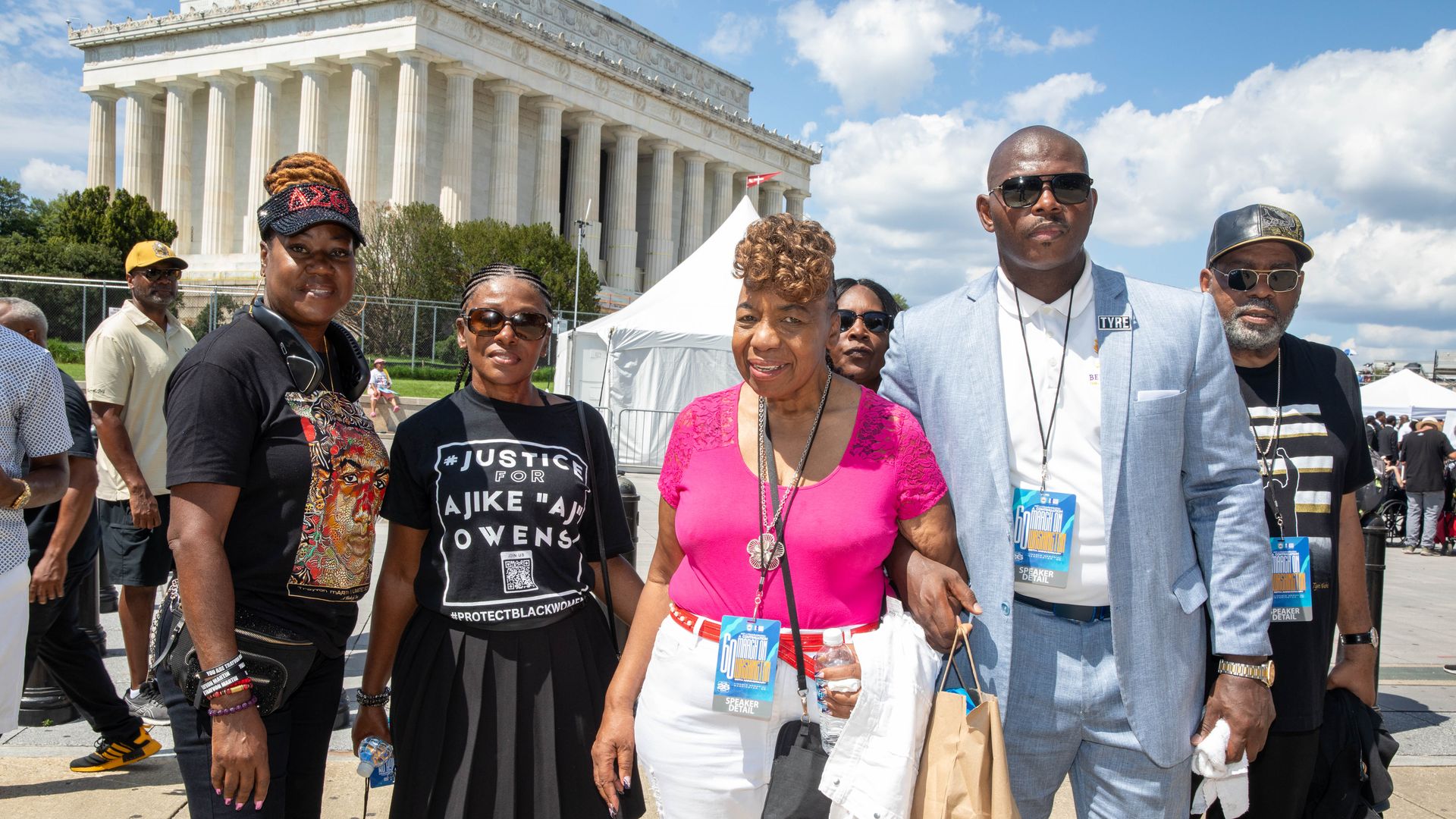
Sabrina Fulton, Gwen Carr and others attend the 60th Anniversary Of The March On Washington on August 26, 2023 in Washington, D.C. Photo: Brian Stukes/Getty Images
Mothers of some of the most high-profile Black victims of police violence are expected to attend Kamala Harris' Democratic nomination acceptance speech Thursday, Axios has learned.
Why it matters: The invitation by Democrats to three mothers whose sons' deaths ignited the Black Lives Matter movement over the past decade suggests the party may symbolically renew the conversation on federal police reform, while also highlighting Harris's connection to victims affected by violence.
Zoom in: Gwen Carr, Sybrina Fulton, and Lezley McSpadden — all Black women and members of the group Mothers of the Movement — were asked to attend by Democratic National Convention officials.
- Carr is the mother of Eric Garner, who was killed by a New York Police Department officer using a banned chokehold during an arrest in July 2014. His plea, "I can't breathe," became a rallying call for protest against police brutality.
- Fulton is the mother of Trayvon Martin, an unarmed 17-year-old Black teenager fatally shot in February 2012 by then-neighborhood watch volunteer George Zimmerman. The high-profile criminal case inspired the Black Lives Matter movement.
- McSpadden is the mother of Michael Brown, a Black 18-year-old who was shot and killed on Aug. 9, 2014, by Ferguson police officer Darren Wilson.
- Chicago mothers Cleo Pendleton and Paula Yates were also invited.
Catch up quick: Organizers have announced nightly themes, with Thursday's focus being "For Our Future," when Harris will accept the convention's nomination for president.
- Campaign and DNC organizers worked with Campaign Zero to invite the mothers, Campaign Zero said. It's not clear where they will sit.
- The Harris campaign declined to comment.
What they're saying: "Seeing Kamala Harris stand firm in her beliefs as a Black woman has restored my hope for justice and strengthened my faith," McSpadden tells Axios.
- "She represents so many of us, understanding and respecting Black motherhood and the diverse communities of Black and brown families, while fighting against oppression and for equality for all."
- "Potentially having the president's ear is an incredible opportunity—it shows that our struggles and demands are being heard at the highest level of government," Fulton said.
- "This moment is truly special because it represents the coming together of grassroots activism and political will, giving us a real chance to reshape a system that has long been marked by injustice," she continued.
State of play: Nearly 13,400 people have been killed by law enforcement in the United States since 2013, according to data released this month by the advocacy group Campaign Zero.
- Campaign Zero data shows Black Americans were 2.9 times more likely to be killed by law enforcement in the U.S. than the general population from 2013 to July, 2024.
- Native Americans were 3.2 times more likely and Latinos 1.3 times more likely to be killed by police than white Americans.
The intrigue: Earlier this summer, Harris invoked the fatal shooting of Sonya Massey to renew the call for police reform, urging Congress to pass the stalled George Floyd Justice in Policing Act, a bill she coauthored while in the Senate.
- Harris has not outlined specific details about any police reform proposals.
- Her early record and comments as a prosecutor showed she was part of the fledging restorative justice movement of the early 2000s while balancing a moderate approach to fighting crime.
Between the lines: Major federal policing reform has stalled in Congress amid partisan bickering, and conservative backlash against the discourse around systemic racism has taken the focus off police violence following the 2014 death of Brown and the 2020 murder of George Floyd.
- Responses to efforts at police reforms since their deaths have been mixed. Some states and cities passed major initiatives, while others resisted any change.
- Advocates say that after 10 years, AI tools and other technologies have advanced enough to comb through policing data and help lawmakers and decision-makers make more effective changes.
Urban League President and CEO Marc Morial told Axios they will "fight like hell" to get the George Floyd Justice in Policing Act passed.
- "It's about accountability; that's all it's about," Morial said. "There's nothing in the Constitution; there's nothing in the statute that says police officers should have qualified immunity ... it's time to overturn it."
Editor's note: This story has been updated with additional statements.
