10 years after Michael Brown's death, police body camera effectiveness still elusive

Add Axios as your preferred source to
see more of our stories on Google.
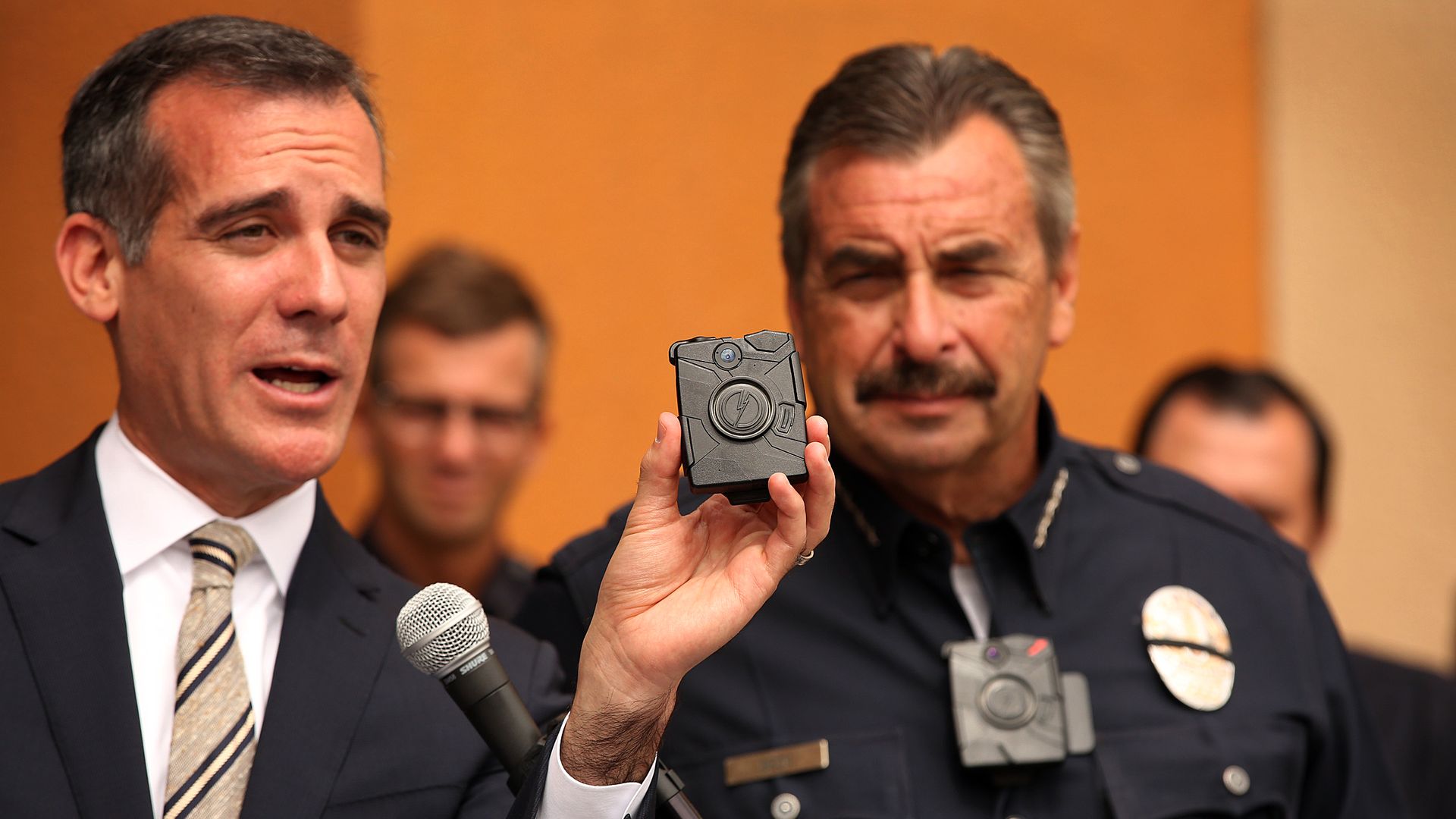
Then-Los Angeles Mayor Eric Garcetti, left, with former LAPD Chief Charlie Beck, right, showing an LAPD body camera and cell phone with special apps that allow the officer to see what the camera is recording, on Sept. 4, 2015. Photo: Al Seib/Los Angeles Times via Getty Images
No one witnessed the struggle on Aug. 9, 2014, when Ferguson police officer Darren Wilson shot and killed Michael Brown in the St. Louis suburb. Many people believed body cameras could have prevented such uncertainty.
Why it matters: Millions of dollars were invested in equipping officers with body cameras, yet 10 years after Brown's death, opinions are divided on their effectiveness as tools for transparency, accountability and building community trust.
The big picture: Advocates say that after 10 years, technology, including artificial intelligence tools, has advanced enough to comb through policing data and help lawmakers and decision-makers make more effective changes.
Catch up quick: Several months after Brown's killing, the Obama administration created the President's Task Force on 21st Century Policing, which recommended improvements to officers' training, such as teaching de-escalation tactics for creating space and distance intense encounters.
- The Justice Department awarded over $23 million in funding for a pilot program to help law enforcement agencies purchase 50,000 body-worn cameras over three years.
- But there are myriad issues.
Case in point: In Philadelphia, the department spent $20 million on body cameras for accountability, but many officers fail to activate them, according to an analysis last year by Axios Philadelphia's Isaac Avilucea.
- The Portland Police Bureau was one of the last major metros to implement the devices earlier this summer. By the end of August, all 800 officers across Portland's three police precincts will have cameras.
Zoom out: Video footage has long been crucial in exposing police brutality, dating back to the Civil Rights era, but over the past three decades, officers have faced increased scrutiny in high-profile cases, such as the beating of Rodney King.
A Stanford University analysis, conducted in 2023, reviewed hours of body camera footage from California police officers, determining that officers tend to be more aggressive toward Black drivers than white drivers.
What they're saying: Stanford Professor Jennifer Eberhardt says body cameras were "seen as this tool that could dramatically increase police accountability."
- "I think everyone thought, 'if we only had this recording of Michael Brown's final moments, everything would be different.'"
- But Eberhardt says the footage had been sitting around for years. Her team wanted to scrutinize the data, uploading footage from thousands of traffic stops into language learning models.
- "We found that even though officers were behaving professionally overall, they spoke to Black drivers with less respect than white drivers; they expressed more concern for the safety of white drivers. They apologized more. I never knew police apologized during stops."
Zoom in: Timothy Dimoff, a former law enforcement officer and national law enforcement procedures expert, acknowledged the shortcomings but noted that cameras have provided the insight over the past five to 10 years that has made departments better.
- "It makes police officers much more highly responsible for their actions," he said. "It has been very useful – the footage of body cameras – to utilize in training and critique things they've been doing right, things they've been doing wrong, and find areas for improvement."
The bottom line: Dimoff said officers still have to make a split-second decision and that's not something a camera can do.
- "The camera slows everything down frame by frame, but the police officer is encountering and interpreting at a much higher or faster rate and doesn't have the luxury of sitting in a chair and watching it in slow motion," he said.
