Kamala Harris' prosecutorial record takes center stage


Add Axios as your preferred source to
see more of our stories on Google.
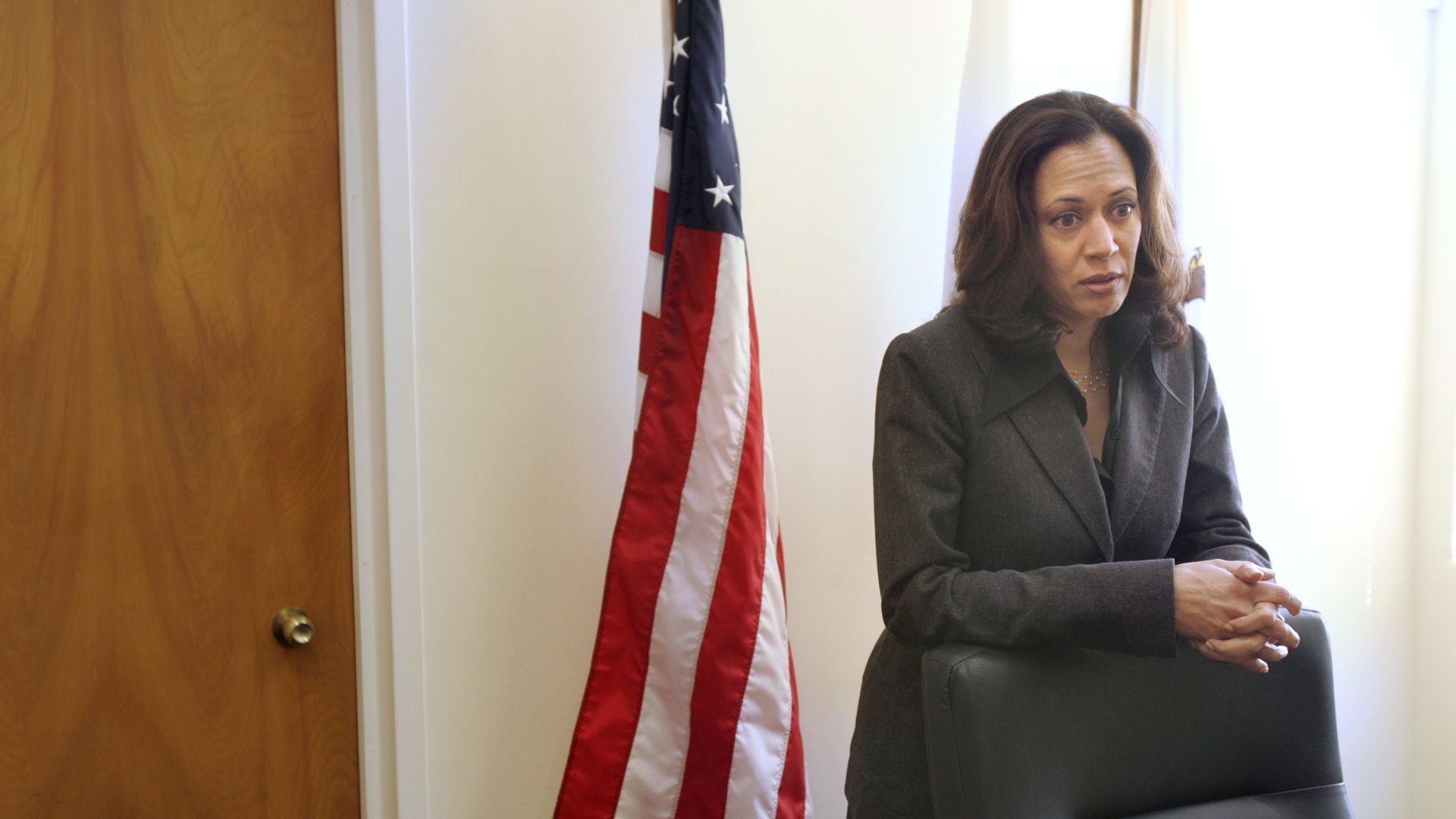
Kamala Harris, then San Francisco District Attorney, in her office in 2006. Photo: Christina Koci Hernandez/San Francisco Chronicle by Getty Images
Vice President Kamala Harris' prosecutorial record is facing fresh scrutiny now that she's running to be president.
The big picture: Harris is pointing to her time as a district attorney and California Attorney General as a point of contrast against former President Trump, the GOP nominee who is a convicted felon.
State of play: It's a risky strategy as Harris has consistently faced criticism from some progressives who accused her of being too tough on crime and helped derail her 2020 presidential campaign.
- This time around, she is betting it will help her against Trump.
- "I took on perpetrators of all kinds: predators who abused women, fraudsters who ripped off consumers, cheaters who broke the rules for their own gain," she said at a campaign rally in Wisconsin this last week. "So hear me when I say I know Donald Trump's type."
Yes, but: The Trump campaign has simultaneously accused Harris of being weak on crime and a San Francisco "liberal" — a classic GOP attack against a Democrat.
Reality check: The violent crime rate per 100,000 residents in California dropped by 10% during Harris's first four years in office as the state's attorney general, according to an Axios review of FBI crime data.
- The violent crime rate in the state was 439.6 per 100,000 residents the year before she took office and fell to 396.4 by 2014.
- During that period, the California Department of Justice improved DNA testing capabilities and cleared the state's DNA backlog for the first time. Her office also signed an agreement with Mexico's AG to combat transnational gangs.
- However, violent crime surged to 444.8 in 2016 during her last year in office to a six-year high, an Axios review found.
Zoom in: As District Attorney of San Francisco, the number of cases from violent crimes in the city her office cleared skyrocketed by 24% during her time as DA, an Axios review found.
- Those cleared cases came as the number of violent crimes rose steadily in the city of San Francisco during her first five years in office then fell 15% in her last two years, the analysis found.
Between the lines: Harris' early record and comments at the time showed she was part of the fledging restorative justice movement of the early 2000s while balancing a moderate approach to fighting crime.
- In her 2009 book, "Smart on Crime: A Career Prosecutor's Plan to Make Us Safer," Harris urged Americans to see crime as "a non-partisan issue" while pushing programs to intervene on potential repeat nonviolent offenders.
- The left, she wrote, needed to get "past biases against law enforcement and (recognize) that even low-incoming communities...want and deserve great public-safety resources."
- "For the right, it means acknowledging that crime prevention is a key to crime fighting, and that the tools we need to ensure community safety are far more diverse than simply laws that make prison sentences longer."
Flashback: Harris dubbed herself a "progressive prosecutor" in her 2019 memoir, "The Truths We Hold: An American Journey."
- Shortly after it was published, the New York Times published a critical op-ed, titled "Kamala Harris Was Not a 'Progressive Prosecutor," claiming she was often on the wrong side of history while serving as California's attorney general.
Controversial stances
- As San Francisco DA, Harris faced backlash for her decision not to pursue the death penalty against the man convicted of murdering San Francisco police officer Isaac Espinoza. Following that decision, no police union endorsed her for a decade, per the Atlantic.
- As attorney general, Harris' office was against DNA testing requested by Kevin Cooper, a Black man convicted of four murders. Year later, Harris urged California to allow the testing, which eventually found evidence of Cooper's guilt. He has maintained he is innocent but remains on death row.
- Harris supported a controversial 2011 truancy law while she was attorney general that threatened jail time for parents of children who had too many consecutive, unexcused school absences. She later expressed regret saying her intent was not to punish parents but to send them a warning.
Criminal justice policies
Harris has been accused of imprisoning an estimated 1,500 people for marijuana-related offenses while she was attorney general, for which she was dubbed "Kamala the Cop."
- While she oversaw about 1,956 misdemeanor and felony convictions for "marijuana possession, cultivation, or sale," per Reuters, most of the people convicted during that time did not serve jail time, defense attorneys and prosecutors in Harris' office told Mercury News.
- Harris later came out in support of the decriminalization — and eventually legalization — of marijuana for recreational use, cosponsoring the Marijuana Justice Act.
- She said in 2022 that, "Nobody should have to go to jail for smoking weed."
Harris has launched criminal justice reform programs, such as her 2005 reentry initiative called "Back on Track," aimed at reducing repeat offenses among low-level drug-trafficking defendants.
- Her office also launched the OpenJustice platform in 2016 in an effort to make law enforcement data more transparent.
Police reform advocacy
Harris has a history of police reform advocacy, which she recently raised as a priority after Sonia Massey's death.
- She denounced the fatal shooting of the unarmed Black woman after police body camera footage was released this week, Harris calling it a "senseless death."
- "Sonya Massey deserved to be safe," Harris said in a statement. "After she called the police for help, she was tragically killed in her own home at the hands of a responding officer sworn to protect and serve.
Go deeper: "I know Donald Trump's type:" Kamala Harris takes aim at rival's record
