Michael Brown killing met with mixed changes nearly 10 years later


Add Axios as your preferred source to
see more of our stories on Google.
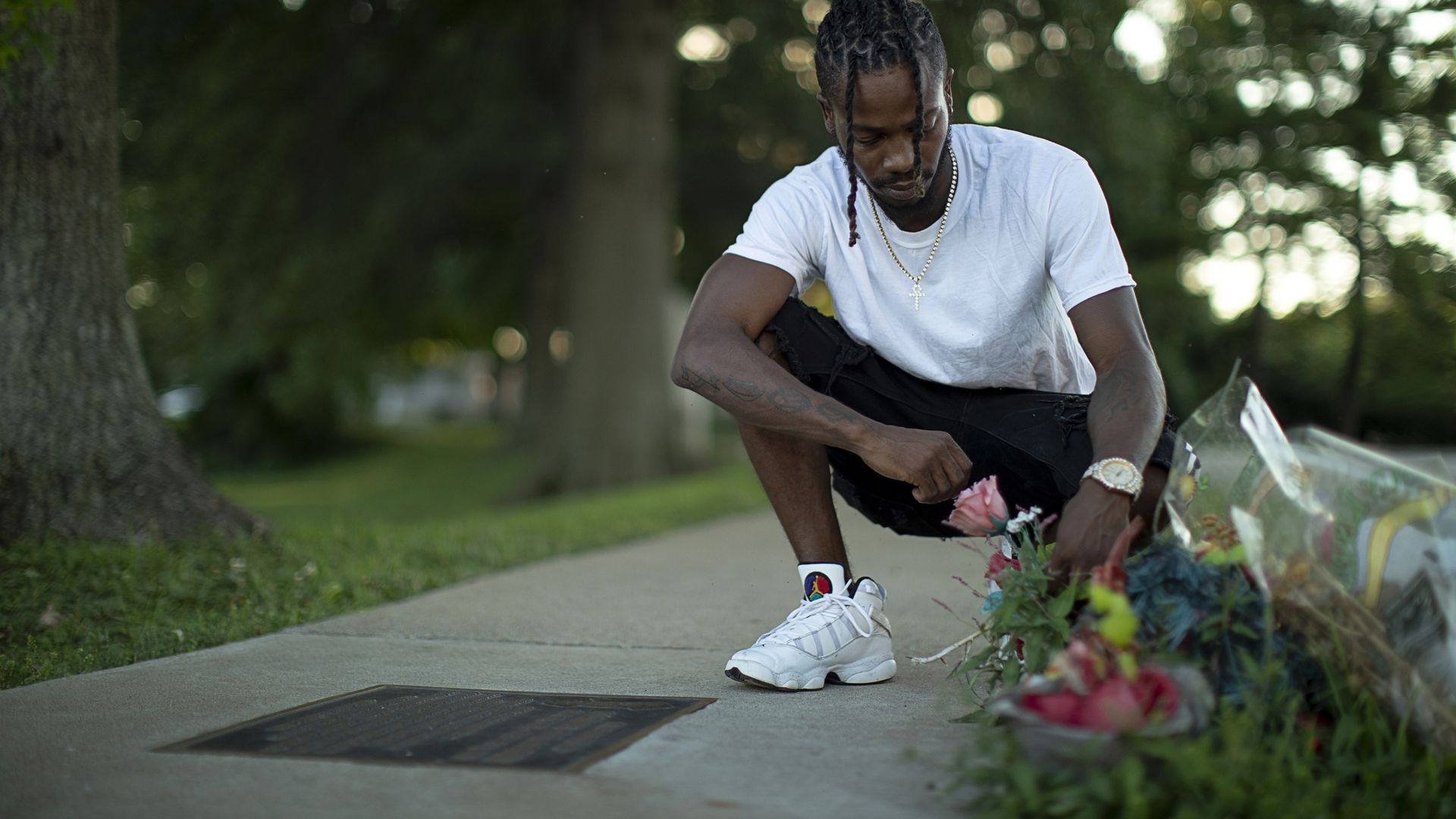
Dorian Johnson next to a Mike Brown memorial in Ferguson, Missouri. Photo: Ray Whitehouse For The Washington Post via Getty Images
It's one day shy of a decade since Michael Brown was killed in a Ferguson, Missouri police shooting that led to crucial conversations about transparency and reform while helping spark a global Black Lives Matter movement.
Why it matters: The anniversary on Friday will likely reignite debates about criminal justice reforms, coming just weeks after the fatal shooting of Sonya Massey by an Illinois deputy, which was caught on video and generated national outrage ahead of the 2024 election.
- On Friday, Robert F. Kennedy Human Rights attorneys will present further details in an ongoing case before the Inter-American Commission on Human Rights, representing Lezley McSpadden, Michael Brown's mother, to bring more attention to Brown's case and pressure the U.S. to reopen it.
Catch up quick: Brown, a Black 18-year-old, was shot and killed on Aug. 9, 2014, by Ferguson police officer Darren Wilson, who had earlier stopped the high school graduate for walking in the middle of a quiet residential road in the St. Louis suburb. A confrontation followed.
- A struggle at Wilson's police vehicle turned into a street pursuit that ended with Wilson fatally shooting Brown.
- Witnesses said Brown had his hands up when he was shot, but federal and local investigators later disputed that. The shooting led to outrage in Ferguson, resulting in burned buildings from demonstrations and violent police responses to protestors.
- A grand jury and an Obama administration federal investigation later cleared Wilson, writing that "this matter lacks prosecutive merit and should be closed."
State of play: Major federal policing reform has stalled in Congress amid partisan bickering, and conservative backlash against discussion on systemic racism has taken the focus off police violence following the 2014 death of Brown and the 2020 murder of George Floyd.
- Responses to efforts at police reforms since their deaths have been mixed. Some states and cities passed major initiatives, and others faced resistance to any change.
Zoom in: The advocacy group Campaign Zero pushed for 24 states, including Louisiana, Maryland, Nevada and Virginia, to pass legislation to reduce police violence.
- Six states and two cities adopted more restrictive no-knock raid laws.
- At least five states passed bills that end or study the end of qualified immunity for police officers, according to Campaign Zero.
- Events in Ferguson and President Obama's $75 million program in December 2014 spurred rapid nationwide adoption of body cameras for police across the country.
Yes, but: President Obama and the two presidents who followed him have faced criticism for not doing more.
- Obama said in 2021 that "institutional constraints" stopped him from speaking out against the killings of Black Americans when he was in office — an excuse some advocates dismissed.
The intrigue: RFK Human Rights attorney Wade McMullen said he hopes the Inter-American Commission on Human Rights concludes the U.S. failed to protect the rights of Mike Brown and his family.
- "(It) can add more fuel and legitimacy to the organizing and advocacy that we're doing to eventually reopen the case with a special prosecutor or a new prosecutor in Missouri," the attorney said.
- McMullen faulted the Obama administration for not doing enough on the case.
What they're saying: Rashad Robinson, president of Color Of Change, testified as part of Obama's Task Force on 21st Century Policing. He said it is important to note that Ferguson "created openings to talk about systemic barriers and activism."
- Still, "when you get to Sonya Massey, which is such a horrific story, and you see this video, and you're like, 'Did anything change?'" he said. "It calls into question all of the work that needs to be done in the systemic nature of policing."
Robinson said there's no easy fix; reforming the justice system or convicting an officer doesn't address the underlying power and racial inequities that contribute to hostile environments.
The bottom line: "You can ban chokeholds, but police can find another way to kill us," Robinson said. "You can give them body cameras and they'll find a way. You can find quick solutions, but that doesn't raise the ceiling."
- "Justice is not a dead black body and someone in jail; it's someone living and thriving," Robinson said.
