What to know about Biden's proposed Supreme Court overhaul

Add Axios as your preferred source to
see more of our stories on Google.
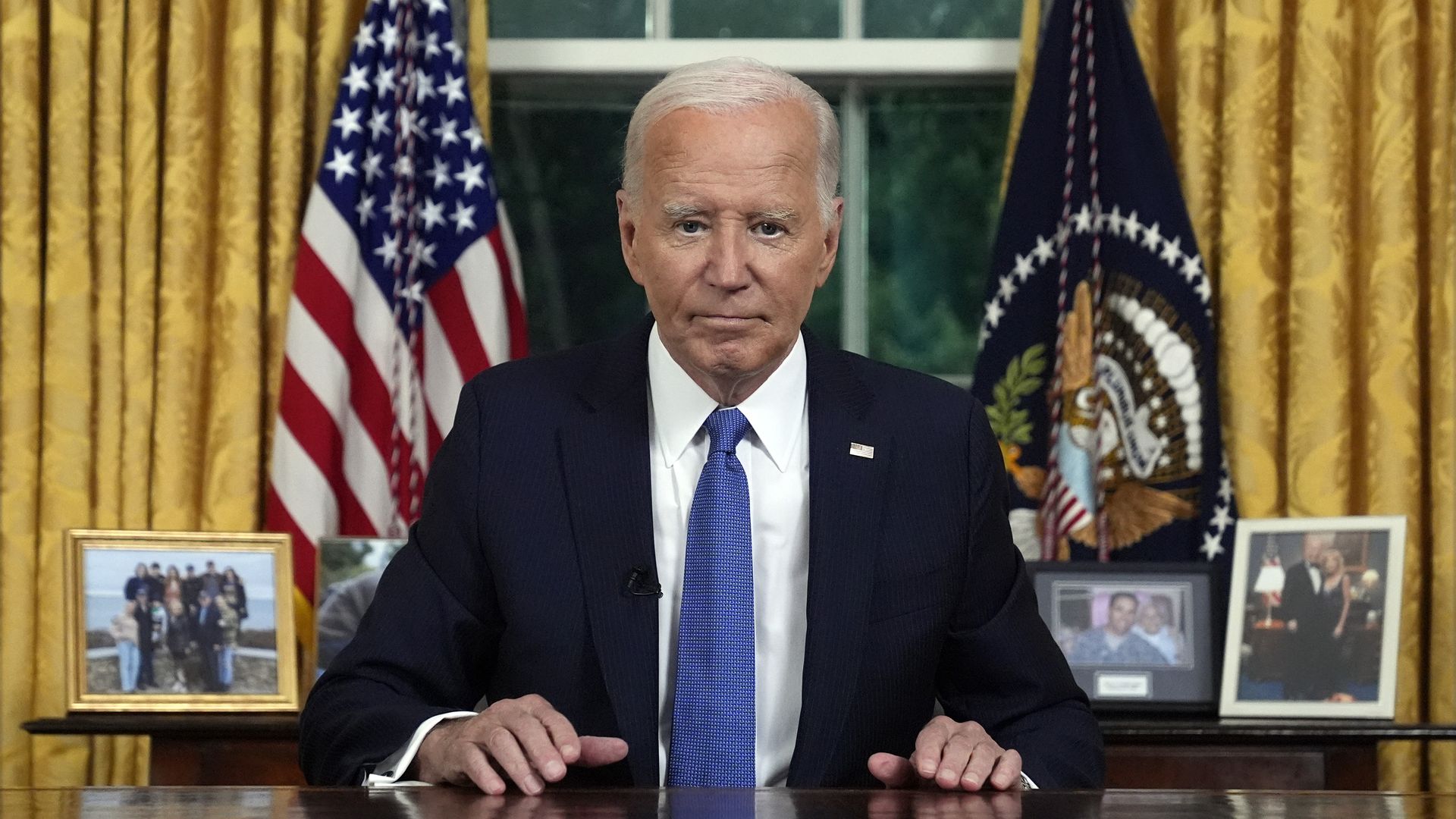
President Biden in the Oval Office on July 24. Photo: Evan Vucci-Pool/Getty Images
The Biden administration on Monday unveiled a plan for sweeping reforms of the U.S. Supreme Court, underscoring the issue as a priority in the president's final months in office.
Why it matters: The reforms are necessary to repair the "crisis of confidence" facing the court, caused in part by recent ethics scandals surrounding certain Supreme Court justices, per a White House fact sheet.
- "What is happening now is not normal, and it undermines the public's confidence in the court's decisions, including those impacting personal freedoms," President Biden wrote in a Washington Post op-ed Monday.
- The proposed reforms would "restore trust and accountability to the court," he added.
Between the lines: Biden didn't consult with Congressional Democrats before putting forth his proposal on Monday, Axios reports.
- His approach likely signals that the slate of reforms is more of a pre-election messaging push rather than a legislative imperative.
Term limits
Biden is calling on Congress to set term limits for Supreme Court justices.
- "I support a system in which the president would appoint a justice every two years to spend 18 years in active service on the Supreme Court," Biden wrote in the Post.
- This would ensure regular turnover of justices and "reduce the chance that any single presidency radically alters the makeup of the court for generations," he added.
Context: Former President Trump appointed three conservative justices to the Supreme Court during his presidency, fulfilling his campaign pledge to do so in order to overturn Roe v. Wade.
- Biden's call also comes after the Supreme Court's bombshell rulings this year limiting executive branch power and determining that presidents have immunity for "official acts".
Ethics code
Biden is also calling on Congress to pass a binding and enforceable code of ethics for Supreme Court justices, labeling the current voluntary system "weak."
- "Justices should be required to disclose gifts, refrain from public political activity and recuse themselves from cases in which they or their spouses have financial or other conflicts of interest," Biden wrote in the Post.
- This would hold Supreme Court justices to the ethics standards that other federal judges are expected to abide by.
- Justice Elena Kagan recently endorsed establishing an enforceable ethics code for the court.
State of play: Supreme Court Justice Clarence Thomas came under intense scrutiny in 2023 amid allegations that he failed to properly disclose luxury trips from GOP megadonor Harlan Crow — who also made private school tuition payments for Thomas' grandnephew — as well as other potential ethics breaches.
- Thomas' wife Ginni Thomas came under scrutiny for her role in efforts to overturn the 2020 election. Justice Thomas declined to recuse himself from cases related to the election.
- Justices Sonia Sotomayor and Neil Gorsuch faced criticism over book and property sales.
- Justice Samuel Alito also faced questions about his disclosure of private jet travel.
- More recently, Alito came under fire for refusing to recuse himself from cases involving Trump and Jan. 6 defendants following controversy over flags flown at his homes.
Past reforms
Though the Supreme Court hasn't always looked the way it does now, it's been a long time since it was significantly reformed.
- While the U.S. Supreme Court was established by the Constitution, the Judiciary Act of 1789 established the structure of the federal judiciary, including a high court comprised of six justices.
- The earliest Supreme Court justices were required "ride circuit" by traveling to other circuits in the country and hearing lower court cases. This practice was eventually abolished in 1891.
- The number of justices on the Supreme Court fluctuated several times over its history, before settling on the current total of nine in 1869. In the 1930s, FDR attempted to pack the court with six more justices but wasn't successful.
Go deeper: Biden to call for Supreme Court term limits and ethics code
Editor's note: This story was updated with additional developments.
