Scoop: 16 Nobel economists see a Trump inflation bomb

Add Axios as your preferred source to
see more of our stories on Google.
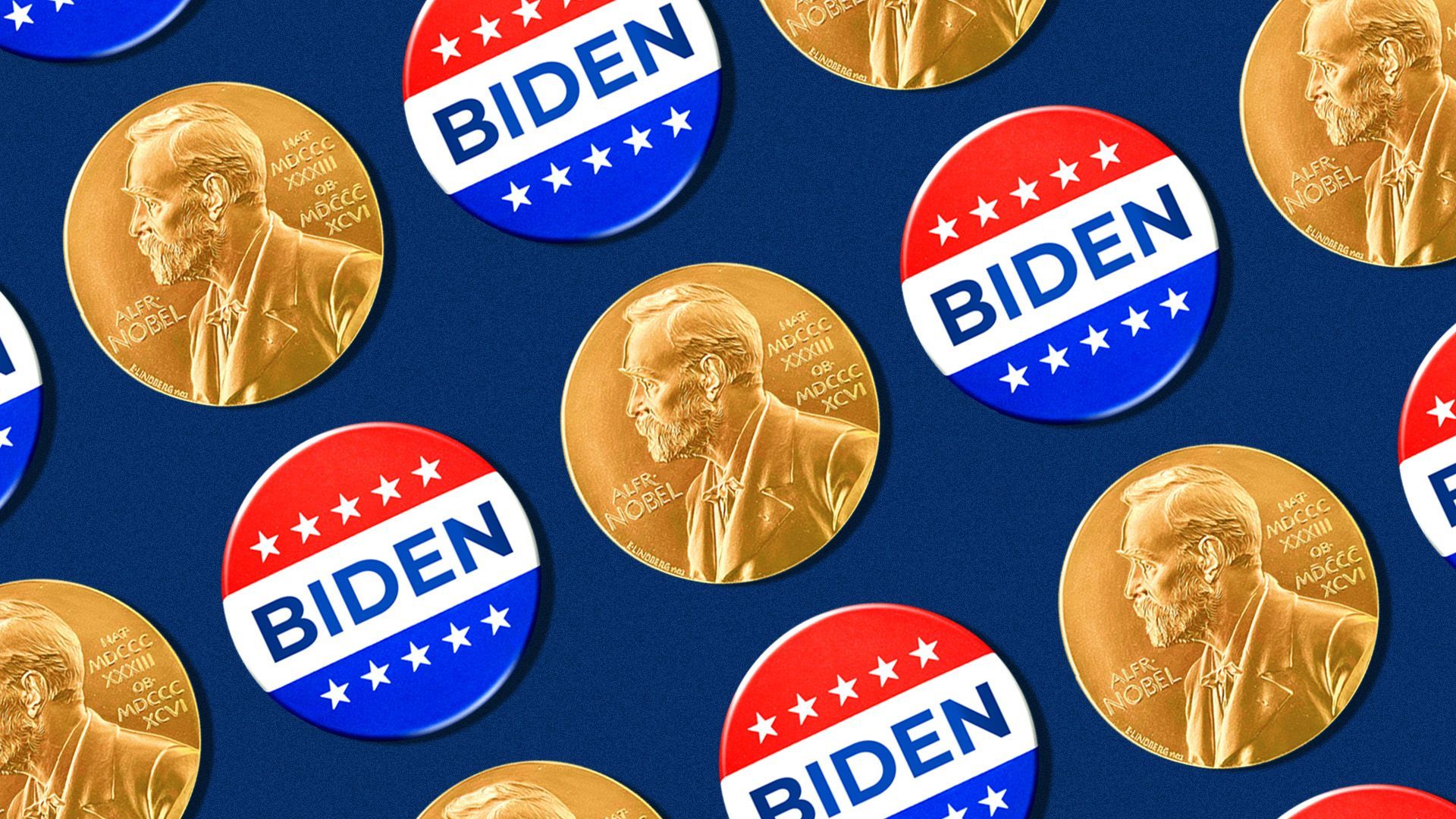
Photo illustration: Tiffany Herring/Axios
Sixteen Nobel prize-winning economists are jumping into the presidential campaign with a stark warning: Former President Trump's plans would reignite inflation and cause lasting harm to the global economy if he wins in November.
Why it matters: The Nobel laureates are lending their academic prestige to a political argument the Biden administration has been making for weeks: Inflation would be worse under Trump.
- "While each of us has different views on the particulars of various economic policies, we all agree that Joe Biden's economic agenda is vastly superior to Donald Trump," the 16 economists write in a letter, first obtained by Axios.
Zoom in: Since prices spiked in the summer of 2022, Democrats have been playing defense on the economy.
- But their various explanations — including a brief embrace of the term "Bidenomics" and big media buys — don't seem to have worked.
- Voters aren't vibing with an economy that the White House says is great.
- Now Biden's team wants to go on offense and draw attention to Trump's actual proposals — including his plans to impose fresh 10% duties on all imports, and minimum 60% tariffs on Chinese goods.
Driving the news: The economists' claim is part of a broader attempt by Biden's campaign to turn the 2024 election into a choice between the two candidates' plans for the future — and not necessarily a referendum on Biden's record.
- "We believe that a second Trump term would have a negative impact on the U.S.'s economic standing in the world, and a destabilizing effect on the U.S.'s domestic economy," the economists write in the letter.
- "Many Americans are concerned about inflation, which has come down remarkably fast. There is rightly a worry that Donald Trump will reignite this inflation, with his fiscally irresponsible budgets," they write.
The message was spearheaded by Joseph Stiglitz, who won the Nobel prize for economics in 2001.
- He was joined by George A. Akerlof (2001), Sir Angus Deaton (2015), Claudia Goldin (2023), Sir Oliver Hart (2016), Eric S. Maskin (2007), Daniel L. McFadden (2000), Paul R. Milgrom (2020), Roger B. Myerson (2007), Edmund S. Phelps (2006), Paul M. Romer (2018), Alvin E. Roth (2012), William F. Sharpe (1990), Robert J. Shiller (2013), Christopher A. Sims (2011), and Robert B. Wilson (2020).
State of play: The economy is expected to be a focus of Thursday night's presidential debate, and both candidates are sharpening their approach to pocketbook issues.
- Besides promising corporate America to lower its tax rate from 21% to 20%, Trump wants to eliminate taxes on tipped wages for workers in the leisure and hospitality industries.
- Biden is sticking with his plan to raise taxes on corporations — and his promise that households who make less than $400,000 a year wouldn't see a tax increase.
- Looming behind both approaches is a federal debt that continues to grow, with tax cuts and spending in Trump's first term adding nearly twice to the debt as much as Biden's, according to a new nonpartisan analysis.
Zoom out: Biden has presided over a period of solid growth, a strong labor market, and stubbornly high inflation.
- Voters don't give him much credit for the first two but they blame him for the third, telling pollsters that high prices are a major source of their economic unease. More than half of voters (wrongly) think the U.S. is in a recession.
- Some 68% of Americans still think the economy is "not so good" or "poor" according to a recent Fox News survey. The remaining 32% of voters say it's "excellent" or "good."
- And that poll showed some improvement over earlier and grimmer surveys.
The Biden administration is trying to meet voters halfway, asking them to accept that inflation has come down while acknowledging there's more work to do.
- Officials also are using the levers they have to try to convince voters that they're focused on lowering prices. Treasury Secretary Janet Yellen's on Monday announced a $100 million plan to support affordable housing financing.
- The White House also is going negative, warning that a Trump presidency would take inflation to new heights and that Jan. 6-style attacks on democratic institutions could undermine global economic stability.
