Facebook said Tuesday it took down the first-ever coordinated inauthentic campaign engaged in U.S. politics that originated from China.
Why it matters: China is upping its online disinformation game beyond its own borders. The effort was part of a larger campaign that targeted Southeast Asia.
YouTube said Tuesday that it has updated its technology to enable the tech giant to better enforce its age restriction policies.
Why it matters: The company has been criticized and penalized for its policies and architecture that displayed harmful content to kids and violated children's data privacy.
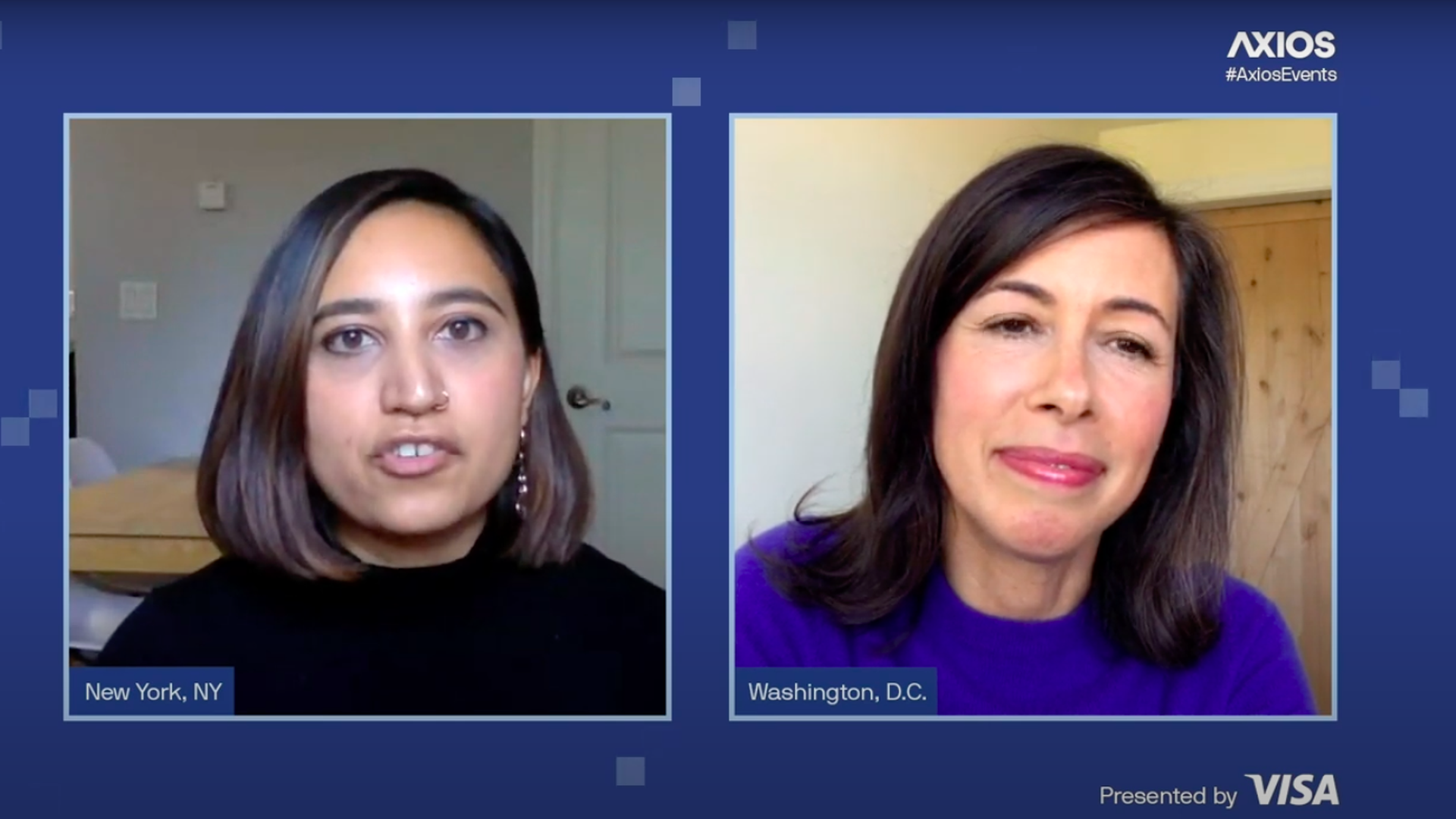
Jessica Rosenworcel, a Federal Communications Commissioner, said Tuesday that she hopes smart cities and 5G could eventually predict and ensure the safety of its residents, even from natural disasters like wildfires.
What she's saying: "Wouldn’t it be fantastic if we knew those kind of things well in advance, if we had a predictive ability that exceeds what we have today because we are looking at patterns at a scale that previously we haven’t been able to do? I think that those things are real and they are not so in the far-off future," she told Axios' Erica Pandey at a virtual event.
About 20% of Dunkin' Brands' customer transactions are digital in some form, Kate Jaspon, the company's chief financial officer, said Tuesday during an Axios virtual event.
Why it matters: Many restaurants and fast-food chains have had to drastically change or speed up their investment in technology services to make orders hands-free, cashless and safer for customers and workers during the coronavirus pandemic.
The big picture: WeChat's ban has had a lower profile than TikTok's, but the fate of the app, widely used by Chinese people around the world to stay in touch with family and friends, is at least as consequential.
Facebook will continue to be the face of the biggest industry campaign against misinformation leading up to the election, according to Jonathan Greenblatt, CEO of the Anti-Defamation League
Driving the news: In an interview with Axios, Greenblatt, whose group is part of the Stop Hate for Profit social media boycott campaign, said that the group plans to focus its boycott efforts on Facebook, because of its scale and because he says the company is less proactive than rivals like Twitter and YouTube on policing misinformation and hate speech.
Up to Us, a four-month-old organization largely made up of young techies, is debuting a social media-based campaign Tuesday aimed at getting young adults (or “Gen Z”) to register to vote for the upcoming U.S. elections in November.
Internet connectivity remains a weak link for the disaster-wracked U.S. territory Puerto Rico, and some experts fear a new tranche of Federal Communications Commission subsidies set aside just for the island might not help the people most in need of a broadband connection.
Why it matters: Puerto Rico is locked out of most federal funding available to U.S. states to help expand internet service. The island risks being left behind as carriers expand and upgrade high-speed internet networks elsewhere, even as infrastructure-damaging tropical storms come faster and harder and the pandemic makes broadband even more of a must-have.
The story of last week's Snowflake and Unity Software IPOs had little to do with data warehousing or 3D game development, and lots to do with dizzying "pops" after pricing.
Economic tension between the U.S. and China continues to escalate but is shifting in focus — away from the tit-for-tat trade war and toward a more direct confrontation over the future of technology at the heart of the conflict between the world's two largest economies.
Why it matters: The battle between the U.S. and China was always about tech supremacy and the direct confrontation could result in an accelerated splintering of global supply chains and a significant reduction of international commerce.
The new deal to rescue TikTok from a threatened U.S. ban — full of provisions aimed at creating the temporary appearance of a presidential win — looks like a sort of Potemkin village agreement.
How it works: Potemkin villages were fake-storefront towns stood up to impress a visiting czar and dignitaries. When the visitors left, the stage set got struck.
Similarly, many elements of this plan look hastily erected and easily abandoned once the spotlight moves on.
An estimated 2.5 million+ Americans have registered to vote on Facebook, Instagram, and Messenger, Facebook announced Monday. More than 733,000 Americans have registered to vote so far via Snapchat.
Why it matters: The broad reach of social media platforms makes them uniquely effective at engaging voters — especially younger voters who may not know how to register to vote or be civically engaged.
Nikola announced Monday that executive chairman Trevor Milton, who is also the company's founder, is out as the electric and fuel cell truck startup reportedly faces federal inquiries into a short-seller's allegations of inaccurate or misleading statements.
Why it matters: It's the latest move in a head-spinning series of events for Nikola.


/2020/09/22/1600791898642.gif?w=3840)








/2020/09/17/1600348480780.gif?w=3840)