Saturday's technology stories

Lyft's new strategy to take on Uber

Lyft, Uber's pink-colored rival in the U.S., has laid off 17 sales employees, the company told Bloomberg.
The reason: According to chief business officer Baga, Lyft is adjusting its corporate sales strategy away from pitching banks, consulting firms, and other companies to use its service. Instead, it will focus on government and health care organizations, he told Bloomberg. For example, Lyft recently announced a partnership with the National MedTrans Network in New York City to provide rides for medical appointments.
Lyft's tough challenge: Uber has a growing share of business travel. Just this week, expense software management company Certify released a report that found that Uber now makes up 52% of all ground transportation business expenses in the U.S. What's more, it was the vendor with the most transactions overall, making up 6% of all transactions. Lyft, on the other hand, only has 4% of ground transportation expenses.
Snap could file for IPO next week
Snap plans to publicly file to go public next week, according to a report from tech news site Recode, citing an anonymous source. Snap declined to comment.
Snap, the parent company of the popular ephemeral messaging app Snapchat, reportedly confidentially filed for an IPO in November, so its financials have yet to be made public. The company is reportedly seeking a valuation as high as $25 billion through its IPO, but demand from investors could push it higher.
Big deal: Snap's IPO will be the first from a high-profile company this year. AppDynamics' was canceled at the very last minute earlier this week after it sold to Cisco for $3.7 billion.
There are still questions about whether Snap's business will impress investors—check out the bearish and bullish takes published on Axios this week.
Twitter publishes two national security letters
In 2015 and 2016, Twitter was twice compelled by the FBI to disclose information about two users — and the gag orders on these requests have been lifted, the company said on Friday. The company has now notified the two users and provided them with the national security letters and the information it collected about their respective accounts, which was much less than was originally requested.
The debate: The U.S. government argued gag orders on these requests were necessary because providing more detailed reporting than what Twitter is authorized to release would make the information classified, and therefore it would not be protected under the First Amendment.
"We would like a meaningful opportunity to challenge government restrictions when 'classification' prevents speech on issues of public importance," writes Twitter in a blog post.
What's next: Twitter is currently in the midst of a lawsuit against the government (Twitter v. Lynch), seeking to get more freedom to discuss national security requests it receives. The next hearing for the case is scheduled for February 14.
- Internet companies have increasingly fought for the right to disclose government and law enforcement requests for user information since the exposure of surveillance programs like PRISM in 2013.
- Microsoft is currently suing the Department of Justice, arguing that it should be able to tell customers when the government requests information about them.

Zuckerberg: “Focus on people who actually pose a threat”
Mark Zuckerberg took to Facebook this afternoon to speak out about Trump's executive orders on immigration.
Expanding the focus of law enforcement beyond people who are real threats would make all Americans less safe by diverting resources, while millions of undocumented folks who don't pose a threat will live in fear of deportation. —Mark Zuckerberg
He also took the opportunity to applaud Trump's pledge to "work something out" for Dreamers, or immigrants who were illegally brought to the U.S. as kids. His organization, FWD.us, will work with the administration on this, he said. And he made a case that everyone benefits when "the best and brightest from around the world can live, work and contribute here."
Why Silicon Valley cares: Beyond personal reasons (Zuckerberg notes that his family and his wife's family immigrated from elsewhere), tech companies have real workforce issues to consider. A large number of so-called Dreamers live and work at these companies, and they also have a lot of engineering and technical jobs they need to keep filling through temporary visas for highly skilled workers.

Tech companies ask Congress to reverse FCC privacy rules
Industry groups are joining a push to roll back the FCC's privacy rules for internet providers.
The details: The groups — which represent companies like Google, Facebook, Verizon and Comcast — want lawmakers to pass a resolution rescinding the rules using a law called the Congressional Review Act. It lets Congress block agency rulemakings within a certain period of time. They're echoing a similar call from conservative groups yesterday.
What this would mean: Internet providers would be able to use and share their subscribers' data without first asking for explicit permission, as the current rules require.
A sign of things to come: Even though the FCC's rules don't actually apply to "edge providers" like Google and Facebook, the groups say "the onerous and unnecessary rules it adopted establish a very harmful precedent for the entire internet ecosystem."
Key context: Even if Congress doesn't act here, the FCC's new Republican leadership could take steps to reverse or change the privacy rules.
Why Trump’s immigration order hit a privacy nerve
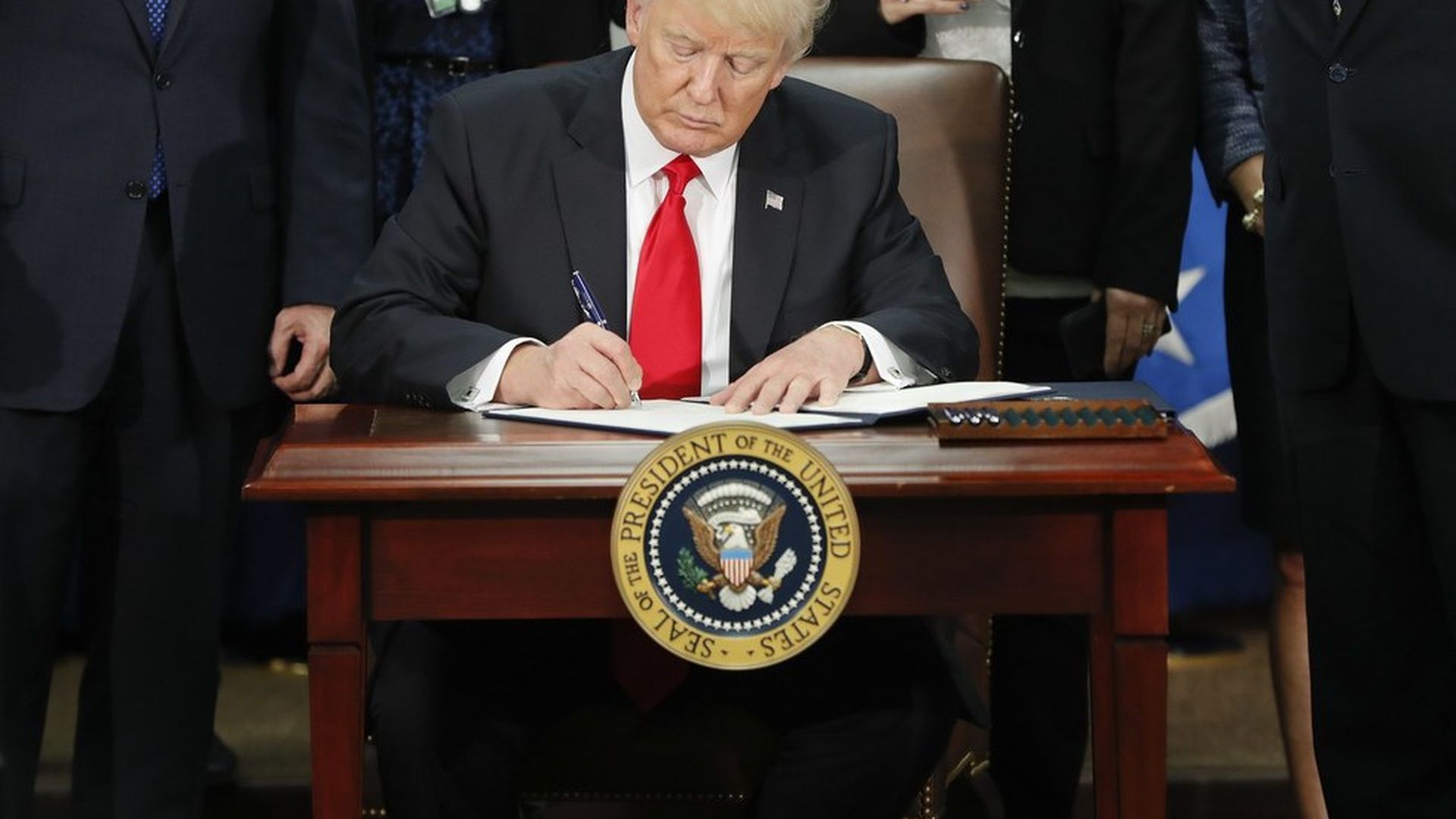
A short section of President Trump's immigration executive order that tells agencies "ensure that their privacy policies exclude persons who are not United States citizens or lawful permanent residents from the protections of the Privacy Act regarding personally identifiable information" is drawing attention in tech circles.
Why privacy hawks are worried:
- Nuala O'Connor, the head of the Center for Democracy and Technology, said that the order sends the message that "people who don't hold a U.S. passport or current green card are not entitled to the same dignity as those of us who do."
- It raises questions about the United States' broader approach to protecting the data of non-citizens.
The bigger picture: The order has worried some in Europe, where recent revelations about American tech companies working with the government surveillance regime have caused officials to be wary of Silicon Valley. It also raises questions about the fate of the US-EU Privacy Shield agreement governing the transatlantic transfer of data.
Hold your horses: A European Commission spokesperson told TechCruch that the Privacy Shield agreement "does not rely on the protections under the U.S. Privacy Act." But the body has promised to keep an eye on the issue.
Update: Ken Propp, a director at software trade group BSA, says that the executive order "should not affect the privacy protections afforded under the US-EU Privacy Shield," and cited the agreement's grounding in a law called the Judicial Redress Act.
Amazon pulls ahead of Apple and Google in the smart home race
Apple has built a suite of products to keep the iPhone at the center of consumer life (a la HomeKit), and Google has invested heavily in home-automation (think Nest thermostat).
But with its fast-growing Alexa voice-based digital assistant and Echo speaker system, Amazon is quickly dominating how people interact with all their devices in the home.
When the iPhone rolled out in 2007, everyone developed [software] for that. Right now, everyone is developing for the voice-activated Internet. —Mark Mahaney, RBC Capital Markets
Why the hype? So-called connected home is a near-term holy grail for major tech players want to own the way people communicate, shop, work and run their households. Amazon is hoping to facilitate all these interactions without an Apple phone or Google web browser as middle man, as Reuters pointed out this morning in a good breakdown of these companies' efforts.
So what? By cutting Google or Apple (at least partly) out of the equation, Amazon easily wins the "smart-home" race for a market expected to be worth $100 billion by 2020, according to Juniper Research. Developers working on software for products to "plug in" to the smart-home infrastructure, in turn, are making sure they're betting on the leading horse.

Facebook pushes longer videos
Facebook is changing its video algorithm to incentivize publishers to create more long-form video. They'll be looking at the percent completion rates to determine video interest and they'll be weighing the percent completion higher for longer videos.
Why it matters: It's another step to compete with TV networks for ad dollars on long-form content.
Facebook's step-by-step :
1) introduced a live platform and paid publishers $50 million collectively to produce content for it as an incentive. They incentivized those partners to make live videos longer by algorithmically favoring videos at least 10-minutes long.
2) Rolled out a video tab to test housing an in-platform destination for long-form video.
3) Announced they were testing mid-roll ads that can be monetized for publishers but are only available for videos longer than 90-seconds.
What to expect: Facebook will still count a video view at any length as three seconds, but without the financial and algorithmic incentive to produce short video, you'll probably see less of that from publishers in your newsfeed.