Sunday's science stories

Rare octopus nurseries discovered deep in the Pacific Ocean
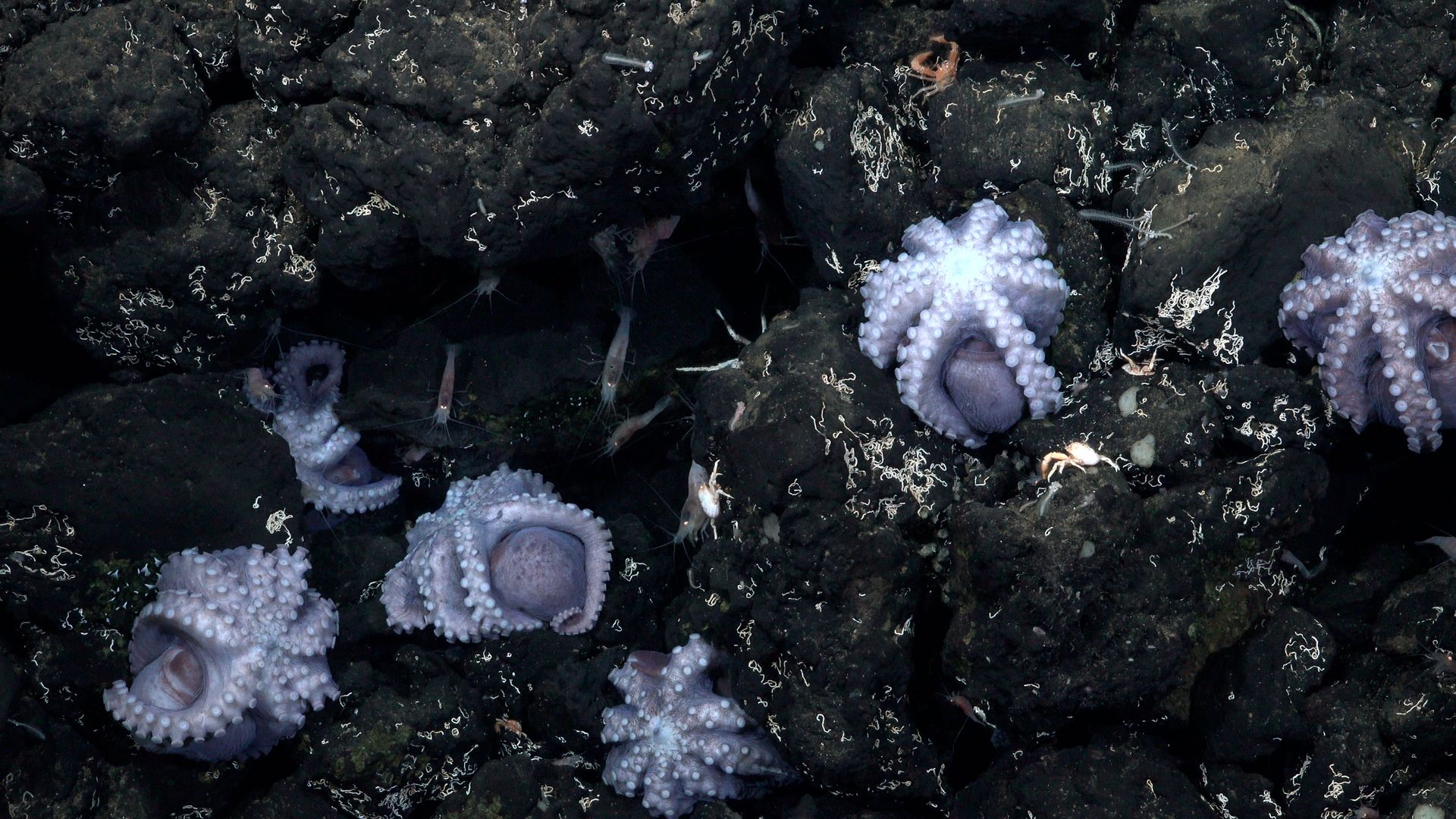
Two octopus nurseries have been spotted deep below the ocean surface off the west coast of Costa Rica.
The big picture: It's a rare sighting. Octopuses are typically solitary creatures and aren't known to brood their eggs near other octopuses. Before this expedition, there was only one other known deep-sea octopus nursery, which was discovered on an underwater mountain off the coast of central California.

How AI may help humans "talk" to animals
Just as the telescope proved Earth is not at the center of the universe, some scientists believe once-unintelligible animal sounds may soon demonstrate humans are not the pinnacle species.
What's happening: New technology is allowing researchers to decipher noise inaudible to the human ear — and discover that animals and plants can communicate in complex and sophisticated "languages."
- Artificial intelligence is opening new opportunities for understanding those sounds — and possibly even translating them into a language we can understand.
Reality check: This is not about being able to talk to your dog, though the human yearning to speak to animals is archetypal and rooted in centuries of mythology.
- Instead, scientists believe acoustics will reveal secrets about the biological world order that could inform efforts to save vulnerable species from the impacts of climate change.
What they're saying: "When this becomes the thing that the entire world sees … suddenly I think we can accelerate and be a force multiplier for every other conservation and climate action out there," says Aza Raskin, co-founder of the Center for Humane Technology and the Earth Species Project, in a discussion at the Aspen Ideas Festival in Colorado.
- "The point is not really to talk to animals, the point is to understand them."
How it works: AI can build shapes — like a word cloud — that represent a given animal's "language." Then it can match patterns among a known language and a new one to translate concepts.
What they found: Already, scientists have learned that flowers can "hear" an oncoming bee that leads them to make sweeter nectar.
- Orca whales speak in dialects unique to their pods, but can communicate in different dialects with other species.
- Dolphins have names given by their mother which they use in communication, similar to beluga whales and bats.
- Elephants have a signal for the herd to help them deflect approaching honeybees, which can be dangerous if they get in their trunk or ears.
What's next: Scientists are looking to build AI bots that can communicate to animals in their own languages — possibly even before they understand what certain sounds mean.
- "We really have no idea what we are going to discover, but it is a vast, vast frontier," says Karen Bakker, a University of British Columbia professor and author of "The Sounds of Life," who spoke at Aspen Ideas.
Yes, but: AI translation could prove a dead end if animals recognize the sounds are not from their own species, Raskin acknowledges. "We're assuming other species want to talk to us," he adds.
- Then there's the question of whether such research should even take place.
- Humans could interfere with millions of years of animal communication, or potentially use it for nefarious ends, such as poaching or precision hunting and fishing.
- Bakker believes a moratorium is needed to first figure out the ethical implications. "My view is we need to get our house in order," she says. "It's a Pandora's box."