Rare octopus nurseries discovered deep in the Pacific Ocean

Add Axios as your preferred source to
see more of our stories on Google.
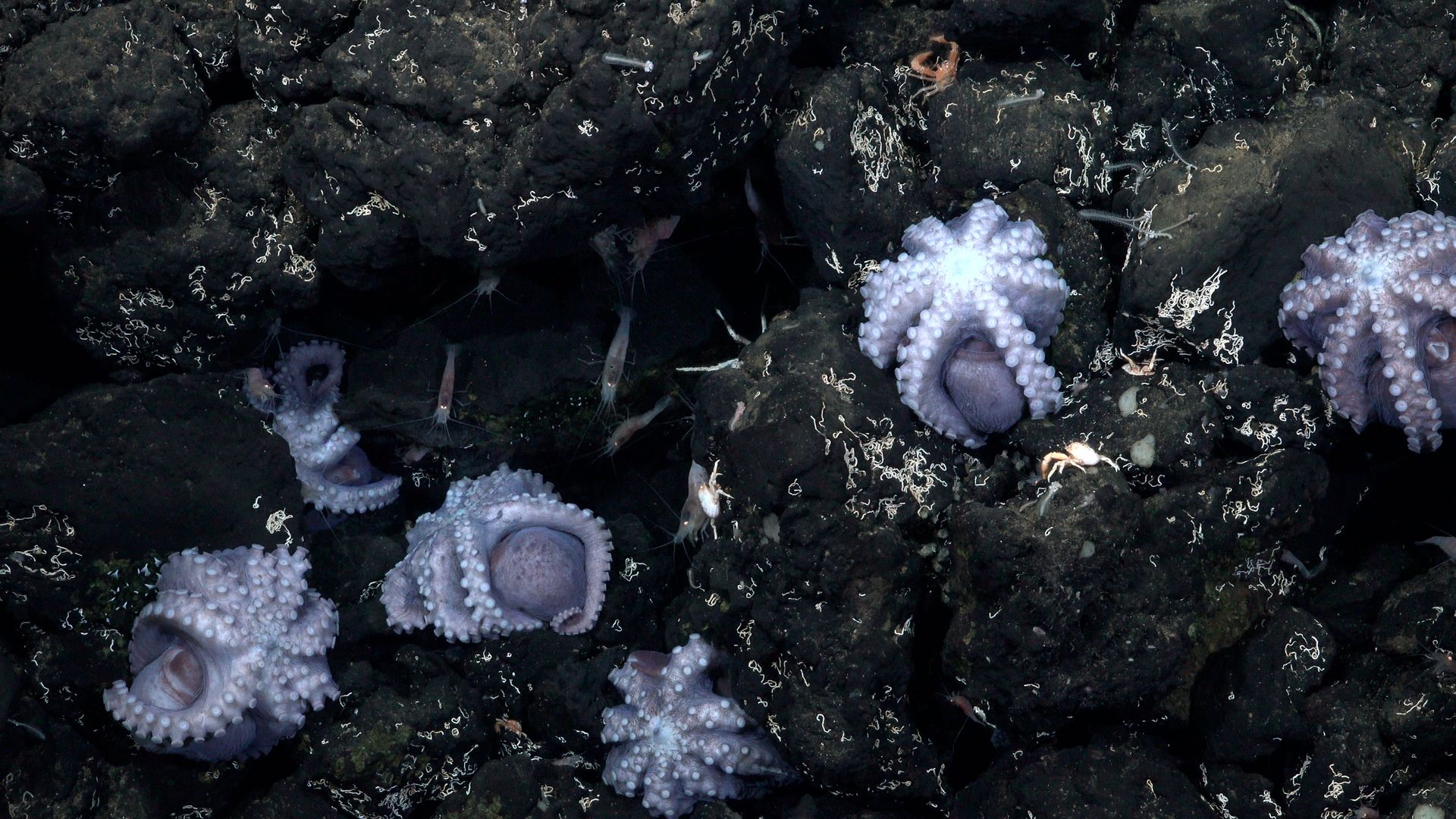
A deep-sea octopus garden. Photo: Schmidt Ocean Institute
Two octopus nurseries have been spotted deep below the ocean surface off the west coast of Costa Rica.
The big picture: It's a rare sighting. Octopuses are typically solitary creatures and aren't known to brood their eggs near other octopuses. Before this expedition, there was only one other known deep-sea octopus nursery, which was discovered on an underwater mountain off the coast of central California.
What they found: A team of international scientists aboard a Schmidt Ocean Institute research vessel discovered the octopus nurseries while sampling low-temperature hydrothermal vents on the ocean floor.
- The larger nursery, or garden, was found more than 9,000 below the sea's surface in the Dorado Outcrop, where a decade ago researchers had previously spotted for the first time octopuses aggregating in the deep sea but they didn't see any developing embryos and weren't sure it was an active nursery.
- The Dorado Outcrop is also next to a low-temperature hydrothermal vent that releases fluids at about 12°C (about 54°F). The ocean at these depths is about 2°C, or about 36°F, and scientists thought the warmer waters wouldn't be hospitable for the octopuses.
- But on this month's expedition, researchers confirmed it was a nursery. They saw mothers protecting their eggs, hatchlings emerging and predators quickly moving in when eggs were exposed. (They found a second nursery near a similar vent on another unnamed outcrop where octopuses behaved in the same way.)
Details: The scientists think the octopuses might be a new species of Muusoctopus, a genus of deep-sea octopuses that lack an ink sac. Specimens from the expedition are now being analyzed by researchers at the Museum of Zoology at the University of Costa Rica.
- "We think some species of octopus have developed an adaptation that they can tolerate being in warmer temperatures to brood their eggs," says Beth Orcutt, vice president of research at the Bigelow Laboratory for Ocean Sciences and co-leader of the expedition.
- It can take an octopus mother four years to successfully brood a baby.
- One possibility is this adaptation "might allow development to happen faster," Orcutt says.
The intrigue: "What we found is a very rare event world-wide, the nursing octopus, but we also encountered many organisms of which there are few records from any where in the planet," expedition co-leader Jorge Cortés-Núñez of the University of Costa Rica writes in an email.
- The expedition also studied five seamounts that had never been explored, and discovered a deep-sea skate nursery.
In studying the deep sea, Cortés, who spent decades focusing on coastal marine ecosystems, says he encountered "creatures much larger than I have read about and many very strange and different from anything I have seen."
- "It also made me aware of the connection of the deep with the surface and vice versa ... and how important it is to have a healthy ocean for a healthy planet."
