
Axios What's Next

April 07, 2023
Pickleball-mania shows no signs of slowing, Jennifer writes today — but not everyone's happy about that.
- Join Axios' Niala Boodhoo Wednesday, April 12 in Oxford, U.K., at the Skoll World Forum for an event laying out a global road map for solving some of the world's biggest problems. Register here to attend in person.
Today's newsletter is 1,121 words ... 4½ minutes.
1 big thing: Pickleball's growing pains
Cities nationwide are grappling with the seemingly limitless demand for pickleball courts — and blowback from neighbors who complain the constant smack-smack-smack is VERY LOUD, Jennifer A. Kingson reports.
Why it matters: Pickleball is America's fastest growing sport, but adherents are clashing with sleep-loving neighbors — and tennis players and schoolchildren who say their courts and playgrounds are being usurped.
Driving the news: Denver just shut some courts after finding that the sound levels from pickleball play surpassed 70 decibels — above the city limit of 55, Axios Denver's Esteban L. Hernandez reports.
- Turf wars between tennis players and pickleballers have devolved into shouting matches (and worse) in San Diego, Atlanta and New York.
- "In some cases, there is a valid concern for the acoustic impact to neighbors," says Carl Schmits of USA Pickleball, the sport's governing body. "And then in other cases, that acoustic concern is being used as a foil by the tennis community to prevent the conversion of existing courts."
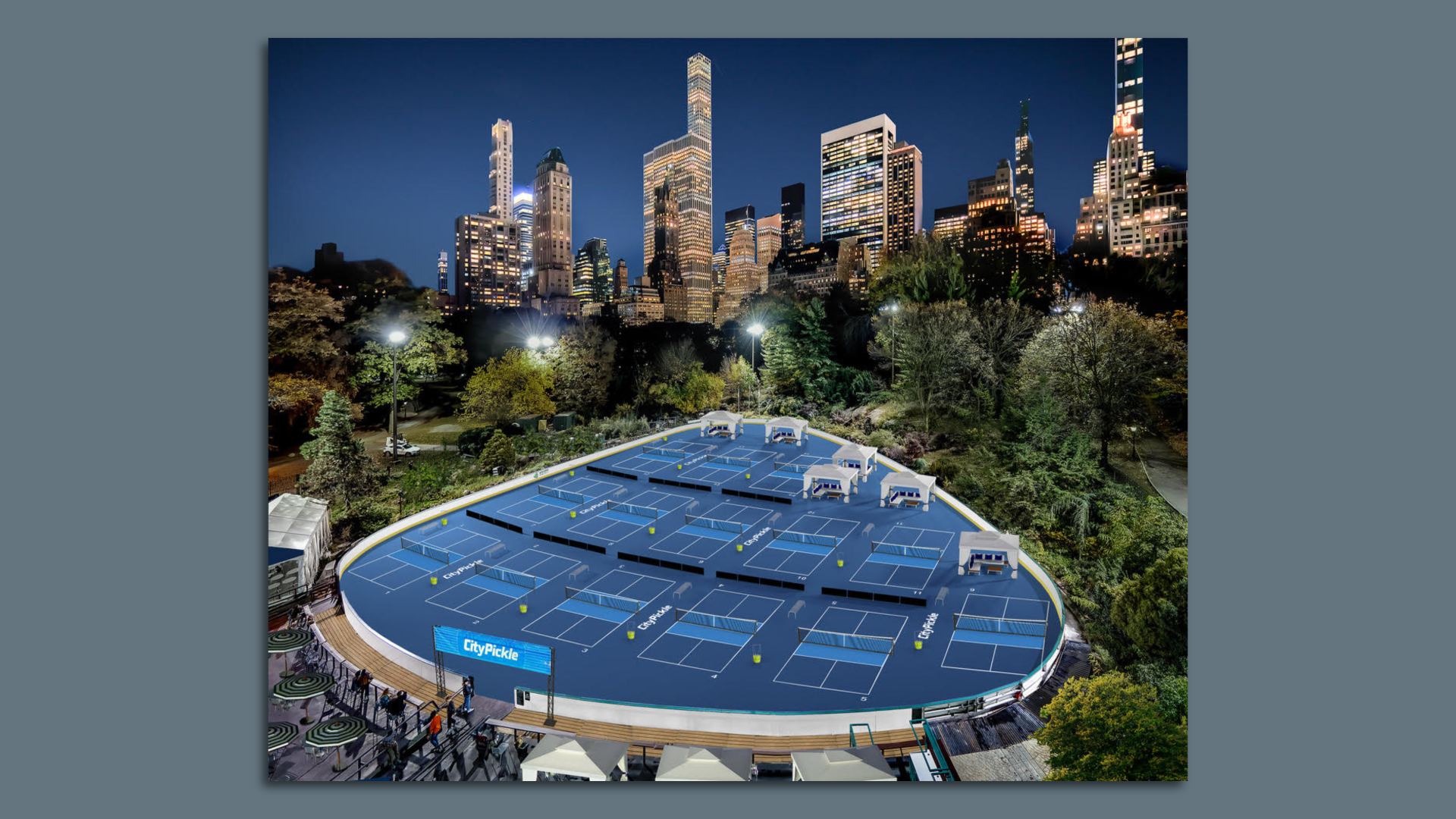
The latest: Manhattan's largest pickleball facility opens today. It has 14 courts in Central Park that'll stay open until Oct. 9, in a well-funded private effort called "CityPickle at Wollman Rink."
- "New Yorkers are really hungry for opportunities for pickleball," says Erica Desai, who founded CityPickle 18 months ago with her friend and tennis partner Mary Cannon.
- CityPickle is trying to bring the "eatertainment" concept to urban pickleball, with plans to open upscale courts in cities across the Northeast where players can get lessons, hold parties, and nosh on tacos and margaritas.
- Its first permanent venue, opening this spring, will be a swanky indoor pickleball club in Long Island City, Queens, with a pro shop, restaurant and climate-controlled courts.
What they're saying: "We think that social nature of pickleball is really a special sauce, and we want to create opportunities to bring together that kind of community and joy that we feel around pickleball," says Desai.
Yes, but: Pickleball can be as controversial as it is popular.
- In places where tennis courts have been converted for pickleball use or noise complaints have run high, pickleball-mania has forced city officials into the uncomfortable position of playing referee.
- In New York City, pickleball players were banned from a Greenwich Village playground after they were accused of "forcibly evicting" the local children, per Gothamist.
- Meanwhile, on the Upper East Side, makeshift courts in Carl Schurz Park "have become the subject of a territorial dispute" among skateboarders, basketball players and pickleballers, per a hyperlocal news site.
Flashpoint: Cities such as Las Vegas and Lansing, Michigan, are using federal COVID-19 relief funds to build pickleball courts — which qualify because they're community facilities aimed at boosting public health.
- Republicans have lobbed pork-barrel accusations at this use of taxpayer dollars.
- But most communities are looking at public-private partnerships to fund court construction, says Schmits of USA Pickleball.
Case study: At a packed forum on pickleball during the U.S. Conference of Mayors' winter meeting in January, Chris Duncan, the mayor of San Clemente, California, raised his hand to describe his community's predicament.
- "Every Council meeting, we have 50-plus people in red shirts" — pickleball fans — who show up to agitate for more public courts, Duncan said.
- "Those 50 pickleballers go against 10 neighbors at every meeting who don't like the sound," he said.
- To meet the "massive demand," the city recently voted to build new pickleball courts — but "funding is an issue" and "we're definitely looking for private partners," Duncan said.
The bottom line: With Town & Country dubbing pickleball the "preferred sport of the 1%" and tennis legends like John McEnroe and Andre Agassi competing in televised tournaments, pickleball's public stature and neighborhood presence will likely continue to rise.
2. 🗺️ Fastest growing (and shrinking) cities
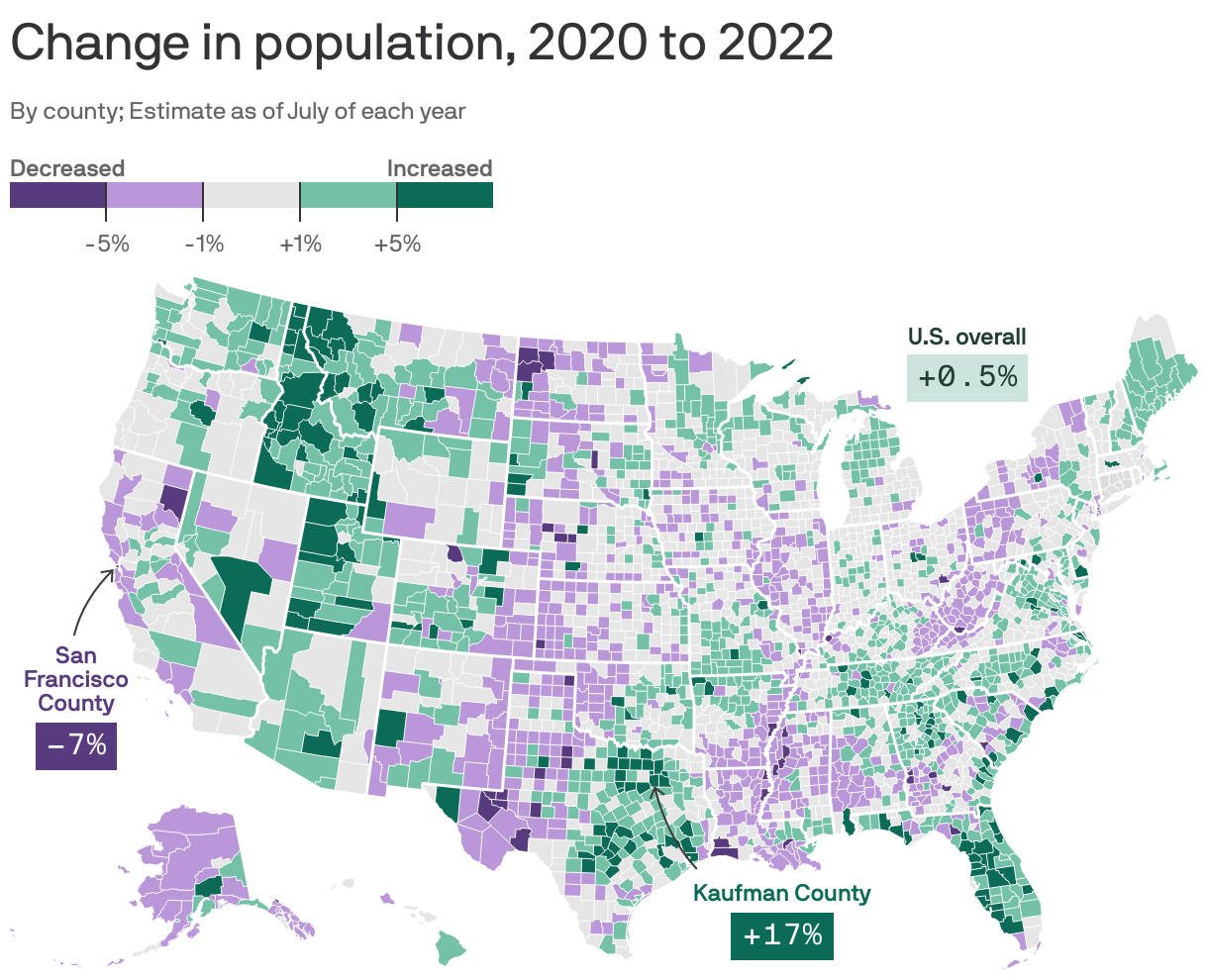
Idaho, Montana and Florida saw the highest population growth among U.S. states between 2020-2022, per new U.S. Census Bureau data, while New York, Illinois and Louisiana suffered the most shrinkage, Alex Fitzpatrick and Kavya Beheraj report.
The big picture: The past few years have been especially turbulent for population trends, with the COVID-19 pandemic affecting birth and death rates, interstate and international migration, and more.
By the numbers: Idaho's population grew by nearly 4.9%, while that of Montana and Florida grew by 3.3% and 3.0%, respectively. Utah and South Carolina came in just a hair under 3%.
- New York, meanwhile, shrank by 2.1%, while Illinois and Louisiana lost 1.6% and 1.3% of their populations, respectively.
Zoom in: Some cities have been hit particularly hard by population loss.
- San Francisco, for example, lost a staggering 7.1% of its residents — a trend that was likely at least partially fueled by tech workers newly unshackled from their offices in the remote work era, combined with high housing costs in the area.
- Manhattan, however, grew a bit, as Axios' Emily Peck reports, complicating the sweeping "big cities are dying" narrative of the late pandemic era.
The bottom line: It'll take a few more years for the effects of the pandemic to fully shake out, but there's never been a more fascinating time to look at data like this.
3. A new treatment for coral reefs
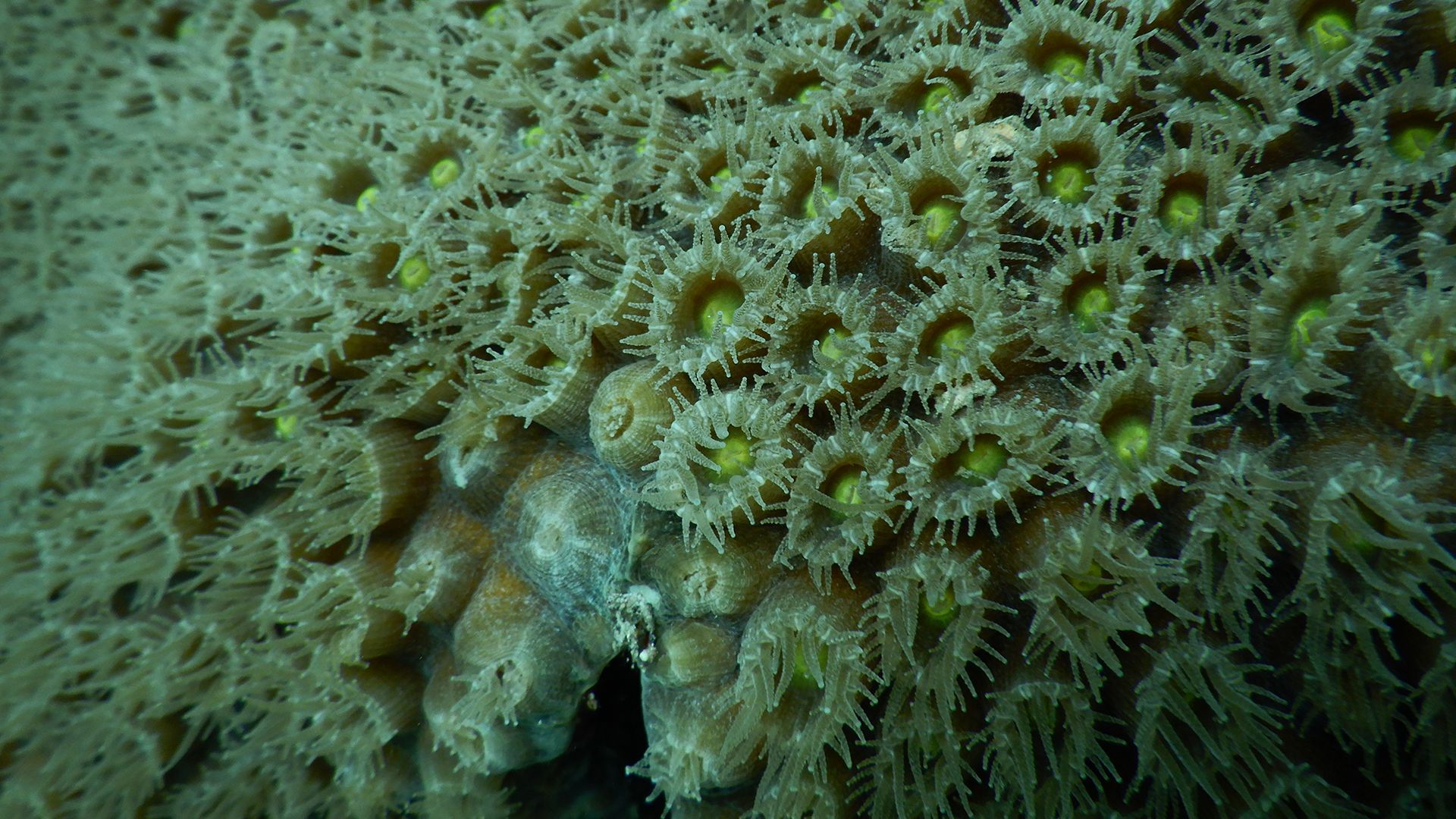
A close-up of polyps of a great star coral colony on a reef near Fort Lauderdale, Fla. Photo: Valerie Paul via the Smithsonian’s National Museum of Natural History
Scientists have discovered a new tool to help treat and prevent a disease that's been wreaking havoc on Florida's coral reefs, Axios' Ayurella Horn-Muller reports.
Why it matters: Stony coral tissue loss disease (SCTLD) is a fast-acting, deadly plague-like affliction that has long confounded researchers.
- It's been spreading throughout the Caribbean, threatening the local economy.
Details: In a study published Thursday in the journal Communications Biology, researchers found that a bacterial probiotic treatment effectively stopped or slowed SCTLD in nearly two-thirds of tested infected coral fragments.
- It also prevented the infection from spreading.
The big picture: Microbiologist Blake Ushijima, who led the study when he was at the Smithsonian Marine Station, tells Axios that the probiotic could be used to fortify healthy corals against an "unprecedented" disease.
- Once infected, large corals that can take hundreds of years to grow can die in weeks, according to Valerie Paul, head scientist at the Smithsonian Marine Station and co-author of the paper.
4. 📸 Uranus in the spotlight
Photo: NASA, ESA, CSA, STScI. Image processing: J. DePasquale (STScI)
A new photo of Uranus captured by NASA's James Webb Space Telescope (JWST) offers an incredible view of our distant planetary neighbor.
- The image, captured using JWST's near-infrared camera in early February, shows Uranus' rings, as well as a polar cap around its Sun-facing pole.
"This polar cap is unique to Uranus," per NASA.
- "It seems to appear when the pole enters direct sunlight in the summer and vanish in the fall; these Webb data will help scientists understand the currently mysterious mechanism."
Uranus' rings — much fainter than Saturn's — had only previously been captured by NASA's Voyager 2 probe in 1986 and by the Keck Observatory in Hawaii.
Big thanks to What's Next copy editor Amy Stern.
Was this email forwarded to you? Get your daily dose of What's Next by signing up here for our free newsletter.
Sign up for Axios What's Next

The next decade of big, sweeping changes will unfold in cities and communities where new technologies like 5G, AI and drones are transforming how we work, live and play together. What’s Next will guide you through the revolution.