
Axios What's Next

April 30, 2024
Sick of your phone and all its attention-sucking temptations? Consider rocking a "dumbphone" instead.
- 🍎 This June 5, we're bringing our AI+ Summit to NYC for Tech Week in partnership with Tech:NYC. Request an invite here.
Today's newsletter is 875 words ... 3½ minutes.
1 big thing: Dumbphone renaissance
Illustration: Natalie Peeples/Axios
Breaking up with your smartphone is hard. But a growing "dumbphone" market is providing offline alternatives, Axios' April Rubin reports.
Why it matters: The well-known negative effects of screens — loneliness, addiction, anxiety, depression — has left many eager to disconnect.
The big picture: A dumbphone is a basic, '90s-inspired cellphone without the vortex of apps that contribute to high screen times — a return to texts and calls, if you will.
- Influencers and brands are in on the trend, with YouTube content creators sharing their experiences and recommendations.
- The New Yorker recently called dumbphones a "burgeoning cottage industry."
Zoom in: DumbWireless, founded in 2022, offers dumbphones ranging from $50 to upwards of $300 from companies including Light, Punkt and Nokia, as well as a T-Mobile service plan with various data options.
- Los Angeles-based couple Will Stults and Daisy Krigbaum founded the platform after struggling to unplug.
- "Everybody gets that creeping feeling that they can't go on with the way they're doing things with their smartphone," Krigbaum tells Axios.
They buy phones and other accessories, like cases and SIM cards, wholesale.
- And they field questions from prospective customers — including concerned parents looking to buy their kids' first phones.
- Another resource, Jose Briones' "Dumbphone Finder," connects people with similar options.
By the numbers: DumbWireless sold about $68,000 worth of phones last month, up from $5,000 in March 2023.
- About 4,200 items were ordered via Briones' Amazon affiliate links from January to March 2024, up from about 800 in the same three-month period in 2023.
- Nokia flip phone sales doubled in 2023 compared with 2022, per Yahoo News.
Between the lines: The alarming relationship between social media use and mental health problems among America's youth has been well documented.
- A buzzy new book by New York University social psychologist Jonathan Haidt even recommends: No smart phones for kids before high school.
Reality check: Smartphone dependency has dipped somewhat among Gen Zers and millennials in recent years, but most are still reliant on screens.
- In 2018, 28% of 18- to 29-year-old respondents said they were dependent on smartphones, per a Pew Research Center survey. In 2023, that dropped to 20%.
Yes, but: Only 1% of people 18 to 29 years old reported owning a non-smartphone in 2023.
- Many dumbphone owners also have a smartphone, swapping SIM cards in order to share their phone number and service plan between the two.
The bottom line: Consider the dumbphone another entrant in Gen Z's embrace of all things retro: landline phones, CDs and film photography.
2. Elon goes to China
Elon Musk meets with Chinese Premier Li Qiang in Beijing on Sunday. Photo: Wang Ye/Xinhua via AP
Elon Musk made an unannounced trip to China over the weekend to discuss the rollout of Tesla's self-driving software there, April reports.
- The Tesla CEO also received quick approval on expanding Tesla's business in the world's largest auto market, in the face of the company's slumping sales and stock prices.
Driving the news: Musk met with Chinese Premier Li Qiang, who said Tesla was a "successful model" for U.S.-China collaboration, CNN reports.
- Tesla will partner with Chinese tech giant Baidu for maps and navigation data, per Bloomberg.
- Musk also discussed transferring Tesla data collected in China to the U.S., per Reuters.
What they're saying: "Honored to meet with Premier Li Qiang," Musk said on X, with a photo of the two of them.
- "We have known each other now for many years, since early Shanghai days."
3. 📈 Young Americans' wealth soars


Household wealth for those under 40 in the U.S. is up 49% from its pre-pandemic level, according to a new analysis from the left-leaning Center for American Progress, Axios Markets' Emily Peck reports.
Why it matters: Young households haven't seen wealth growth like this since the Federal Reserve first started tracking this data in 1989.
Driving the news: Those under 40 have seen big asset gains and have been able to reduce some liabilities.
- Average housing wealth rose $22,000 as homeownership rose and home prices soared.
- Liquid assets climbed, courtesy of leftover savings from pandemic relief and higher wages.
- And the value of the group's financial assets — mostly stocks and mutual funds — increased by $31,000.
Meanwhile, non-housing debt fell by $5,000.
- With more money in their pockets, people were able to pay off credit cards (the student loan moratorium helped), or not take that debt on at all.
Reality check: Older Americans are still far wealthier than the youngs.
4. No mow May? Maybe "less mow May"
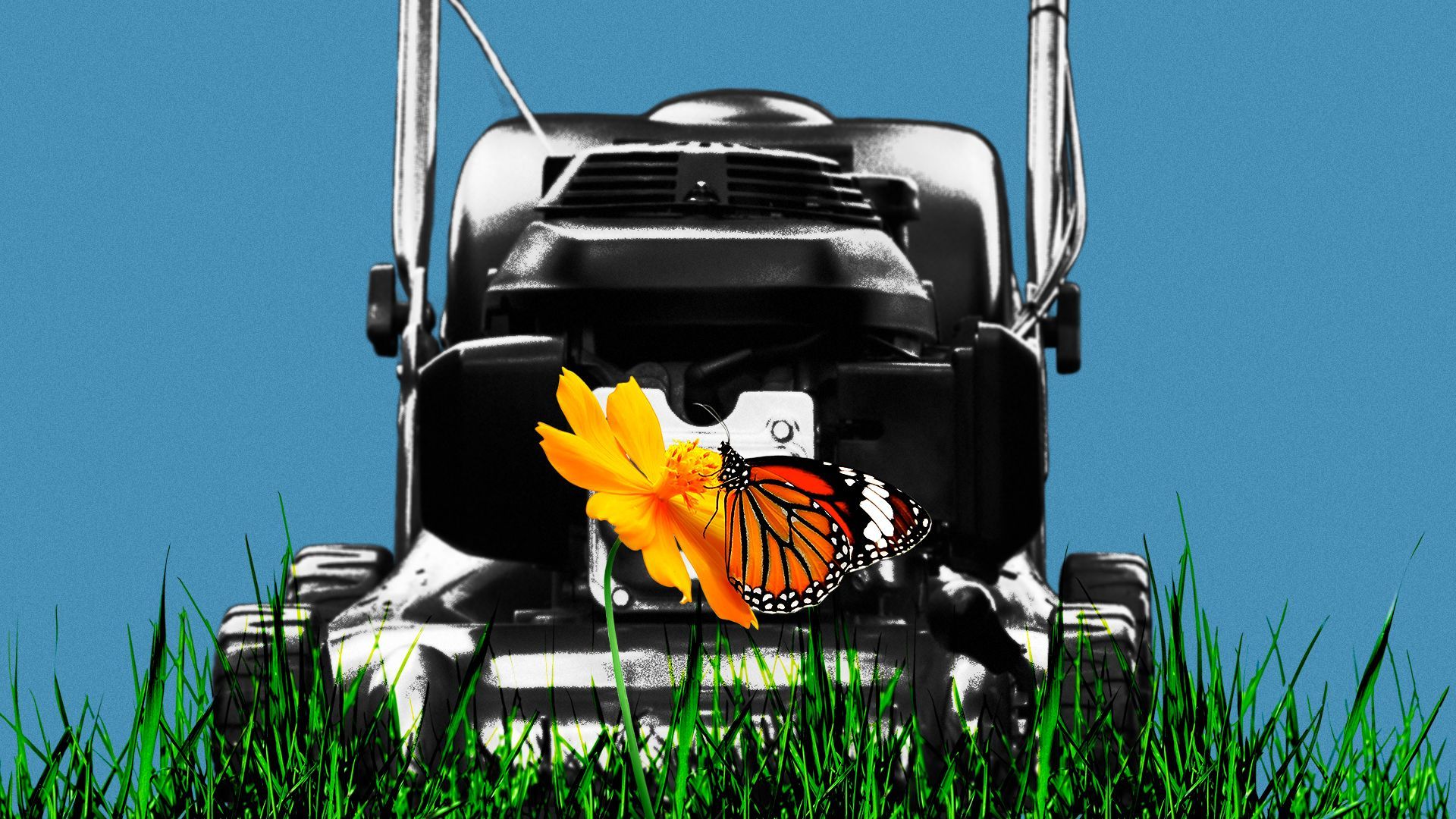
Illustration: Lindsey Bailey/Axios
An Iowa women's group is asking people to consider embracing "Less Mow May" this spring, Axios Des Moines' Linh Ta reports.
Driving the news: The Women's International League for Peace and Freedom is pushing the initiative to help pollinators find food, league volunteer Carolyn Uhlenhake tells Axios.
- The group is giving away free signs touting "Less Mow May," plus encouraging people not to use pesticides and to mow a little higher.
Flashback: The league last year asked Des Moines officials to endorse "No Mow May" and to hold off enforcing the city's tall grass ordinance until June.
- But the city reversed course after receiving hundreds of complaints, reinstating a rule that grass be 10 inches or less.
Yes, but: Some environmentalists are turning against "No Mow May," arguing that not mowing for a full month would allow weed growth that could lead to more pesticide use.
Big thanks to What's Next copy editor Amy Stern.
Was this email forwarded to you? Get your daily dose of What's Next by signing up here for our free newsletter.
Sign up for Axios What's Next

The next decade of big, sweeping changes will unfold in cities and communities where new technologies like 5G, AI and drones are transforming how we work, live and play together. What’s Next will guide you through the revolution.