Axios from Tel Aviv
May 03, 2023

Welcome back to Axios from Tel Aviv.
- This week's edition (2,090 words, 8 minutes) starts with Iranian President Ebrahim Raisi's visit to Syria.
- It also brings you a scoop on what a delegation led by U.S. House Minority Leader Hakeem Jeffries told Israeli Prime Minister Benjamin Netanyahu during the lawmakers' visit to Israel last month. And it looks at the latest from Sudan and Lebanon.
1 big thing: Iran's and Syria's presidents hold rare meeting in Damascus
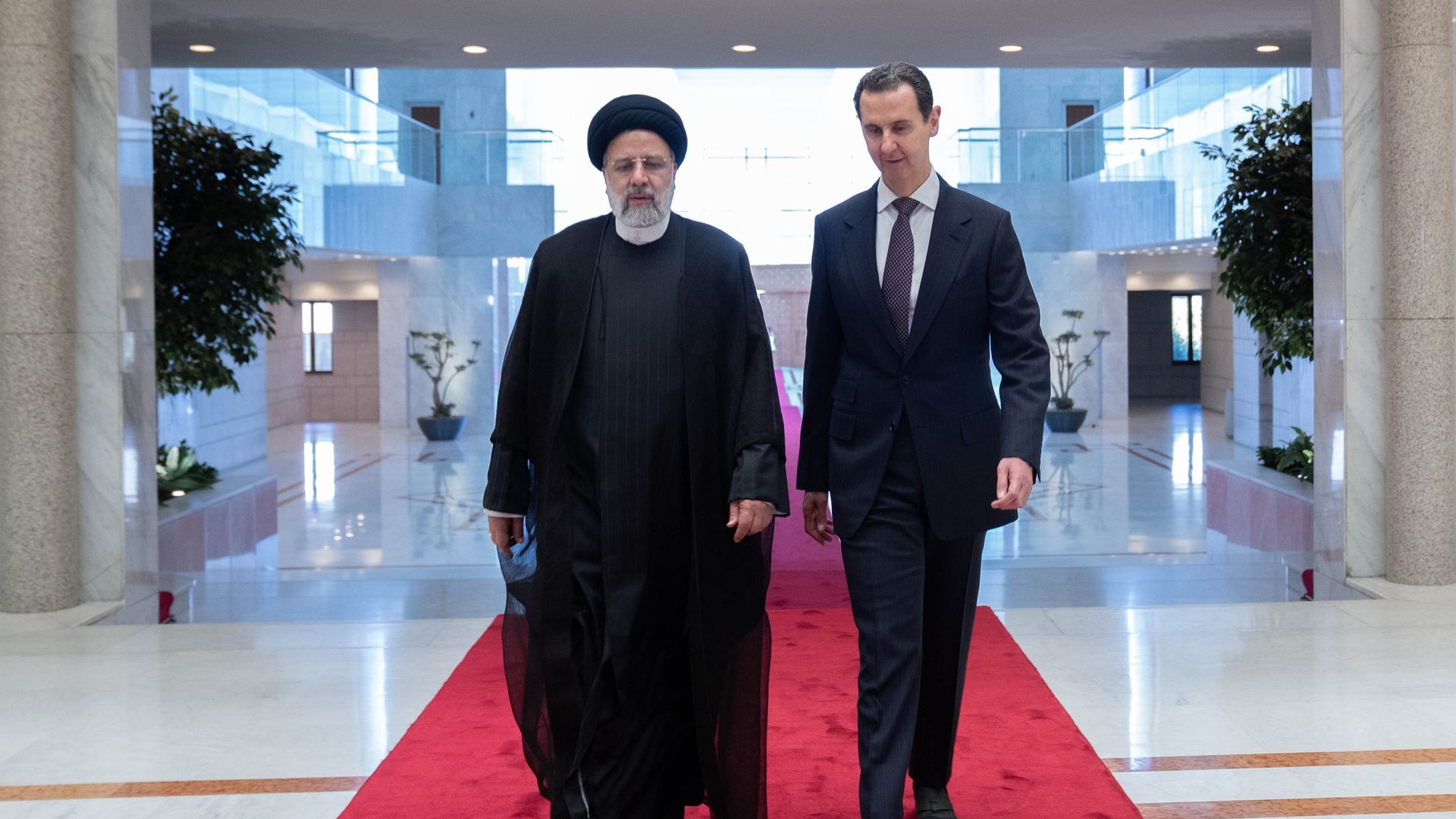
Iranian President Ebrahim Raisi (left) and Syrian President Bashar al-Assad meet in Damascus. Photo: Handout/Syrian Presidency via Facebook
Iranian President Ebrahim Raisi arrived in Damascus today for an official visit that included a meeting with Syrian President Bashar al-Assad.
Why it matters: It is the first visit to Syria by an Iranian president since the country's civil war broke out in 2011. Iran has been one of the main backers of the Assad regime during the war and is now looking to play a key role in reconstruction efforts.
State of play: By supporting Assad both militarily and financially, Russia and Iran have helped the Syrian president's regime retake territory once controlled by the rebels.
- Iranian military advisers help Assad’s army and Iran brought in Hezbollah forces to help the Syrian president in the war.
- Iran also established several militias in Syria to back the regime.
Driving the news: Iranian officials have repeatedly said Tehran wants to be a key player in the reconstruction process in Syria.
- That will allow Iran to benefit economically from the rebuilding and gain even bigger influence in the country.
- "Syria is entering the reconstruction phase and Iran will stand by Syria during this phase too," Iranian Foreign Ministry spokesperson Nasser Kanaani said on Monday.
Iran and Syria also want to signal a united front against Israel.
- Raisi told the pan-Arab television channel Al Mayadeen on Tuesday that his visit to Damascus is part of Iran’s support for the axis of resistance to Israel.
- Earlier this week Israel reportedly sent a signal of its own ahead of Raisi’s visit when it bombed targets at the Aleppo International Airport causing it to shut down for repairs.
The big picture: Raisi’s visit to Damascus is taking place amid a wider normalization wave in the region — mainly between Iran and Saudi Arabia, which recently announced they were resuming diplomatic relations.
- As part of this regional process, Saudi Arabia is trying to normalize relations between the Assad regime and the rest of the Arab world.
- On Monday, the foreign ministers of Jordan, Egypt, Saudi Arabia and Iraq met in Amman with the Syrian foreign minister to discuss the possible return of Syria to the Arab League.
- In a statement at the end of the meeting, the ministers called for all foreign forces to leave Syria and urged the Syrian regime to take certain steps like allowing the safe return of Syrian refugees and stopping all drug smuggling across the country.
Between the lines: Saudi Arabia and other Gulf countries like the United Arab Emirates are also eying big infrastructure projects in Syria as part of the reconstruction of the country.
- Rebuilding in Syria is expected to cost hundreds of billions of dollars.
What they're saying: During their meeting today, Assad thanked Raisi for Iran's support during the civil war. “You didn’t only give us political and economic support, you supported us with your blood," Assad said, according to a video released by his office.
- Raisi replied that Syria "achieved victory despite the threats and sanctions" because it resisted. He pledged that any changes in the region will not influence the relationship between Iran and Syria.
Meanwhile, the Biden administration is not enthusiastic about the Arab efforts to normalize relations with Assad.
- Secretary of State Tony Blinken told his Egyptian counterpart in a call on Tuesday that “those engaging with the Assad regime should weigh carefully how those efforts are addressing the needs of the Syrian people," the State Department said.
What to watch: Turkish Foreign Minister Mevlüt Çavuşoğlu announced on Wednesday that his counterparts from Turkey, Syria, Iran and Russia will meet in Moscow next week.
2. Scoop: Jeffries' message to Bibi
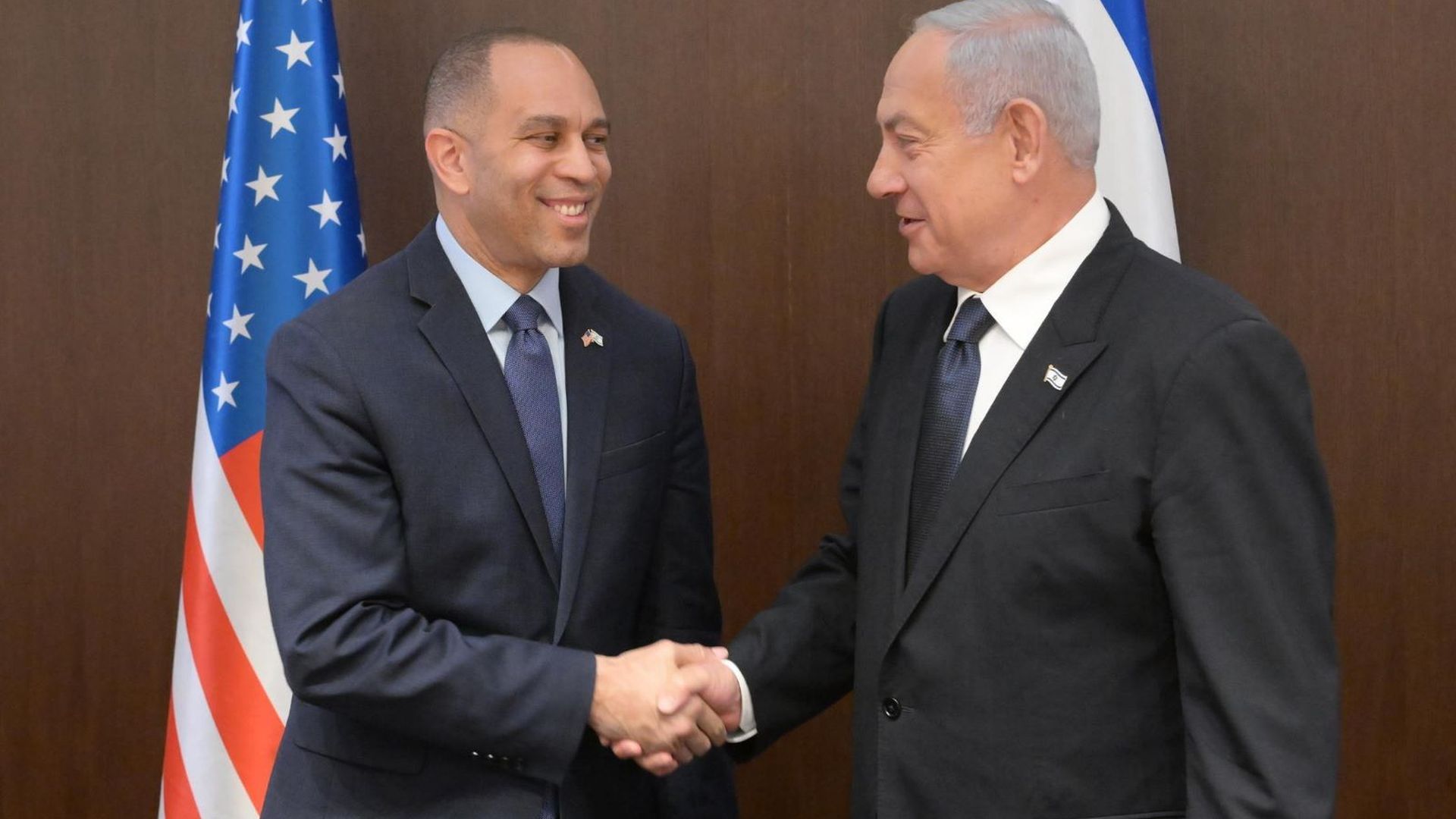
House Minority Leader Hakeem Jeffries shakes hands with Israeli Prime Minister Benjamin Netanyahu. Photo: Handout/Israeli GPO
House Minority Leader Hakeem Jeffries (D-N.Y.) and other Democratic lawmakers told Israeli Prime Minister Benjamin Netanyahu last month that his government’s judicial overhaul plan makes it harder for them to defend Israel in the U.S., two people, including a member of Congress, who attended the meeting tell me and Axios' Andrew Solender.
Why it matters: Netanyahu suspended the judicial overhaul legislation in March after mass protests and pressure from the U.S., but Jeffries' message suggests there is still concern among Democrats that the process may resume before Israel has reached a broad consensus on judicial reform.
- Negotiations in Israel over the plan have been ongoing, but no major breakthrough has been announced.
Behind the scenes: Jeffries and several other members of Congress told Netanyahu in Jerusalem that the judicial overhaul created a lot of negative “noise” about Israel in the U.S. and among their constituents, according to one of the sources who attended the meeting.
- “They told Netanyahu it is very difficult for them to defend Israel under such circumstances, and their message was: help us help you," the source said.
- One of the members of Congress who attended the meeting confirmed the delegation did tell Netanyahu the judicial overhaul makes it harder for them to speak up for Israel.
- "I can confirm that this very message was shared with Netanyahu by the delegation and, in particular, by each of the Jewish members at the table," said the lawmaker, who spoke on the condition of anonymity to offer details about a private meeting.
- The member of Congress said that at the same time, the delegation shared with Netanyahu an “equally warm sentiment on the occasion of Israel's 75th anniversary and our unique and enduring friendship."
Netanyahu told the group he is ready for a compromise on the judicial overhaul and added that the legislation that will allow the Knesset to override Supreme Court rulings with a simple 61-member majority is off the table, according to one of the sources who attended the meeting.
- The Israeli Prime Minister's Office and Jeffries' office declined to comment.
The big picture: Several days after Jeffries’ visit, House Speaker Kevin McCarthy arrived in Jerusalem with a bipartisan delegation.
- McCarthy refrained from pressing Netanyahu in public about the judicial overhaul. He told reporters that democracy must include checks and balances, but stressed: "Israel can decide what it wants to do."
3. Gallant to CENTCOM chief: Intel sharing will continue, despite leak
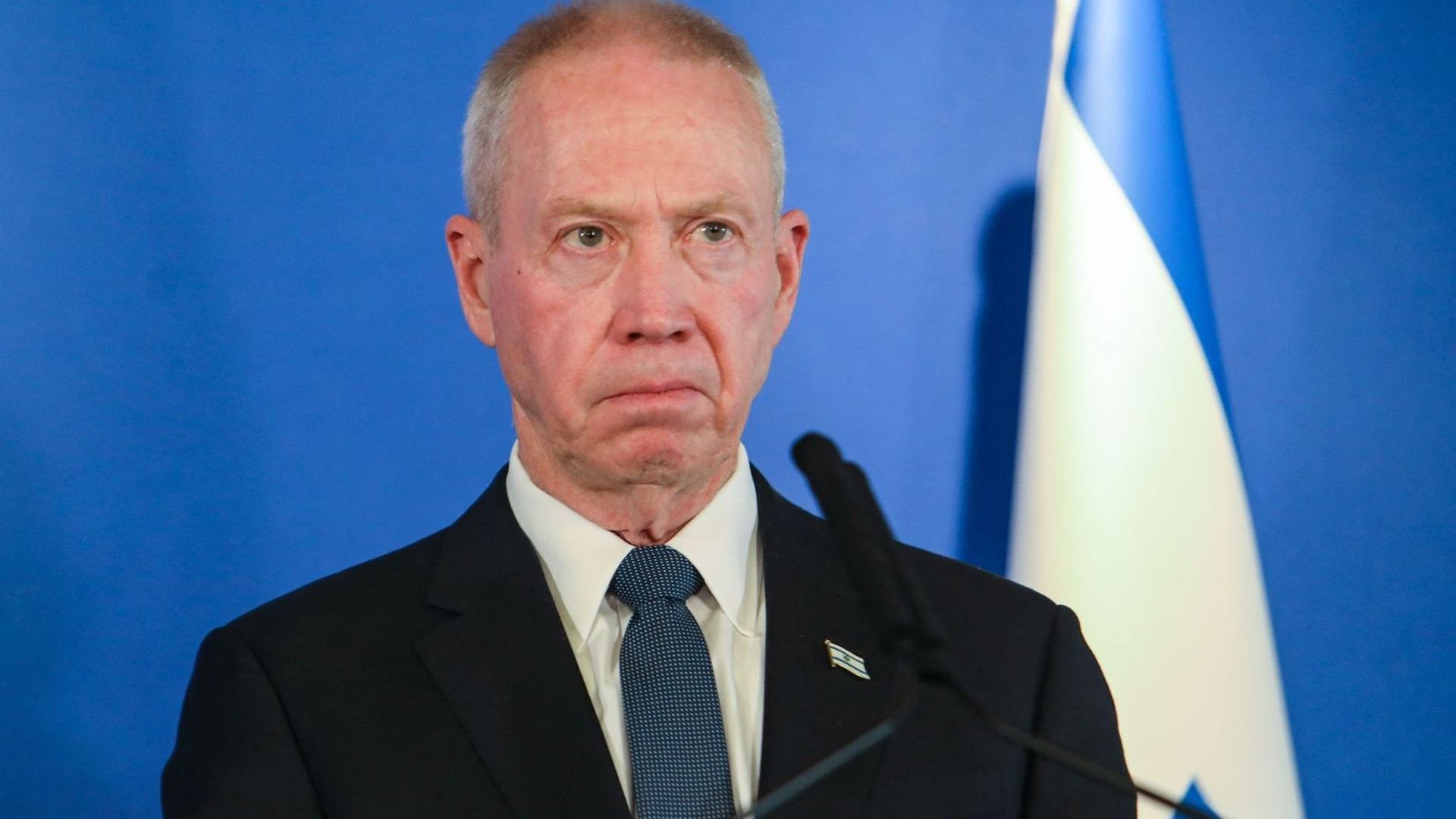
Israeli Defense Minister Yoav Gallant. Photo: Gil Cohen-Magen/AFP via Getty
Israeli Defense Minister Yoav Gallant told Gen. Erik Kurilla, head of the U.S. Central Command, that Israel will continue information and intelligence sharing with the U.S., despite concerns after a trove of top-secret Pentagon documents was leaked online, two Israeli defense officials told me.
Why it matters: The leak of classified documents included sensitive details from U.S.-Israeli consultations and threatened to complicate the vast intelligence sharing between the two allies.
Behind the scenes: In the days after last month's leak, Kurilla spoke to IDF Chief of Staff Herzi Halevi in a phone call and reassured him that the U.S. is committed to safeguarding intelligence and will take steps to prevent further leaks, an Israeli defense official told me.
- The call, which hasn't been previously reported, was part of a wider push by the Biden administration to reassure allies and partners around the world.
- That push also included a call between U.S. Defense Secretary Lloyd Austin and Gallant, as I previously reported.
- Israeli officials said that the Israeli defense establishment had moved on from the leak.
What they're saying: "The Minister of Defense and CENTCOM commander agreed to deepen the special cooperation and information sharing between the Israeli and U.S. defense and intelligence agencies and to broaden the regional operations led by CENTCOM," Gallant’s office said in a statement after Gallant and Kurilla spoke last week.
- CENTCOM spokesperson Col. Joe Buccino said, “CENTCOM is committed to securing information shared with all our partners.”
4. U.S. urges Lebanon to elect president after 6 months without a leader

A Lebanese flag in Beirut. Photo: Liu Zongya/Xinhua via Getty Images
The U.S. this week urged crisis-hit Lebanon to move “expeditiously” to elect an "appropriate" president six months after the last head of state departed the presidential palace, Hanna Davis writes for Axios from Beirut.
Why it matters: Divisions between the different regional and world powers have stalled the country's presidential election, compounding the country's growing economic crisis that has plunged millions into poverty.
- Lebanon’s politics are split between an Iran-Syria alliance that supports Hezbollah versus a Saudi-backed bloc that is allied with the U.S. and much of the West.
Catch up quick: Lebanon’s divided parliament has failed multiple times to elect a president since former President Michel Aoun left the post in October.
- Hezbollah — an Iran-backed militia group and Lebanon’s most powerful political actor — has nominated Marada Movement leader Sleiman Frangieh as its preferred presidential candidate.
- But Frangieh, who is also a close friend of Syrian President Bashar al-Assad, does not have the necessary backing of the largest Christian blocs in Lebanon’s parliament, nor the support of the international community.
- The top presidential candidates backed by parties opposed to Hezbollah include Lebanon’s army commander Gen. Joseph Aoun and Zgharta MP Michel Mouwad.
The big picture: The election of a president in Lebanon “is always the work of foreign powers," Hilal Khashan, a professor of political science at the American University of Beirut, told Axios.
- Diplomats from the U.S., Saudi Arabia, France, Qatar, and Egypt convened in Paris in February to discuss Lebanon’s political crisis, but they came to no explicit agreements or conclusions on the presidential election.
- Iran has established a chokehold over the country through Hezbollah’s growing influence. The group's consensus is required for any decision on Lebanon’s future president. Iran’s foreign minister visited Beirut last week and said his country will accept any president chosen by consensus.
What they're saying: The Biden administration on Monday weighed in on the presidential election, saying it "is the time for action to select appropriate leadership and save the country from further disaster."
- The statement by State Department spokesperson Matthew Miller didn’t specifically name any of the candidates but stressed the need “to select appropriate leadership” who can unite the country and lead reforms to save Lebanon’s economy.
- “Lebanon needs a president free of corruption who can … advocate for transparency and accountability and put the interests of Lebanon’s people first," Miller said.
Between the lines: Hezbollah leader Hassan Nasrallah has previously announced that whoever is selected as the next president should stand up to the U.S., the ally of the militant group’s nemesis, Israel.
- When asked on Tuesday if Miller's statement was a signal that the U.S. opposes the pro-Hezbollah Frangieh, deputy State Department spokesperson Vedant Patel said, "We are not attempting to pick a candidate or put our finger on the scale for anyone one way or the other."
What to watch: The key to Lebanon’s election of a president is an agreement between the Iranians and the Saudis, Khashan said.
- The recent Saudi-Iran rapprochement might open a door to a political settlement but will take time, Khashan noted. The Saudis have other regional priorities to address first, like the war in Yemen.
- The Saudis have been pushing for the election of Gen. Joseph Aoun. Khashan said they are still not willing to support a "pro-Iranian president."
5. Sudan latest: More truces announced, but fighting continues
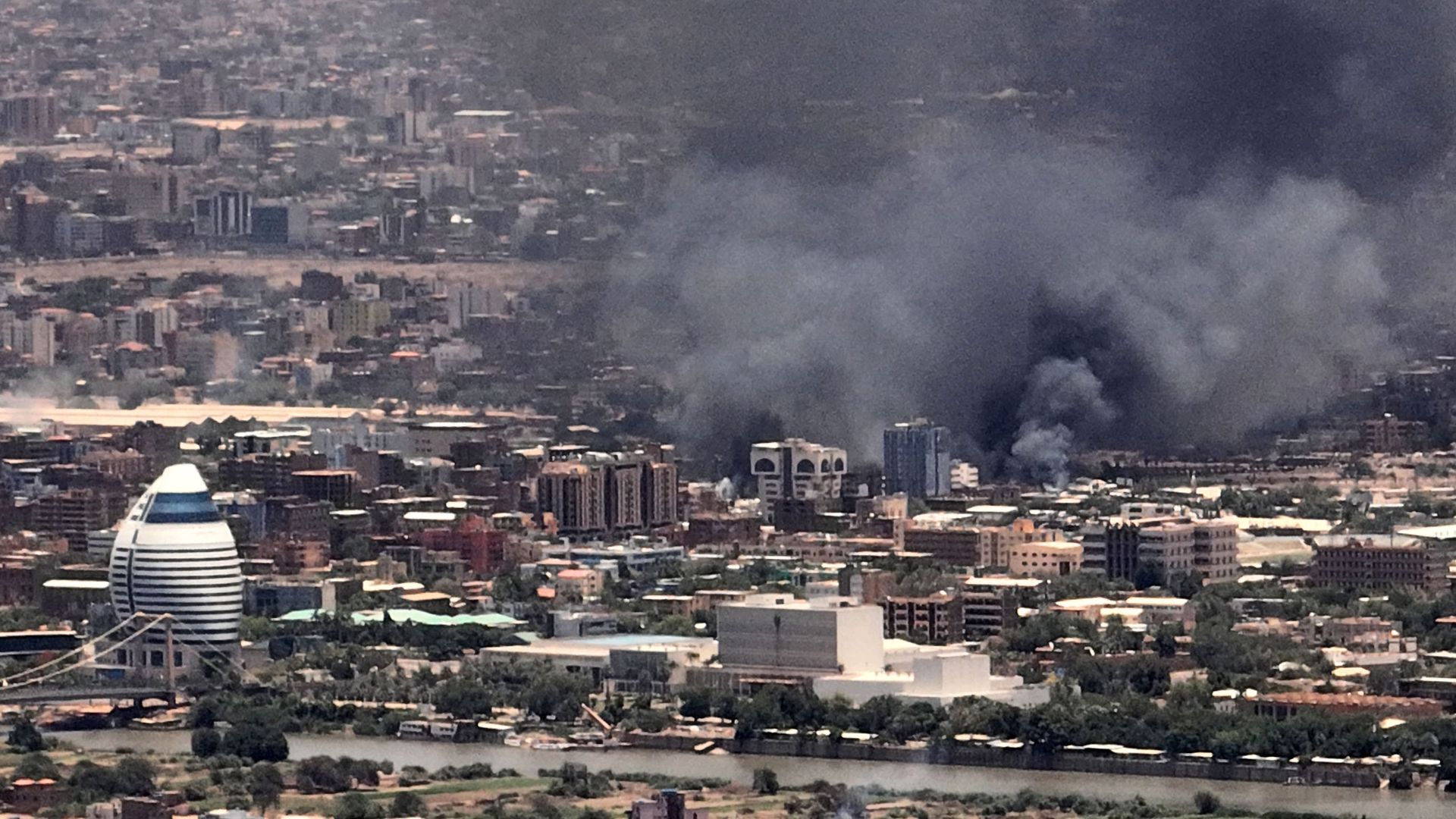
Smoke billows during fighting in the Sudanese capital Khartoum. Photo: AFP via Getty Images
The warring generals in Sudan have agreed in principle to a new seven-day cease-fire, South Sudan's president said yesterday, though all previous truces have not stopped the fighting, with both sides accusing each other of violations.
The big picture: More than two weeks of fighting between the Sudanese military and the rival Rapid Support Forces paramilitary group has killed more than 550 people, wounded 5,000 others and displaced hundreds of thousands.
- The fighting has dramatically exacerbated the political, economic and humanitarian crises in the country.
- UN humanitarian chief Martin Griffiths is in Sudan today to secure agreements from the warring parties to commit to protecting and allowing humanitarian assistance.
Driving the news: South Sudanese President Salva Kiir spoke on Tuesday with the two warring generals — Sudanese army chief Abdel Fattah al-Burhan and RSF commander Mohamed Hamdan Dagalo, known as Hemedti — and asked them to extend the cease-fire and name representatives for peace talks that would be held at an agreed venue, the South Sudan Foreign Ministry said in a statement.
- According to the statement, al-Burhan and Hemedti agreed in principle to a seven-day truce starting on Thursday and also agreed to name their representatives to the talks.
- The Sudanese Military and the RSF haven’t confirmed their agreement.
State of play: The Biden administration and numerous other African, Arab and Western governments have been trying to press the generals to end the fighting.
- Mediation efforts by the Biden administration, Saudi Arabia and the African Union led to several announcements of 72-hour cease-fires, but they only led to a modest decrease in violence.
- "No cease-fire is perfect, but what we feel confident about is that these cease-fires, including this most recent extension, have led to a reduction in violence … that have allowed allied and partner countries to evacuate their own citizens," State Department deputy spokesperson Vedant Patel told reporters yesterday.