Axios from Tel Aviv
April 05, 2023

Welcome back to Axios from Tel Aviv. Happy Passover!
- This week's edition (2,035 words, 7½ minutes) starts with the slew of normalization developments in the Middle East. It also brings you a scoop on the alarm the top U.S. general caused in Israel.
⚡ Situational awareness: Violence erupted at Jerusalem's Al-Aqsa Mosque compound overnight as Israeli police stormed the area.
- The violence, reminiscent of the tensions that led to the 2021 Gaza war, prompted militants in Gaza to fire rockets toward Israel. Israel then retaliated with airstrikes. Go deeper.
1 big thing: Saudi-Iran deal spurs wider normalization wave
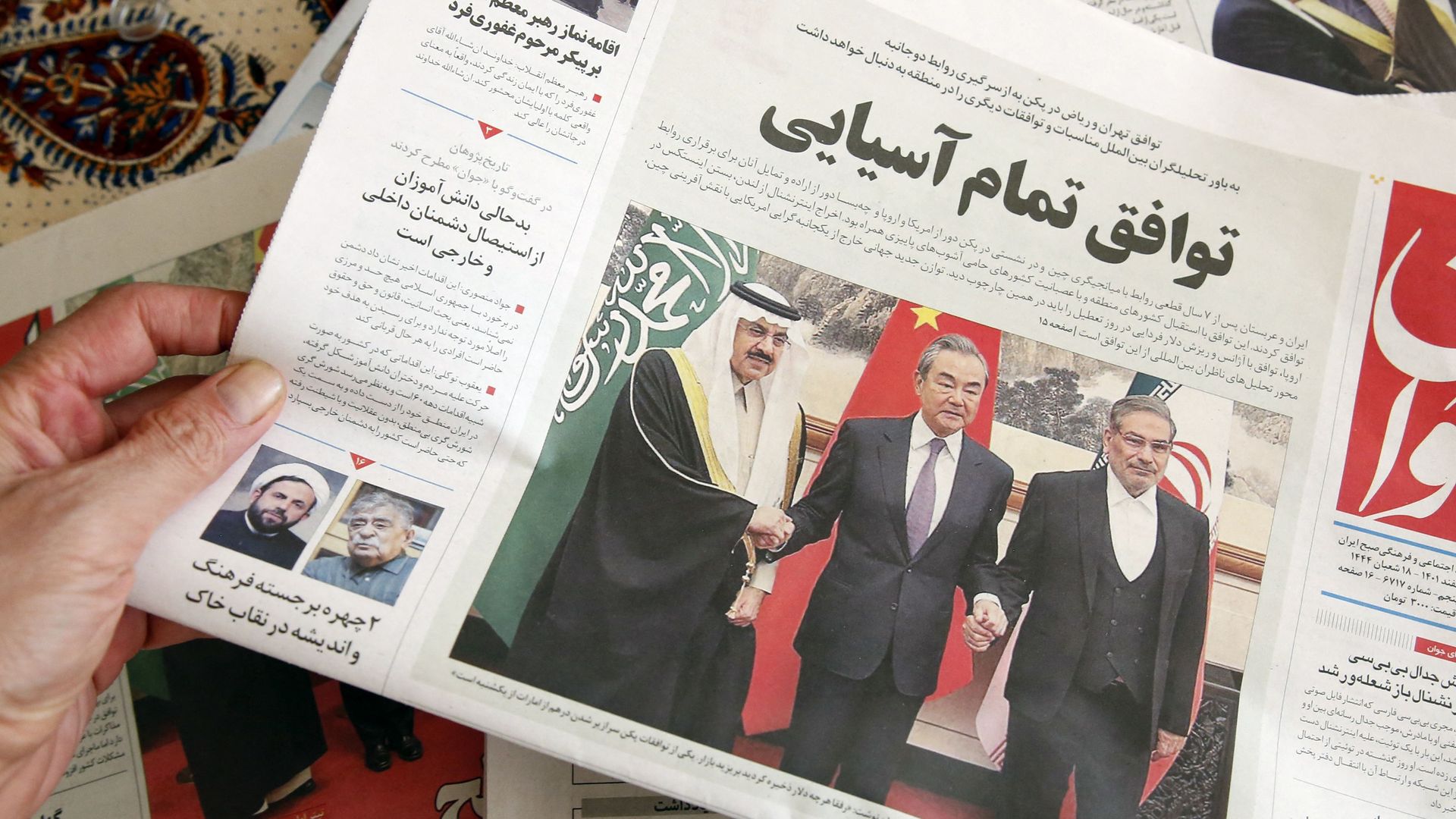
A man in Tehran holds a local newspaper with a front-page story of the China-brokered deal between Iran and Saudi Arabia. Photo: Atta Kenare/AFP via Getty Images
The foreign ministers of Saudi Arabia and Iran will meet on Thursday in Beijing under the auspices of their Chinese counterpart Wang Yi in another significant step in resuming full diplomatic relations between the two regional adversaries, according to Iranian and Saudi press reports.
Why it matters: The meeting is part of a wider wave of normalization between the Saudi-led camp and the Iranian axis in the Middle East in recent months in an effort to de-escalate tensions and end regional conflicts, including the war in Yemen.
Catch up quick: Iran and Saudi Arabia on March 10 agreed to resume diplomatic relations after secret talks in Beijing mediated by the Chinese government.
- It was a major breakthrough for the two Middle East rivals, who haven't had diplomatic relations since 2016 when Saudi Arabia cut ties with Iran after Iranian protesters stormed its embassy in Tehran in protest of the kingdom's execution of a Shiite cleric.
Driving the news: Since the agreement was announced, the foreign ministers of Saudi Arabia and Iran have spoken on the phone three times to prepare for the meeting, according to statements about the calls issued by both sides.
- Iran’s vice president said on Tuesday that President Ebrahim Raisi has accepted the invitation of Saudi King Salman to visit the kingdom in the near future.
Between the lines: The foreign ministers' meeting is expected to take place during the holy month of Ramadan, which is traditionally a time for reconciliation and peace efforts.
State of play: Iran is also working on resuming full diplomatic relations with the United Arab Emirates. Iranian Deputy Foreign Minister Ali Bagheri said on Tuesday that the Islamic Republic has appointed an ambassador to Abu Dhabi for the first time in eight years.
- Meanwhile, Syrian Foreign Minister Faisal Mekdad visited Cairo on Saturday — the first such trip by a Syrian foreign minister in more than a decade. The visit represented a major normalization step between a key Saudi ally and a key Iranian ally.
- A day later, Reuters reported that Saudi Arabia wants to invite Syrian President Bashar al-Assad to visit the kingdom in May to participate in the Arab League leaders summit. Syria was expelled from the Arab League in 2011 after the regime’s crackdown on protestors.
- Russia on Tuesday hosted the deputy foreign ministers of Turkey, Syria and Iran in Moscow as part of an effort to normalize relations between Ankara and Damascus. The Russians hope to soon hold a foreign ministers' meeting between Turkey and Syria.
2. 🚨 Scoop: Milley's remarks on Iran alarms Israel

Gen. Mark Milley, chair of the Joint Chiefs of Staff, testifies during a House Appropriations Defense Subcommittee hearing on March 23. Photo: Drew Angerer/Getty Images
A statement Gen. Mark Milley, the chair of the Joint Chiefs of Staff, made during a House hearing last week on Iran's nuclear program alarmed Israeli defense and intelligence officials to the point they protested and asked the Biden administration for clarifications, four Israeli officials told me.
Driving the news: Milley, testifying before the House Appropriations Subcommittee on Defense, said that the U.S. "remains committed as a matter of policy that Iran will not have a fielded nuclear weapon."
- The word "fielded" created the impression among Israeli officials that the U.S. had changed its policy on Iran and would tolerate Tehran having a nuclear weapons program, the four sources said.
- Milley also said it would only take Iran two weeks to produce enough uranium for a nuclear weapon. It would then "only take several more months to produce an actual nuclear weapon," he added.
Behind the scenes: Senior officials in the Israeli Prime Minister’s Office, Ministry of Defense, IDF, Foreign Ministry and Mossad who deal with the Iranian issue were alarmed by Milley’s remarks, the Israeli officials said.
- The word "fielded" made the Israeli officials question whether the U.S. would allow Iran to develop a nuclear weapon as long as it didn't deploy it on a missile or other delivery system, the four Israeli officials said. The Biden administration's policy has always been based on preventing Iran from obtaining a nuclear weapon.
- The Israeli officials said they were also alarmed by Milley's assessment of the time Iran would need to produce a nuclear weapon once it has a sufficient amount of uranium enriched to 90% purity.
- Milley’s "several months" timeline was not only significantly shorter than the estimate of the Israeli intelligence community, but it was also a U.S. estimate that hadn't been shared with Israel, the Israeli officials said. Israeli officials believe it would take Iran one to two years to build a nuclear device.
The big picture: A senior Israeli official told me that other senior Israeli officials from several agencies who work on Iran issues called their U.S. counterparts and expressed concern about Milley's remarks. They also asked that Milley clarify his remarks or retract them.
- Several days later at a House Armed Service Committee meeting, Milly stressed that the U.S. is committed to ensuring Iran never obtains a nuclear weapon. This time, he didn't use the word "fielded."
- He did, however, repeat the claim that Iran would need “several months to produce an actual nuclear weapon" if it enriched enough uranium to 90%.
What they're saying: Israeli officials saw Milley's statement before the House Armed Service Committee as the clarification they hoped for. "We asked the Biden administration to fix it and they did," a second senior Israeli official said.
- Joseph Holstead, a Joint Staff spokesperson, told me that the "U.S. policy remains the same."
- Milley's use of the word "fielded" in the "past was military vernacular," Holstead said.
3. UAE succession uncertainty put to rest as MBZ names son crown prince
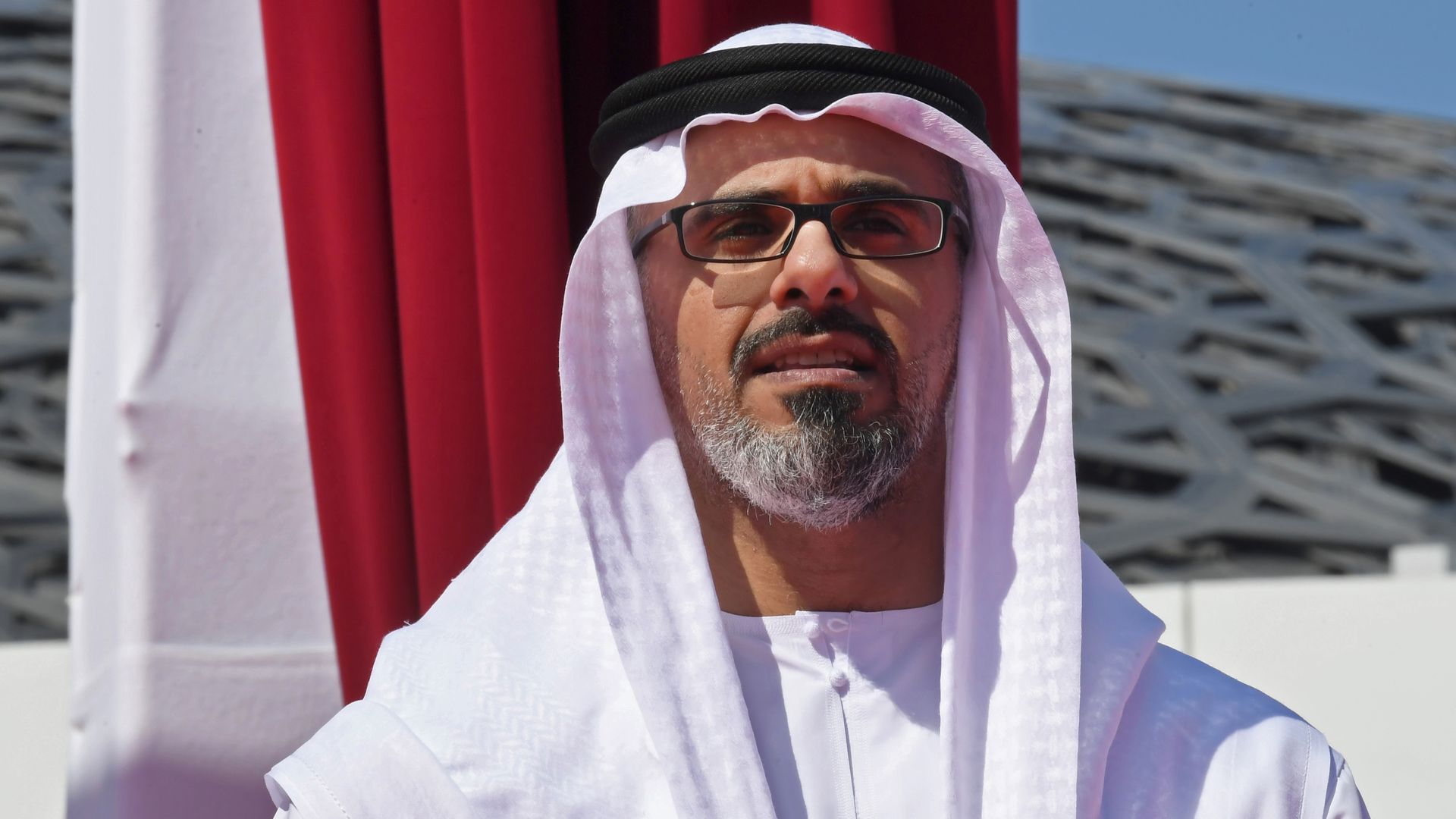
Sheikh Khaled bin Mohamed bin Zayed Al Nahyan in 2018. Phot: Karim Sahib/AFP via Getty Images
UAE President Mohammed bin Zayed (MBZ) appointed his eldest son Khaled as crown prince last week, elevating him above an older generation of senior royals and ending the uncertainty about the kingdom's line of succession.
Why it matters: It took MBZ 10 months to announce this decision after succeeding his late half-brother last May, suggesting he needed time to build internal consensus and reach an understanding with his five full brothers, some of whom were perceived as potential candidates for the crown prince position.
- Sheikh Khalid, who is in his early 40s, has held senior positions as the head of the UAE’s domestic security service, deputy national security adviser and a member of the Abu Dhabi executive council, but he has kept a relatively low public profile.
Driving the news: His elevation was part of a broader reshuffle within the ruling family that included promotions for three of MBZ's brothers.
- Mansour bin Zayed was appointed as vice president alongside Dubai ruler Mohammed bin Rashid, who already held that title.
- Two other brothers, Hazza bin Zayed and Tahnoon bin Zayed, were named deputy rulers of Abu Dhabi.
- The ruling family presented a unified front after the announcements. Sheikh Khalid's uncles congratulated him and pledged their support, as did regional leaders, including Saudi Crown Prince Mohammed bin Salman.
Between the lines: The UAE constitution doesn’t clearly define the succession process.
- “Along history, the succession of Abu Dhabi rulers was the opposite of being systematic or peaceful. The rule was inherited by brothers, nephews, cousins and sons, and in many cases, the transfer of power entailed significant rifts within the ruling family," said Moran Zaga, a researcher from the University of Haifa who specializes in the UAE.
- MBZ, 62, was named crown prince in 2004 and became the kingdom's de facto ruler after his brother suffered a stroke a decade later.
- “The transfer of power vertically, to his son, means that the next generations of MBZ’s brothers will be further away from the center of power. That is why MBZ made sure to distribute economic, political and symbolic power to his brothers in the framework of the same succession announcement, not one minute later," Zaga told me.
4. Lebanon crisis threatens stability of security forces
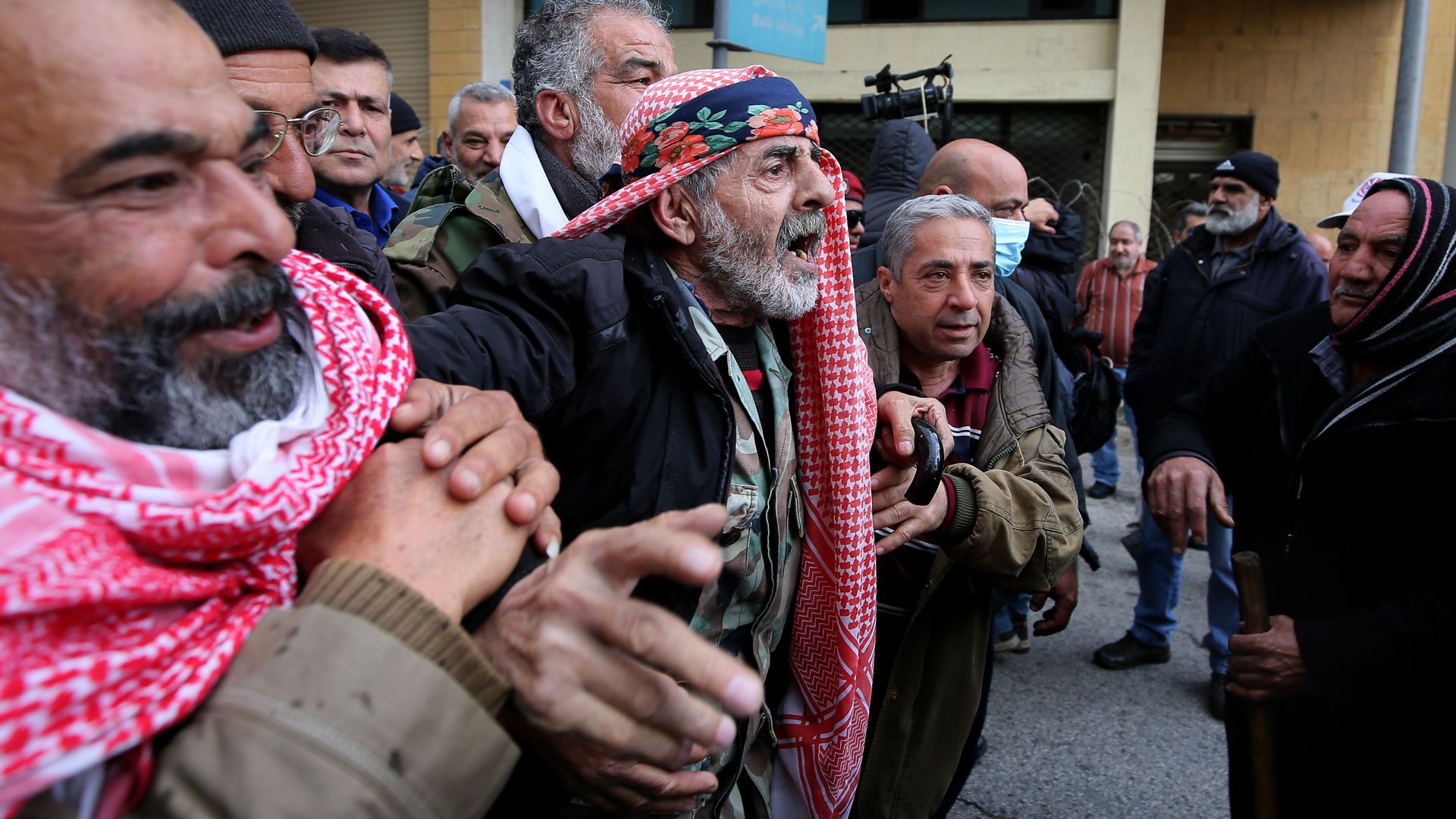
Lebanese army retirees protest living conditions and economic crisis on March 30. Photo: Marwan Naamani/picture alliance via Getty Images
Lebanon's spiraling economy is threatening the stability of the military and security services, as current and retired security personnel see the value of their salaries and pensions plummet, Hanna Davis reports for Axios from Beirut.
Why it matters: Without adequate salaries, soldiers have taken second jobs or, in some cases, deserted their ranks, threatening Lebanon’s security. The army serves as a stabilizing force to police the country’s sectarian feuds, and it's long been a critical partner for the U.S. as it's able to function as a counterweight to the Iran-backed armed group Hezbollah.
Driving the news: Last week, protesters, including hundreds of army retirees angered over the rapid depreciation of their pensions, tried to remove barbed wire fencing outside the prime minister’s headquarters and threatened to retaliate if tear gas was used. Tear gas was fired to disperse angry crowds in a similar protest a week earlier.
- Army personnel have not protested on this scale before in Lebanon, according to Sami Nader, the director of the Beirut-based Levant Institute for Strategic Affairs. The salaries and pensions of the country’s security personnel have drastically decreased in value, unable to keep pace with the rampant inflation of the Lebanese pound.
- “The salaries in the public sector — including the military and armed forces — are dwindling by the day,” Nader said.
- An active Lebanese soldier, who spoke on condition of anonymity to Axios, said his salary has tanked from what was worth $1,300 three years ago to now just $114. He has resorted to driving for various ride-sharing apps to compensate for his income loss, he said, but still barely has enough to cover his daily expenses.
- "I am under terrible psychological pressure and terrible economic pressure," he said.
State of play: The International Monetary Fund has offered a $3 billion bailout package to Lebanon, conditional on a host of structural and financial reforms. But with the country in a double executive vacuum since November — without a president or a fully empowered Cabinet — no progress has been made on the reforms that could help revive the deteriorated economy.
- Without a political solution on the horizon, the pound will likely continue to spiral, and along with it the salaries of the country’s security personnel and public sector workers.
5. McCarthy's and Jeffries' dueling trips to Israel
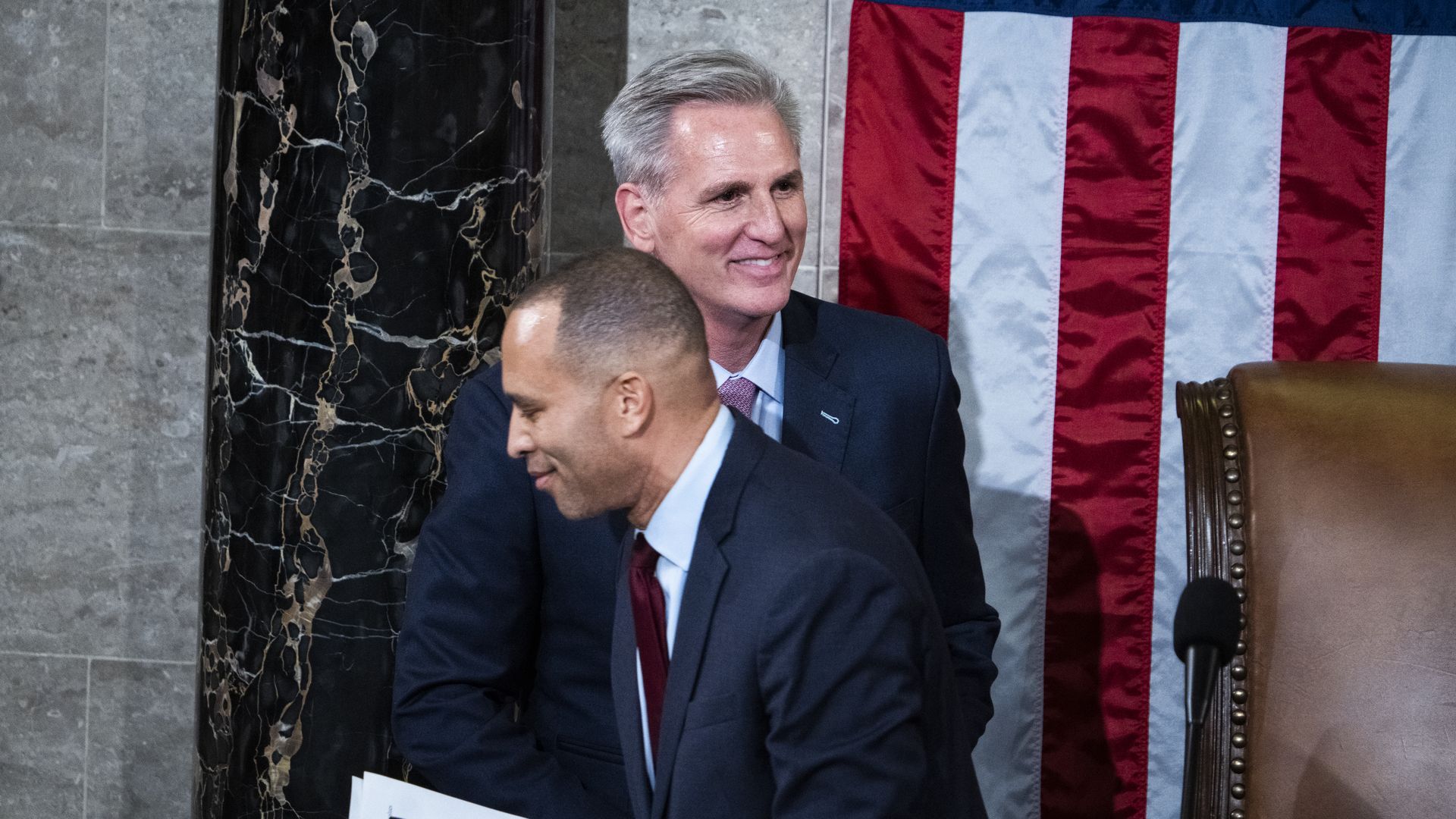
House Speaker Kevin McCarthy and House Minority Leader Hakeem Jeffries at the U.S. Capitol on Jan. 7. Photo: Tom Williams/CQ-Roll Call Inc. via Getty Images
House Speaker Kevin McCarthy (R-Calif.) and House Minority Leader Hakeem Jeffries (D-N.Y.) are expected to visit Israel on separate trips later this month, according to the Israeli Foreign Ministry.
Why it matters: The visits by Republican and Democratic congressional leaders will take place amid tensions between President Biden and Prime Minister Benjamin Netanyahu over the Israeli government's judicial overhaul plan and its policies toward the Palestinians.
- Israel's governing coalition and the opposition are also holding talks on a possible compromise deal on judicial reforms ahead of the new Knesset session, which starts May 1.
Details: Jeffries is expected to arrive in Israel on April 22 for a three-day visit, according to the Israeli Foreign Ministry. His office declined to comment.
- McCarthy is expected to arrive in Israel on April 30 and leave on May 2, the Israeli Foreign Ministry official visits schedule states. McCarthy’s office sent an invitation to Republican and Democratic members of the House to join him on the trip.
- According to the invitation obtained by Axios' Andrew Solender, McCarthy will leave on April 28 and visit Jordan before arriving in Israel.
Catch up quick: Netanyahu last week announced he was suspending the judicial overhaul legislation until the next Knesset session in order to give a chance for dialogue with the opposition.
- Netanyahu’s announcement came a day after he fired Defense Minister Yoav Gallant, who warned that the judicial overhaul would pose a threat to national security if it wasn't halted.
State of play: Despite the firing, Gallant remains defense minister. On Monday — eight days after the initial announcement — Netanyahu’s aides told reporters that “due to the security situation” in the country, the prime minister decided to suspend the firing of Gallant. They added that Netanyahu "will deal with the issue at a later stage."
🫓 Bonus: Happy Passover!

My Seder table. Photo: Barak Ravid/Axios
My family — like Jewish families around the world — is celebrating Passover with the traditional Seder tonight.
The big picture: Passover's universal message of freedom and human rights is still relevant today in many parts of the world, including in Israel.
- We will read the Haggadah, which tells the story of the liberation of the Jewish people from slavery and their exodus from Egypt around 3,500 years ago, according to Jewish tradition.
- As many before me summarized it in the past: "They tried to kill us, we survived — let's eat."