Axios Markets

July 12, 2023

1 big thing: Mexico is now the top U.S. trade partner
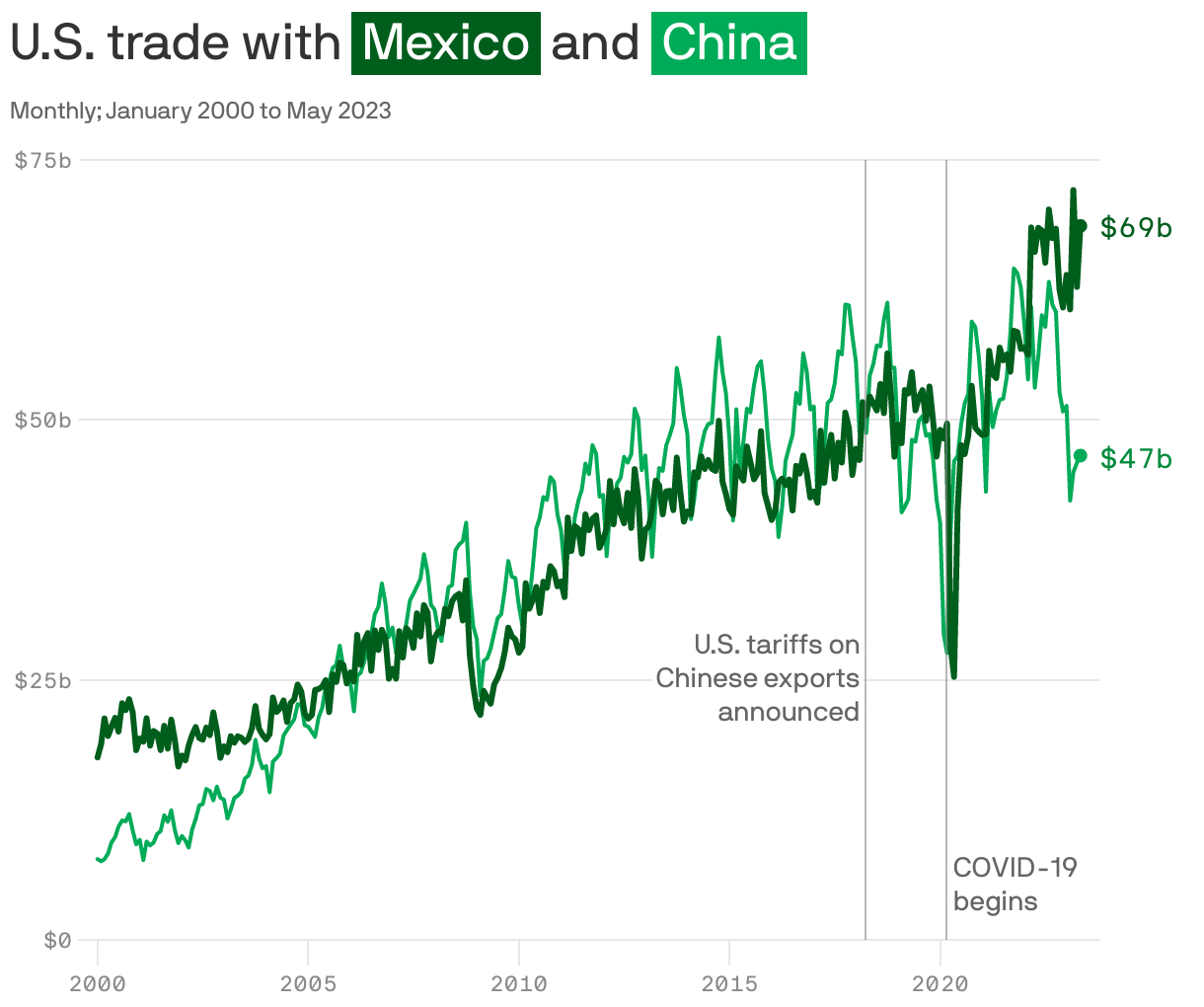
Mexico supplanted China this year as the United States' top trading partner, Emily writes.
Why it matters: The milestone reflects a real shift in the dynamics of the global economy — away from prioritizing low prices and greater efficiency (via super fragile supply chains) to something more nuanced.
- "Today’s global economic relationships encompass a myriad of concerns, among them national security, climate policy and supply-chain resiliency," writes Luis Torres, senior business economist at the Dallas Fed in a piece out this week highlighting the change.
- Declining trade with China means rising costs for U.S. consumers and companies.
- It also reflects worsening diplomatic relations between the U.S. and China — which is concerning for reasons that go beyond economics.
Zoom out: The decline of China as the country's top trading partner comes after years of worsening U.S.-China relations and reflects Mexico's rise in manufacturing — hastened along by a new push to "nearshore" that work closer to the U.S.
- The auto industry accounts for nearly a quarter of the total manufacturing trade activity between the U.S. and Mexico.
- China exports more to the U.S. than the U.S. sends to China, but trade with Mexico is more balanced between imports and exports.
- For example, in some industries, products are started in U.S. plants, and finished in Mexican factories before coming back into the U.S. "We complement each other," Torres tells Axios.
Meanwhile, the Biden administration is pushing to improve its relationship with China.
- Last week, Treasury Secretary Janet Yellen met with China's premier, Li Qiang, a top economic aid to President Xi Jinping.
- More visits from U.S. officials are expected over the summer.
Catch up quick: China emerged as the U.S.'s top trading partner courtesy of its entry into the World Trade Organization in 2001 — it surpassed Canada in 2014.
- But trade with China started declining after the Trump administration imposed restrictive tariffs on Chinese imports in 2018 — and China responded with retaliatory tariffs. They further declined when the pandemic twisted up supply chains around the globe.
State of play: The Biden administration left those tariffs in place. Today, the average U.S. tariff on Chinese imports is 19.3%, while China's average tariff on U.S. imports is 21.2%, per data cited by the Peterson Institute for International Economics.
- This is far more than the 9% paid by other WTO members, which have "most-favored-nation" status, Torres writes.
- Mexico and the U.S. trade with far fewer barriers, part of the free trade deal formerly known as NAFTA, renegotiated as the United States-Mexico-Canada Agreement in 2020.
2. Catch up quick
3. There's Big Tech, and there's the Magnificent Seven


Nasdaq is rebalancing its widely traded Nasdaq 100 Index to offset the growing heft of the giant tech companies known as the Magnificent Seven, Matt writes.
Why it matters: It's another indication of the top-heavy quality of the markets at the moment.
The latest: Nasdaq announced it would conduct a "special rebalance" of its Nasdaq 100 index prior to trading on July 24.
- That will reduce the degree to which the Nasdaq 100's performance is determined by this elite club of seven tech giants: Apple, Microsoft, Alphabet, Amazon, Nvidia, Tesla and Meta.
What they're saying: "As described in the published index methodology, a Special Rebalance may be conducted to address overconcentration in the index by redistributing the weights. The Special Rebalance will not result in the removal or addition of any securities," Nasdaq said.
- The methodology spells out that when any group of big stocks — all those making up more than 4.5% of the index — amounts to more than 48% of the index, then the index will be rebalanced.
Be smart: While the Nasdaq composite — a group of more than 3,000 stocks listed on the Nasdaq exchange — is often cited in the press, the Nasdaq 100 is the basis for incredibly popular trading products, such as the Invesco QQQ ETF.
- Invesco says — citing Bloomberg — that the QQQ is the second-most heavily traded ETF in the U.S., after the SPY index, which tracks the S&P 500.
4. Microsoft is about to get even bigger

FTC chair Lina Khan. Photo: Tom Williams/Getty Images
5. Small biz check-in


The vibes from small business owners are still pretty pessimistic — but they seem to have stopped getting worse, Axios' Kate Marino writes.
- The NFIB's Small Business Optimism Index, out yesterday, ticked up in June to the highest level so far this year.
Why it matters: Small businesses often feel an economic slowdown more quickly or sharply than large corporations — they have less scale, less margin for error, and less access to capital markets.
- And as Axios' Hope King reported, things have been pretty tough out there lately for small business owners — especially following the regional banking mini-crisis in March.
State of play: Although small business leaders are still more pessimistic than the Index's historical average of 98 (going back 49 years), there are a few green shoots worth highlighting.
- The share of companies planning for capital expenditures in the next three to six months went up to 25% in May — and held steady there in June. That's up from 21% at the beginning of the year (and it dipped to 19% in the wake of the March bank failures).
- Context: An increase in spending plans is not what you expect to see going into a recession, as our colleague Neil Irwin recently explained.
- Meanwhile, the share of owners expecting better business conditions in the next six months improved by 10 points in June, to the best reading since February 2022. (But still, more owners are negative than positive.)
Go deeper: Read the NFIB's June report
Axios Markets

Stay on top of the latest market trends and economic insights