Axios Login

January 31, 2022

I'm too despondent over the 49ers' fourth-quarter unraveling to write today's newsletter.
Today's newsletter is 1,137 words, a 4-minute read.
1 big thing: The next chip crisis will be bigger

Illustration: Aïda Amer/Axios
The global chip shortage that's kept automobiles, iPads and game consoles in short supply is nothing compared to what could happen if a political crisis or natural disaster hit Taiwan, Axios' Margaret Harding McGill reports. That's because Taiwan is home to TSMC, which makes a huge chunk of the world's most sophisticated computer chips.
Why it matters: Washington's focus on the semiconductor shortage has thus far centered on keeping products on shelves and car dealership lots stocked — but U.S.-China tensions, along with the threat of natural disasters, provide a recipe for an even broader economic crisis.
What's happening: Right now, no U.S. company can manufacture the most advanced leading edge chips used in smartphones, laptops, servers, super computers, gaming consoles and other products.
- Instead, most of the supply for those chips are made by Taiwanese company Taiwan Semiconductor Manufacturing Company (TSMC), and is concentrated in Asian countries.
- A Chinese ambassador to the U.S. recently warned of potential military conflict over Taiwan, calling the issue the "biggest tinderbox" between China and the U.S. Plus, the self-governing island also faces risks from earthquakes, flooding and climate change.
- The current chip shortage has caused lengthy delays for new car orders, and was blamed in part for U.S. GDP remaining 1% lower than its pre-pandemic trend..
What they're saying: "It's extreme concentration of some of the most strategically important chips in the world, and no capacity in the United States in the case of major disruptions," Will Hunt, a research analyst at Georgetown's Center for Security and Emerging Technology, told Axios.
- "The current shortage pales in comparison to the economic impact of what might happen if the United States lost access to chips in Taiwan," Hunt told Axios.
Yes, but: Intel recently announced plans to invest $20 billion in two leading-edge chip factories in Ohio, while TSMC is building a facility to make its five-nanometer chips in Phoenix.
- "We are completely in that game, and that's not slowing down," Al Thompson, Intel vice president of U.S. government relations told Axios.
Meanwhile, the chip shortage experienced by the auto industry is for older, less advanced chips and is being fueled by a mismatch in demand and supply.
What's next: House lawmakers introduced legislation that could see a vote as early as this week that would in part dedicate $52 billion in funding for domestic semiconductor production.
Between the lines: The funding, which the Senate approved last year, is meant to address long-term chip challenges, not the short-term crisis.
- "This is about ensuring more of the chips that are so critical to our country and our economy are researched, designed, and manufactured domestically over the long term, so we can make our supply chains more resilient and avert the next chip shortage," Dan Rosso, spokesperson for the Semiconductor Industry Association, told Axios.
2. Spotify CEO responds to critics
Photo: Vivian Zink/Syfy/NBCU Photo Bank/NBCUniversal via Getty Images
Spotify CEO Daniel Ek yesterday finally responded to a growing chorus of critics panning the streamer for not doing enough to address COVID-19 misinformation, Axios' Sara Fischer reports.
Why it matters: While health experts have been sounding the alarm about the issue for weeks, it took the threat of high-profile talent boycotts for Spotify to finally admit that it hadn't been transparent around its content policies.
Details: Instead of taking action on the anti-vaccination content from the company's most popular podcaster, Joe Rogan, Ek's statement doubled down on Spotify's commitment to "creator expression," while also vowing to be more transparent about its rules.
- Moving forward, Ek said Spotify would add a content advisory to any podcast episode that contains COVID-19 "discussion." He also said the company is testing new ways to highlight its rules to creators to avoid ambiguity.
- Ek's post also linked to a post on Spotify's website that listed the company's long-standing content moderation policies, which were leaked to The Verge last week. The policies, while previously kept from the public, ban any content suggesting that vaccines cause death, but not anti-vaccination content broadly.
Critics were quick to slam Spotify, arguing Ek's statement didn't go far enough to address Rogan's anti-vaccination comments that still are available on the platform.
- Ek's statement didn't mention Rogan by name at all.
Flashback: In 2020, Spotify inked an exclusive, multi-year deal to distribute all of Rogan's podcasts, reportedly for over $100 million. Rogan's podcasts are by far the most popular on the platform, with millions of streams per episode.
The big picture: Spotify is facing a very public boycott from popular musicians and podcasters in response to the way it handled an ultimatum from musician Neil Young last week.
- Young demanded that Spotify take down his music unless it took action to address Rogan's vaccine misinformation.
- Other singers and podcasters, including fellow Canadian singer Joni Mitchell and E Street Band member Nils Lofgren, followed suit.
3. More groups call on IRS to dump ID.me
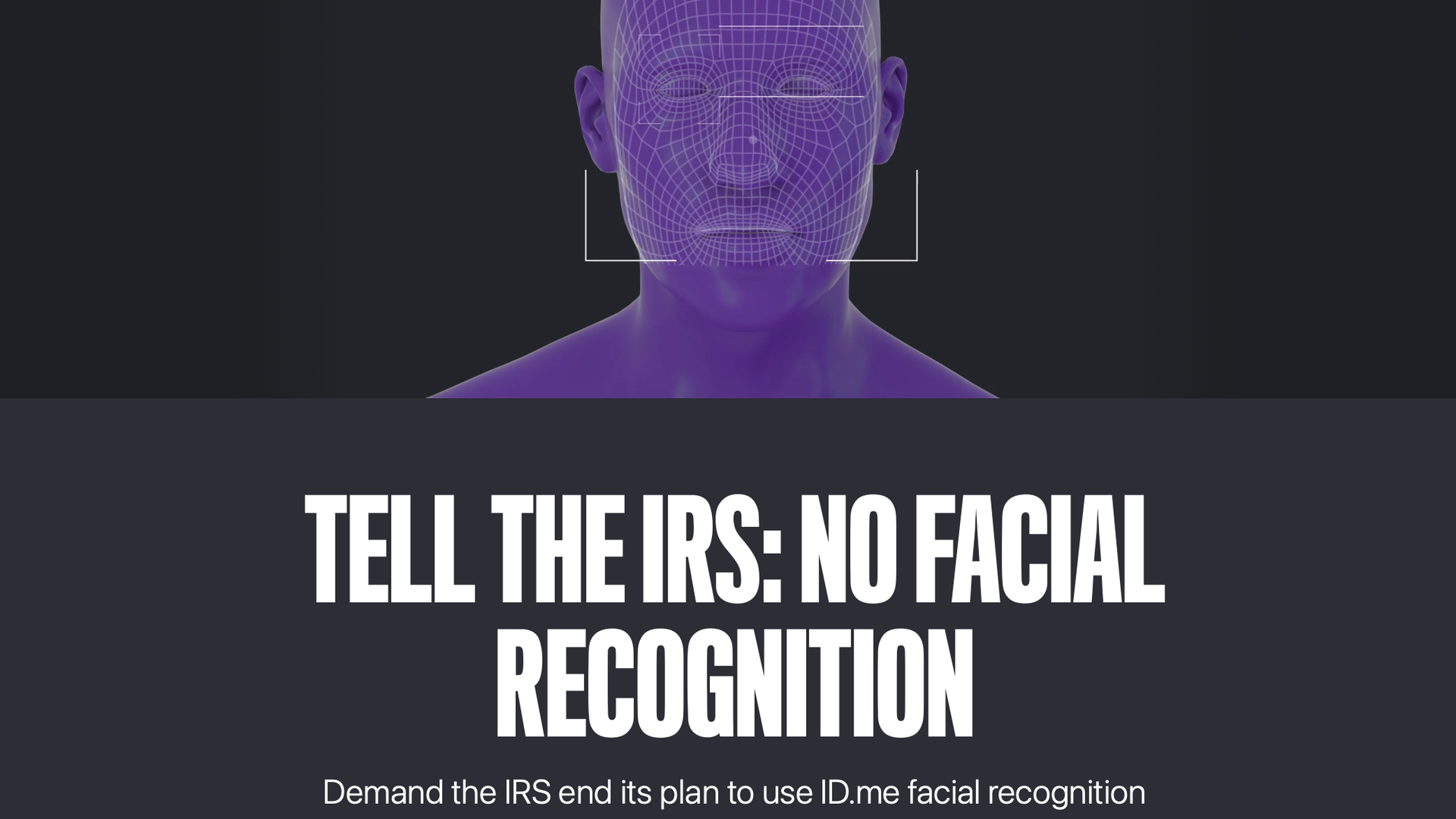
Screenshot: Dumpid.me
A growing number of civil rights groups are calling on the IRS to sever ties with ID.me over concerns about the company's face recognition technology as well as its lack of transparency.
Driving the news: A coalition of groups, including Fight For the Future, the Algorithmic Justice League and EPIC, have launched Dumpid.me, an online petition urging individuals to indicate their opposition to the agency using the private company's video selfie-based technology to verify identity.
- Meanwhile, as Bloomberg reported on Friday, the IRS is weighing alternatives to ID.me. "Treasury and the IRS are constantly in search of ways to improve taxpayers experience, and are looking into alternatives to ID.me," the agency confirmed in a statement to Axios.
- "ID.me welcomes the opportunity to meet with Fight for the Future to discuss the importance of digital identity verification in efforts to stop fraud and ensure equitable access for all," ID.me spokesperson Patrick Dorton said in a statement to Axios.
Catch-up quick: The IRS plans to require taxpayers who want to do certain online transactions to use ID.me's video selfie-based authentication system.
- The ACLU and other groups raised a number of concerns about the equity and propriety of relying on such technology.
- Those concerns were exacerbated after revelations that ID.me compares selfies to a database of those who have previously used its service, despite previously denying using so-called one-to-many face recognition.
- In an interview with Axios, CEO Blake Hall apologized for misleading the public, but defended the practice as an important step in fighting fraud.
4. Take note
On Tap
- It's another big week of earnings reports, with Google, PayPal, Electronic Arts and AMD reporting on Tuesday. Facebook parent Meta, Qualcomm and Spotify highlight Wednesday's earnings calendar, while Amazon, Snapchat and Pinterest offer their reports on Thursday.
Trading Places
- Jimmy Garropolo.
ICYMI
- The Wall Street Journal has a worthy read on how Lina Khan is looking to redefine how antitrust law looks at markets, including Big Tech. Plus, you will get to learn the word "monopsony."
5. After you Login
I was still very sad after the game, but this did make me feel a little better.