Axios Generate

July 27, 2023
๐ Hi readers! There's a lot going on, but today's newsletter still has a Smart Brevity count of just 1,318 words, 5 minutes.
๐ถ Exactly 25 years ago, Brandy and Monica were midway through an epic 13-week run atop the Billboard Hot 100 with today's intro tune...
1 big thing: Big Oil profits fall, but it's all relative
Illustration: Aรฏda Amer/Axios
Oil and natural gas giants Shell and TotalEnergies reported big second-quarter profit drops this morning, reflecting lower commodity prices after an extremely lucrative stretch, Ben writes.
Driving the news: Shell tallied roughly $5.1 billion in adjusted Q2 earnings, down 56% from the same period in 2022, and below $9.6B in this year's first three months.
- The decline from last quarter "mainly reflected lower LNG trading and optimization results, lower realized oil and gas prices, lower refining margins, and lower volumes," Shell said.
- Fellow super-major TotalEnergies, meanwhile, reported $5 billion in profits, down 49% from last year's second quarter.
Yes, but: It's all relative! The environment is still pretty favorable for oil majors. The companies are not changing their ongoing efforts to reward investors.
- Shell announced another $3 billion in share buybacks to be completed by the time it reports Q3 results, with TotalEnergies planning $2B next quarter.
The big picture: Industry profits soared to new records in the year after Russia's early 2022 invasion of Ukraine shocked energy markets and sent prices surging.
Today's results were "broadly in line with Shell's performance in 2021, while TotalEnergies outperformed its pre-invasion results," Reuters notes.
Of note: Both companies' reports fell short of analysts' expectations, per CNBC and others.
What they're saying: In a presentation, Shell CEO Wael Sawan touted the company's second-highest 1H adjusted earnings in a decade.
- He noted the results compared favorably to 2014, even though Brent crude averaged $110-per-barrel in the first half of that year, compared to $80 in the first six months of 2023.
2. Biden's heat wave "hazard alert" for workers

Illustration: Brendan Lynch/Axios
The Labor Department will boost efforts to protect workers from extreme heat as temperature records fall in the Southwest and elsewhere, Ben writes.
Driving the news: The White House asked Labor to issue a formal "hazard alert" that will "reaffirm that workers have heat-related protections under federal law," officials said on Thursday.
- It will provide employers with information on protecting workers and help ensure workers know their rights.
- In addition, Labor will "ramp up enforcement of heat-safety violations," expanding inspections of "high risk" sectors like construction and agriculture.
The intrigue: It's the first time the Labor Department has used the "hazard alert" tool to address extreme heat, a White House official tells Axios.
State of play: Officials are touting several initiatives today, and President Biden will make remarks on the heat wave this morning.
- Other efforts include NOAA investments to improve weather forecasts and Interior Department steps to help ensure drinking water availability in drought-stricken Western communities.
3. Why auto giants linked arms to expand EV charging
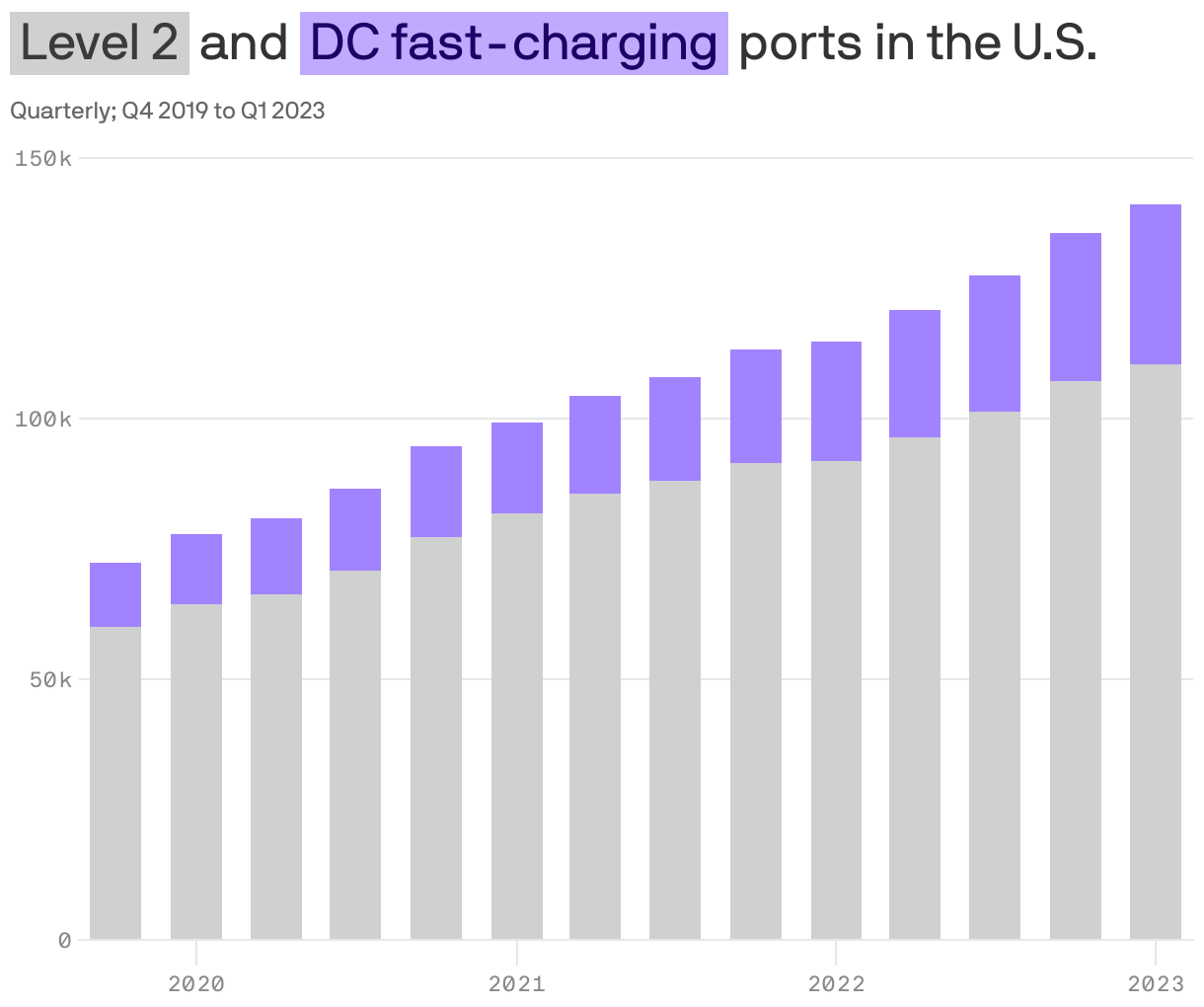
Seven of the world's biggest automakers see strength in numbers as they look to expand the electric vehicles market and compete with Tesla, Ben and Axios' Joann Muller report.
Catch up fast: On Wednesday, GM, BMW, Stellantis, Hyundai and other heavyweights announced a joint venture aimed at deploying over 30,000 public chargers in North America.
Why it matters: The unusual tie-up shows that as the industry invests billions of dollars in electrified lineups, they know broader charging availability is needed to help convince drivers to make the switch.
The big picture: EVs were slightly over 7% of U.S. sales in the first half of 2023, per Cox Automotive.
- The White House is targeting 50% by 2030, a goal multiple automakers share, and brewing EPA rules could effectively require even more.
Zoom in: The 30,000 fast-chargers envisioned โ which adds to other projects by charging providers and car companies โ is roughly the same number currently in the U.S.
Yes, but: The automakers acknowledge far more is required, citing a National Renewable Energy Laboratory estimate that over 180,000 "will be needed to support 30-42 million plug-in vehicles expected on the road by 2030."
Quick take: The joint venture may be an effort to quell Tesla's growing influence over the EV ecosystem after it pledged to open its own Supercharger network to other brands.
How it works: The new stations will support both Tesla's North American Charging Standard (NACS) and the competing Combined Charging System (CCS).
- The companies plan to tap subsidies via the 2021 infrastructure law.
The bottom line: "Automakers know that their efforts to sell EVs will be stymied if the infrastructure isnโt in place," Cox Automotive analyst Michelle Krebs tells Axios via email.
4. Meet the U.N.'s new climate science boss
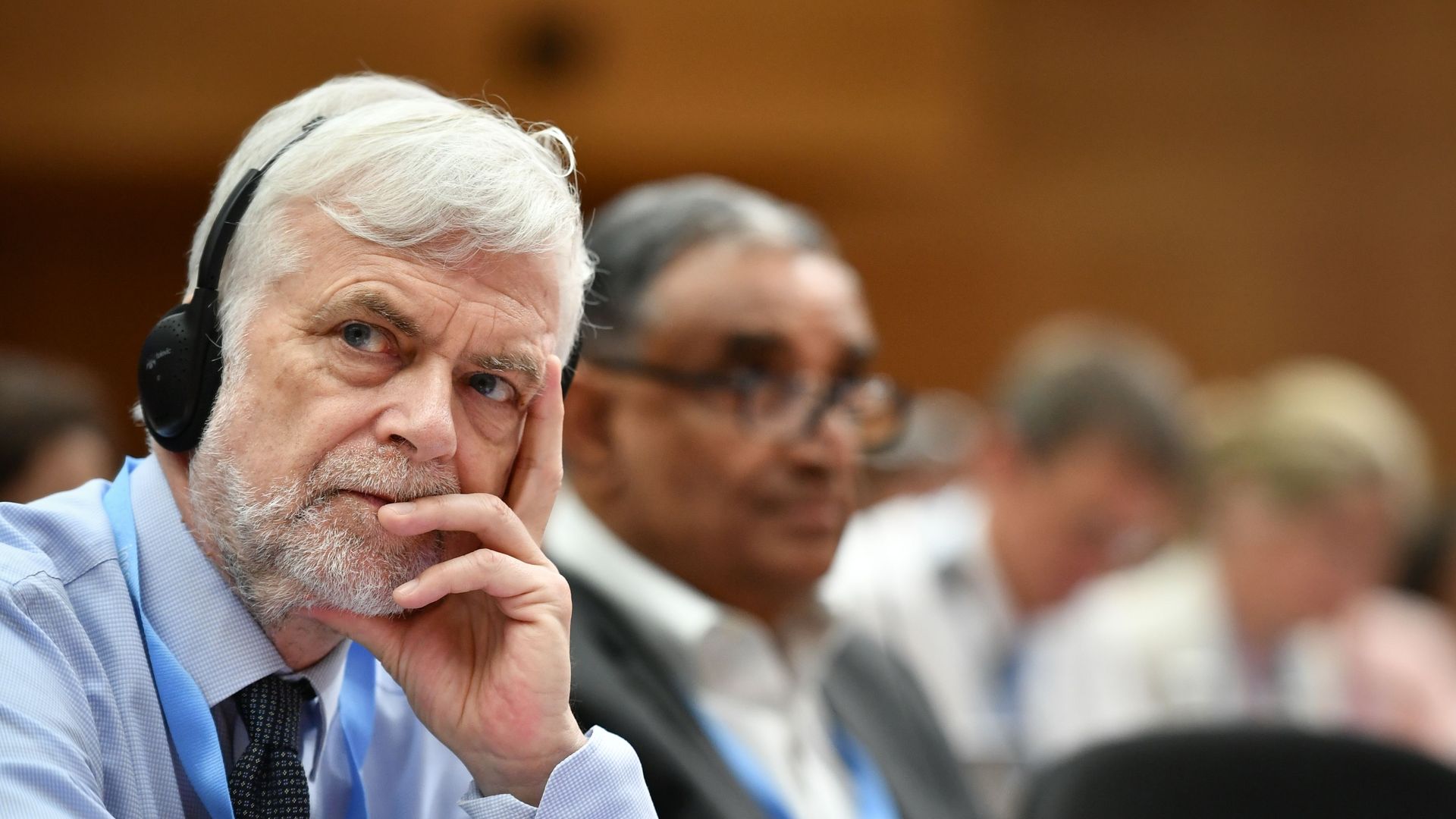
Jim Skea attends an IPCC meeting in 2019 in Geneva. Photo: Fabrice Coffrini/AFP via Getty Images.
Jim Skea of the U.K. is the new leader of the influential U.N. Intergovernmental Panel on Climate Change. He will steer the science group through its next major assessment report, Andrew writes.
Why it matters: The IPCC's scientific reports help shape climate policy by informing leaders of the latest findings.
Between the lines: Skea, a professor at Imperial College London, co-chaired the section of the IPCC's Sixth Assessment Report that focused on climate mitigation.
- He must now navigate the internal politics of the organization and help determine which special reports the group pursues in the next five to seven years.
The intrigue: Skea emerged the winner from a field of four candidates, including two women. The IPCC has never had a female leader.
5. ๐๐ฝโโ๏ธCatch up fast on policy: Analysis, pipelines, oil, methane
Illustration: Natalie Peeples/Axios
๐ From the wonky but important files, the federal Energy Information Administration (EIA) is revamping the model it uses to create long-term outlooks, Ben writes.
- Driving the news: EIA said the National Energy Modeling System requires "substantial updates to better model hydrogen, carbon capture, and other emerging technologies."
- The big picture: The next version will aim to better account for policies, including climate law. That means the 2024 version of the multi-decade annual outlook won't happen, but it returns in 2025.
- Quick take: Long-term outlooks, even the most rigorous, should be taken with boulders of salt. That said, efforts to refine them can help policymakers, investors and other stakeholders that use them as rough guideposts.
๐ House Republicans have a new pipeline safety bill they say also promotes the use of natural gas, Axios Pro: Energy Policy's Jael Holzman reports.
- Why it matters: The bill reveals some of what a future Congress under full GOP control might do, like preempting local gas bans.
- Go deeper: Subscribe to Axios Pro: Energy Policy for the full story and must-read congressional coverage.
๐ข๏ธ The White House said it's creating a new, Cabinet-level task force on methane to back a "whole of government" approach to curbing the potent greenhouse gas. Reuters has more
๐ A group of left-leaning Congressional Democrats has urged the Justice Department to probe oil majors over what they call "campaigns of deception" about what they knew about their products' danger to the climate.
6. Automakers seek electric charge in China
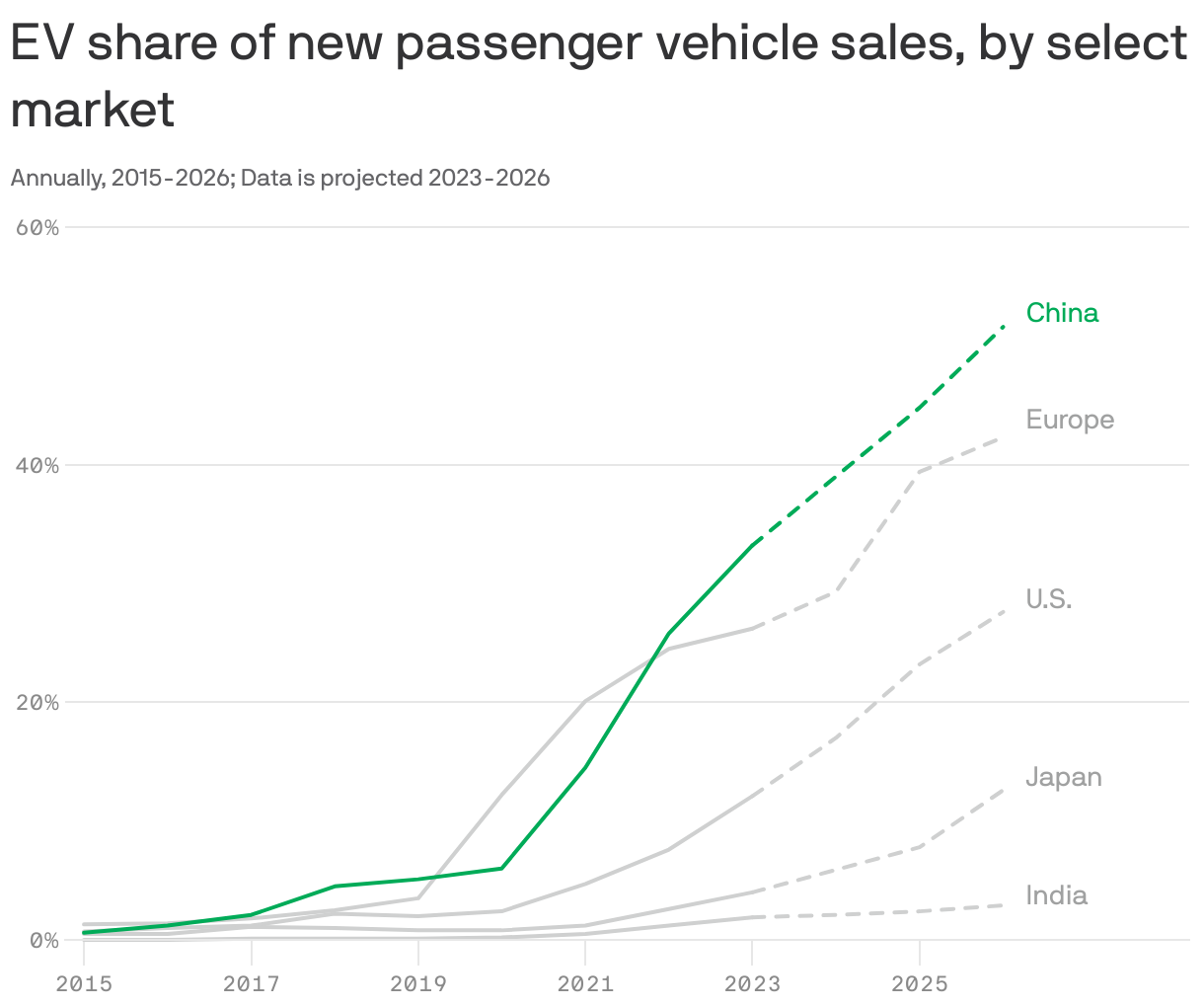
This week brings the latest evidence of automakers acting with more urgency to compete in China's fast-growing EV market, Ben writes.
Driving the news: The Volkswagen Group has a new deal with China's Xpeng to develop two VW-branded mid-sized models for the Chinese market.
- VW, which has struggled in China, is investing around $700 million for a 5% stake in Xpeng. And the VW Group's Audi unit is expanding its partnership with China's SAIC, with an eye on new luxury offerings.
- Meanwhile Nissan, when reporting earnings yesterday, said it's also boosting its focus on reversing declining sales in China.
The big picture: As EVs snag a growing share of China's auto pie, consultancy AlixPartners projects that Chinese automakers will outsell foreign automakers domestically this year, for the first time in decades.
The bottom line: China accounted for roughly 60% of global EV sales in 2022, per International Energy Agency data, and automakers are scrambling to position themselves in the world's biggest auto market.
Bonus: Chinese EVs are heading west
Illustration: Sarah Grillo/Axios
Inexpensive EVs from China have quickly gained a toehold in Europe โ and could be taking over American driveways next, Joann reports.
Why it matters: The Biden administration is incentivizing rapid EV adoption while also trying to reduce U.S. dependence on Chinese EV supply chains.
- Yet experts say meeting the administration's proposed vehicle climate standards demands more low-priced EVs.
- With today's U.S. prices averaging close to $55,000, there's a big market opening for budget-priced cars from Chinese brands like BYD, Xpeng Motors and Li Auto.
๐ฌ Did a friend send you this newsletter? Welcome, please sign up.
๐ Thanks to Chris Speckhard and Javier David for edits to today's edition, along with the talented Axios Visuals team.
Sign up for Axios Generate

Untangle the energy industryโs biggest news stories


