Axios Generate

July 02, 2024


🤯 Wow, is there a lot going on! We've got you covered with 1,545 words, 6 minutes.
🎶 On this date in 1982, Elvis Costello & the Attractions released the album "Imperial Bedroom," which provides today's intro tune...
1 big thing: American Airlines' hydrogen-electric move

Exclusive: American Airlines has entered into a conditional purchase agreement with hydrogen fuel cell aviation upstart ZeroAvia for 100 hydrogen-electric engines intended to power regional jets with near zero in-flight emissions.
Why it matters: American sees ZeroAvia's engines as a potential game-changer for powering its regional flights.
- Aviation is a growing source of greenhouse gases, with limited options for cutting emissions.
Driving the news: This is American's first engine order from ZeroAvia, in which it has been investing since 2022.
- The Dallas-based airline is also investing an undisclosed additional sum in the company.
Zoom in: ZeroAvia is developing hydrogen-electric, or fuel cell-powered, engines for commercial aircraft that it says can reduce in-flight emissions to close to zero, other than water vapor.
- Such engines use hydrogen in fuel cells to generate electricity, which then is used to power motors on an aircraft's engines.
- The emissions from such engines are meant to just be water vapor, rather than traditional jet engines, which emit a range of pollutants including planet-warming greenhouse gases.
How it works: So far, ZeroAvia has been testing its next-generation engines on propeller aircraft, including a De Havilland Dash 8 and Dornier 228.
- It is developing a hydrogen fuel cell-powered engine for a Dash 8 Q400 aircraft in Everett, Washington, in conjunction with Alaska Airlines.
- That facility will also be the hub of development activity for the Bombardier CRJ700 propulsion system.
Between the lines: Its agreement with American, though, would have ZeroAvia produce hydrogen electric propulsion systems to replace turbofan jet engines, which no one has yet done.
- However, ZeroAvia points to a technical study with the regional jet's engine manufacturer, MHI RJ Industries, demonstrating its feasibility.
- For American, the startup is designing an engine for larger aircraft, such as the CRJ700. As of last year, American operated 140 such aircraft with 65 seats each.
The intrigue: American has a goal of reaching net zero emissions by 2050. That would heavily depend on a dramatic scale-up of "sustainable" aviation fuels, or SAFs, along with the use of cleaner-powered aircraft such as those that use hydrogen electric or all-electric power.
2. Hurricane Beryl has rewritten storm history books
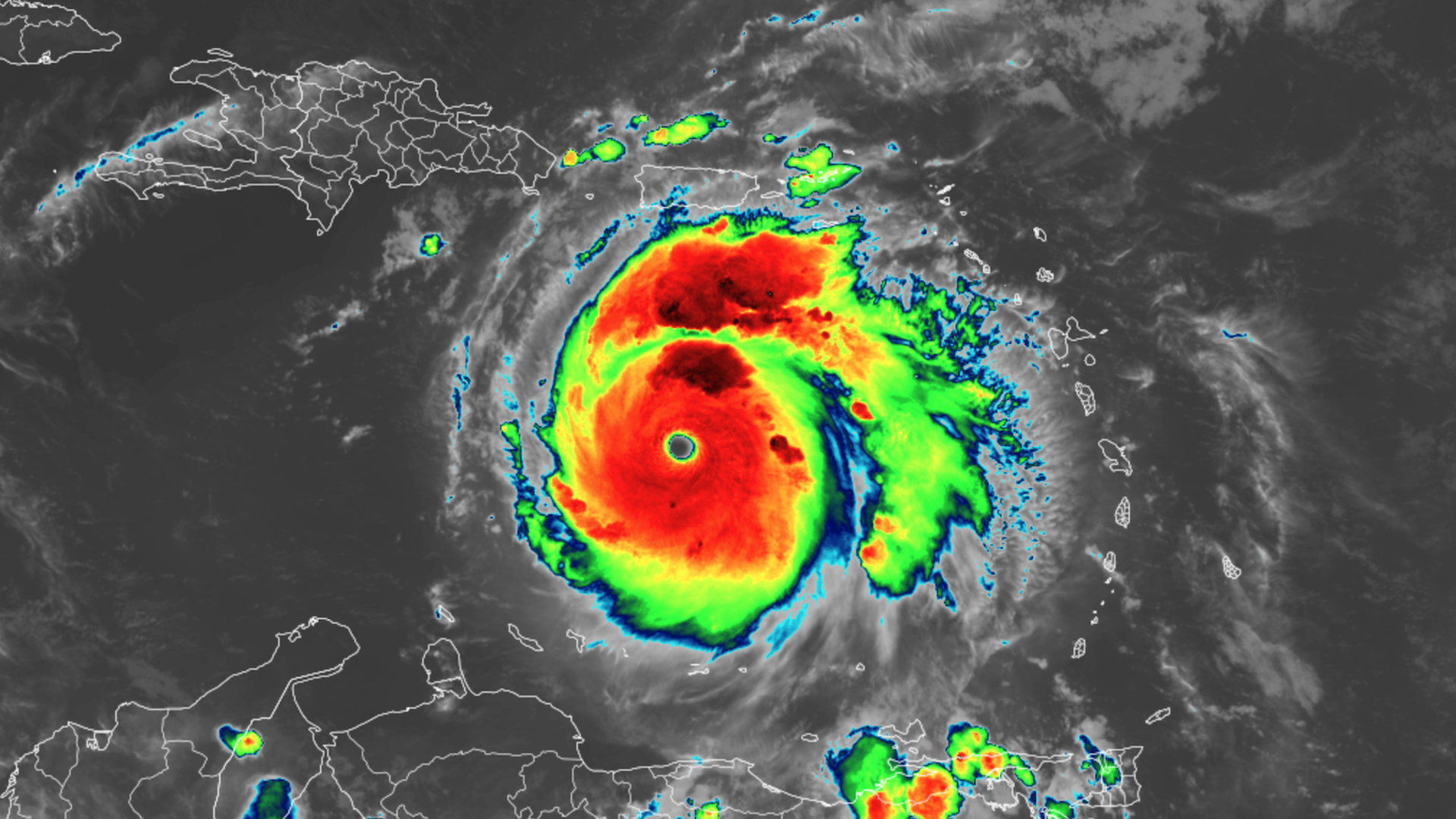
Hurricane Beryl is exactly the type of hurricane experts had warned about during the run-up to the 2024 season: an ultra-intense outlier in time, location and intensity.
Why it matters: The storm's milestones are likely to be a preview of what's to come this season — more record-breaking and destructive storms amid record-warm ocean temperatures.
The big picture: So far, Hurricane Beryl has set records for:
- The earliest Category 5 storm on record in the Atlantic Ocean, beating the previous milestone by a little more than two weeks.
- The strongest storm to make landfall in the southern Windward Islands.
- The fastest intensification rate (65 mph in 24 hours) ever observed in any storm in June.
What they're saying: "It's both unprecedented AND completely expected," said meteorologist Sam Lillo.
3. SCOTUS hits regulators from multiple angles

Exactly 30 years ago, a Warren G hip-hop classic opened with the line "Regulators, mount up!" But now the Supreme Court is giving very different signals.
Why it matters: A 6-3 ruling yesterday from the court's conservative majority brings even more jeopardy for expansive executive rules.
- It's the latest of several decisions that together sap bureaucratic powers in areas where Congress hasn't given detailed marching orders.
🗞️ Driving the news: The latest ruling holds that the six-year clock to bring Administrative Procedure Act claims doesn't start until a plaintiff is injured by an agency action, instead of when it's first finalized.
- The case, Corner Post v. Board of Governors of the Federal Reserve System, is about debit card fees. But it could enable challenges to various kinds of existing rules, analysts say.
- It came 72 hours after the court's decision in Loper Bright Enterprises v. Raimondo overturned "Chevron deference," which could constrain recently issued climate regulations still in court, and future policies.
🏃🏽♀️ Catch up quick: Right before Chevron, SCOTUS stayed a recent EPA air pollution rule while challenges play out — a move that some analysts say could spell trouble for other new agency policies.
- And in 2022, the court's conservatives, in a case about power plant emissions, curtailed executive running room on "major questions" absent explicit Capitol Hill blessing.
🖼️ The big picture: Conservatives, often backed by business groups, see today's court as a needed corrective, reigning in agencies using power in ways Congress never articulated.
- But liberal justices and green groups, among others, say the court is preventing agencies and their technical experts from acting on emerging and evolving risks.
🔭 What's next: ClearView Energy Partners, in a note, says the Loper Bright and Corner Post cases have together changed the landscape.
- "To the extent that uncertainty can quash investment and impair return, we would suggest that Loper Bright could have significant implications for U.S. energy infrastructure on its own," they write.
- "And, to the degree that Corner Post provides a means for reopening (or extending) disputes, we think it could increase the amplitude and frequency of future policy flux."
4. Biden's LNG limbo ... is now in limbo
A Louisiana federal judge has blocked the White House pause on new LNG export licenses to major markets, but the on-the-ground effects of the order are pretty hazy for now.
Why it matters: The injunction yesterday is a victory for attorneys general in 16 GOP-led states and industry groups battling the pause, which Biden officials announced in January to weigh the economic and climate effects of surging exports.
- It calls the pause "completely without reason or logic."
The intrigue: The decision from district Judge James Cain Jr. is a legal smackdown, but don't expect new permits to start flowing yet.
- Attorney Craig Segall with the climate group Evergreen Action said the Natural Gas Act doesn't set a deadline on federal permit decisions.
- "The statute just says 'expeditious.' Moving expeditiously but rationally on these complex public interest questions could and should take months or longer, pause or no pause," he said via email.
State of play: Cain — a Donald Trump appointee — found many counts are likely to succeed on the merits.
- Louisiana AG Liz Murrill applauded the order in a statement: "LNG has an enormous and positive impact on Louisiana, supplying clean energy for the entire world, and providing good jobs here at home."
The other side: The Energy Department said it disagrees with the ruling and is evaluating next steps.
- The White House said it's disappointed, noting U.S. LNG exports — already the world's largest — are slated to grow sharply this decade regardless.
- The administration is "committed" to decisions based on strong environmental and economic analysis, it said.
What we're watching: The next phase of the legal battle — and the election, given Donald Trump's pledge to immediately resume permitting.
5. California faces long duration, intense heat wave
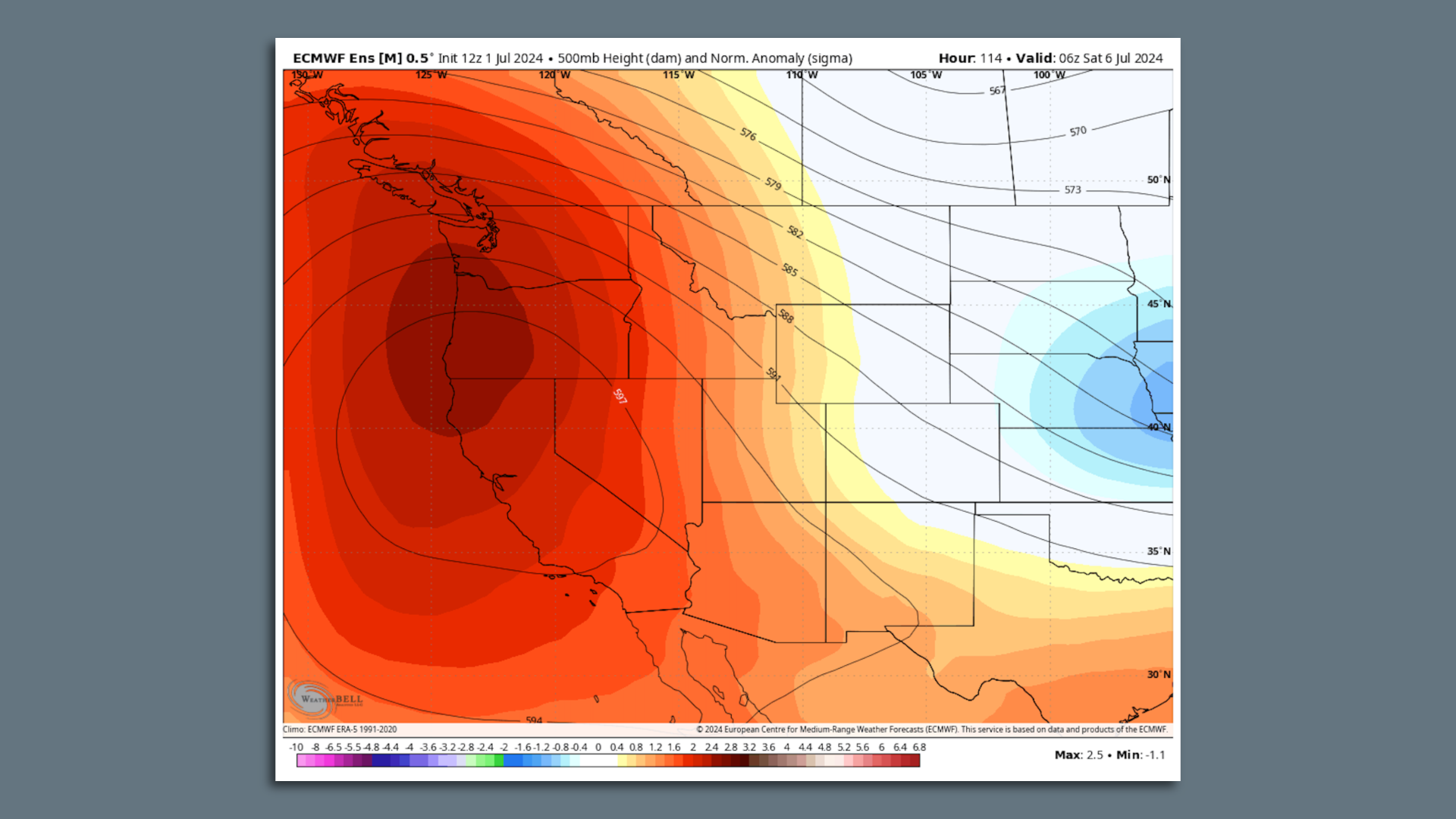
California, and then a broader slice of the West, is set to experience a long duration and intense heat wave along with an increase in wildfire risk.
Threat level: The National Weather Service has hoisted excessive heat warnings for much of the Golden State from today through Monday, with highs well into the 100s°F in inland areas, and 90-degree-plus readings encroaching on coastal areas at times.
- Numerous daily record highs are likely to be set, along with potential monthly milestones for warm overnight minimum temperatures and heat streaks. "The duration of this heat wave is concerning," the NWS stated this morning.
- The intense heat and wildfire threat will extend from Washington State to Arizona.
- July records for streaks of 100°F and 110°F days could break longstanding records for locations in California and Oregon.
- Heat risk levels are likely to reach the "extreme" category, or level 4 out of 4 on the NWS/CDC scale. "For people without effective cooling, this level of heat can be deadly," the NWS office in Sacramento warns.
How it works: The heat will result from a strong area of high pressure, colloquially known as a heat dome, moving in from the Pacific. It will become stronger and broader as time goes on.
Context: Human-caused climate change is making heat waves more likely, more intense and longer-lasting.
Between the lines: After an unusually wet winter and a warmer-than-average June, abundant vegetation in the region is drying out.
- This will heighten wildfire risks.
6. White House floats new worker heat protection rules


The Biden administration today published a new rule for employers that aims to help protect about 36 million workers from heat-related illnesses and death.
Why it matters: The rule, if finalized, would establish the country's first federal safety standard addressing excessive heat in the workplace — at a time when large swaths of the country are experiencing extreme heat.
- There were 33,890 work-related heat injuries and illnesses between 2011 and 2020, per Bureau of Labor Statistics data.
State of play: Under OSHA's proposal, employers in certain jobs would have to establish a workplace heat safety coordinator and develop procedures for responding to symptoms of heat illness.
- They would need to evaluate their plans annually. Employers will also be required to monitor heat levels for outdoor workers.
Zoom in: The rule would apply to indoor and outdoor workers who engage in physical activity and are exposed to a heat index of 80°F or higher.
It's meant to protect workers "whether they are making deliveries, carrying mail all day, working construction, picking vegetables, repairing power lines, doing landscaping," a senior administration official told reporters yesterday.
📨 Did a friend, colleague or even a frenemy send you this newsletter? Welcome, please sign up.
🙏 Thanks to Chris Speckhard and Chuck McCutcheon for edits to today's edition, along with the brilliant Axios Visuals team.