Axios Future of Defense

November 27, 2024

Happy early Thanksgiving! Fingers crossed for your travel plans.
- Got a favorite dish? Send it my way. And don't beat me up for preferring ham.
👀 Situational awareness: Drones are buzzing military bases used by American forces in the U.K. A Pentagon spokesperson on Tuesday would not say why they weren't shot down, or what information they may be collecting.
- My thought bubble: Expect more of these incursions as more people get their hands on drones. Also, don't take the UFO bait.
In this edition: Defending air bases, an Epirus interview and F-35 smack talk.
Today's newsletter is 1,485 words, a 5.5-minute read.
1 big thing: Oreshnik's fallout

Here's what a week of phone calls taught me about Russia's attack on Ukraine that used an "experimental" intermediate-range ballistic missile dubbed Oreshnik: It was messaging, not mass destruction.
Why it matters: The Nov. 21 salvo underscored how little recourse Moscow has to Western aid — like Army Tactical Missile Systems — once deemed red lines.
- Russian President Vladimir Putin is "running out of things to do, apart from puffing up his chest and making a lot of noise," Stephen Schwartz, an independent expert on nuclear weapons and policy, told me.
- "He's done and said any number of things, and they have not stopped what the United States and NATO and Ukraine are doing."
My thought bubble: Trafficking fighters from Yemen, resorting to North Korean reinforcements and testing a nuclear-capable missile in a war that was supposed to last only days are not signs of confidence.
- A lot of people also made a lot of noise about Russia's updated nuclear doctrine. But as expert Jeffrey Lewis put it on X: "Same wine, new bottle."
Catch up quick: The rollout of Oreshnik, a derivative of the RS-26 Rubezh, scrambled the weapons-watching and content-creating worlds.
- What was used? (Ukrainian and Western assessments clashed.) Where'd it hit? (Dnipro.) Who knew ahead of time? (The U.S., through nuclear risk-reduction channels.)
- Videos posted on X, Bluesky and other forums showed objects streaking through the sky and landing without so much as a fireball.
Context: Whatever the U.S. and other governments knew about Oreshnik and the RS-26 is now beefier. Every launch offers a peek inside the armory and a foothold for future defense.
- Ukrainian authorities showed remains of a missile they had not seen before to journalists over the weekend, AFP reported.
- Sabrina Singh, the Pentagon deputy press secretary, declined to say if early detection systems spotted the attack.
Yes, but: "It's not about tactical battlefield effects from this thing," Tom Karako, the director of the missile defense project at the Center for Strategic and International Studies, told me. "This was saber rattling, first and foremost."
What's next: A single missile doesn't matter. Putin gets this.
- He promised continued trials, snowballing into mass production. But take this with a grain of salt.
2. Indo-Pacific perils
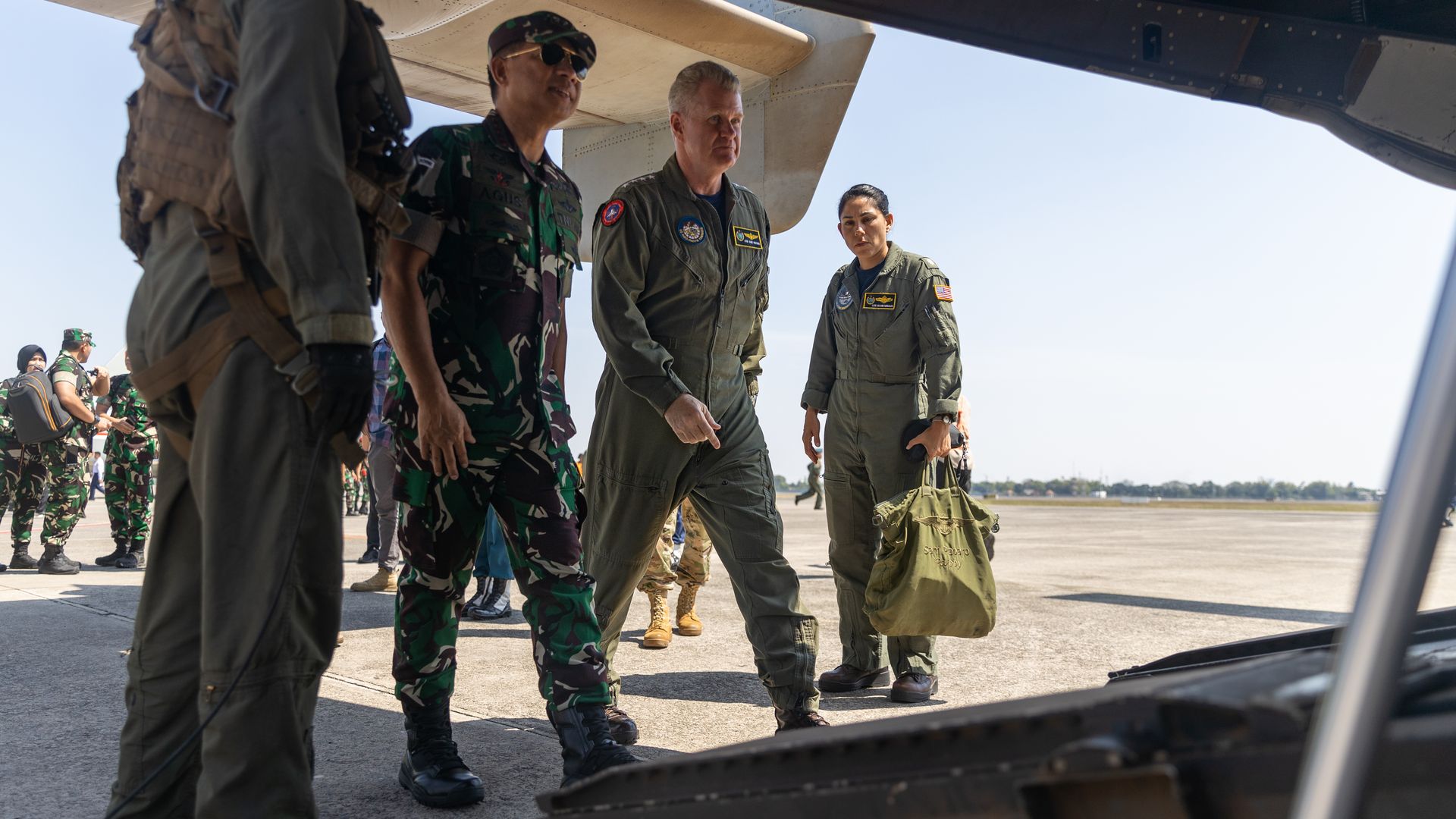
America's No. 1 man in the Indo-Pacific, Navy Adm. Samuel Paparo, minced no words at recent events as he offered two alarming insights.
- First, Russia will likely provide submarine technology to China and missile technology to North Korea. The former jeopardizes "American undersea dominance."
- Second, support provided to Israel and Ukraine is "eating into" some of the most precious U.S. weapons stockpiles, dampening potential U.S. firepower in China's backyard.
Why it matters: This is a damned if you do, damned if you don't moment — a test of American production and planning prowess.
- How the Pentagon juggles competition with Russia and China, counterterrorism crusades in other countries and negotiations back home will have consequences.
By the numbers: The U.S. has provided more than $64 billion in security aid to Ukraine since early 2022.
- That includes three Patriot air defense batteries, 40-plus High Mobility Artillery Rocket Systems, 31 Abrams tanks, more than 300 Bradley infantry fighting vehicles, countless drones and stacks upon stacks of ammunition.
- There are fears aid will dry up in a second Trump administration. That's just two months away.
My thought bubble: Remember when I wrote about global war and its implications? Here's another perfect example.
The bottom line: "The relationships are 19th century," but they concern "21st century weapons," Paparo said over the weekend at the Halifax International Security Forum.
- "This is a dangerous environment, and this is adding complexity to the environment itself."
3. Quick hits
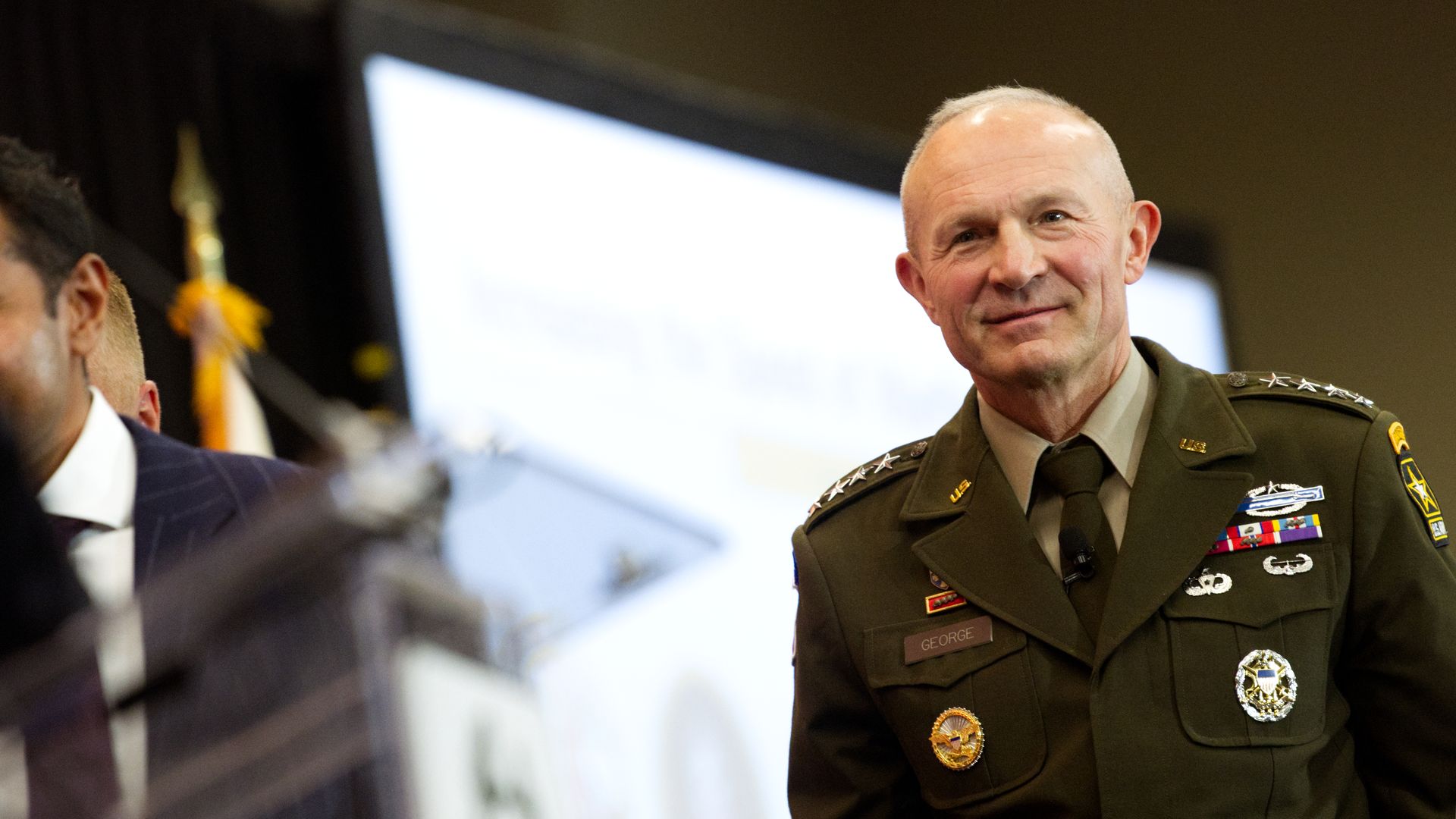
🛡️ The way forward for air base defense is together, not solo, U.S. Army Chief of Staff Gen. Randy George told me during a discussion at the National Security Innovation Forum in Washington.
- Why it matters: Air Force Secretary Frank Kendall at an earlier event said he'd be cool with his service taking on the responsibilities. George recently discussed the matter with his Air Force counterpart, Gen. David Allvin.
- 💭 My thought bubble: There isn't nearly enough overhead defense for everyone everywhere. As George put it: "Everybody's going to have to figure this out."
💻 President-elect Trump is eyeing an AI czar, responsible for federal policy and coordination, at a time when everyone wants in.
- Why it matters: The person will be charged with applying public and private resources to keep the U.S. at the AI forefront, Axios' Mike Allen scooped.
- 💭 My thought bubble: The Defense Department, already with its own AI outpost, will feel the ripple effects.
🇮🇱 State-owned Israel Aerospace Industries is investing in Indian tech startups through a new innovation acceleration program.
- Why it matters: The international effort, which offers funding and mentorship, could churn out advances in autonomy, signal processing, quantum computing and more.
- 💭 My thought bubble: India is drawing a lot of eyes. Its proximity to and beef with China are of note.
✈️ A human aboard an L-39 Albatros and two AI-augmented L-29 Delfin jets together engaged and defeated mock enemy aircraft in tests handled by Lockheed Martin.
- Why it matters: These Skunk Works trials, the first to include a real-time battle manager, push robo-wingmen one step closer to reality.
- 💭 My thought bubble: Can't get enough of human-machine interfaces? Then check out my trip to the U.S.-Mexico border.
4. Axios interview: Andy Lowery

This week's conversation is with Andy Lowery, the chief executive at Epirus.
- We sat down at the company's Navy Yard offices, lit by big windows and decorated with models of weapons and vehicles.
- For lunch? Cava.
Why he matters: The Pentagon is spending $1 billion a year to get directed-energy weapons right.
- While they have yet to be widely adopted, Lowery's company delivered four drone-zapping Leonidas to the U.S. Army earlier this year and is now advocating for additional applications.
- "These drone swarms are getting bigger. Soon we'll see 1,000, and it's going to take a system like ours" to defeat that, Lowery previously told me.
Q: When you hear "future of defense," what comes to mind?
A: Irregular, asymmetrical warfare will become the regular, symmetrical warfare that we'll be fighting. And it's here to stay.
Q: What's the biggest challenge the defense industry faces at the moment? What can be done to alleviate it?
A: The biggest challenge that the defense industry is facing today is that they're built on a foundation of 50 or 60 years of a particular point of view, or point of perspective, of how the world would potentially go if warfare ended up happening.
- We don't have the right muscles today to be a country at war.
- I think it was Shyam from Palantir Technologies that said the DOD would be better off with half the budget being spent in half the time. I completely agree with that.
Q: What region of the world should we be watching? Why?
A: I don't really have a nontraditional answer for that. I think it's China.
- I have, in previous consumer positions, been through different cities in China. I've seen their prowess in consumer electronics, let's call it.
Q: How many emails do you get a day, and how do you deal with them?
A: I probably get around 50 or so legitimate emails that I should answer and respond to today, and I get probably 100 of some very enterprising, ambitious salesmen of various sectors. It could be anything from recruiters to people selling cardboard boxes.
Q: What's your secret to a successful overnight flight?
A: Not to take them. That's probably been said by someone. I used to take those all the time when I was younger.
- It is really, really, really tough. But if you get used to sleeping on planes, you can pull it off. If you're going to do it, make sure you schedule yourself two or three days on the backside and recover.
Q: What's a piece of gear or tech you can't go without?
A: I don't like gear or tech. I have no watch. Less is more.
Q: What advice would you give your younger self?
A: Learn to motivate yourself without using fear.
5. Check this out

It's the post seen 'round the world. Well, at least the defense world.
Why it matters: Elon Musk, President-elect Trump's de facto tech whisperer, went on a tear about the F-35.
- Let's "stop the worst military value for money in history that is the F-35 program!" he wrote in another post.
Zoom in: The prized aircraft is pricey, yes. But it can do a ton of things drones can't.
- This doesn't have to be one or the other; in fact, they can work together.
My thought bubble: Treating the F-35 as a punching bag to get Department of Government Efficiency fans frothing helps no one.
- And sidenote: China would love if the U.S. ditched this jet.
Shoutout to Nicholas Johnston for editing and Matt Piper for copy editing.
👋🏼 Thanks, as always, for reading and sharing. Tell your friends to subscribe, here.
Sign up for Axios Future of Defense