In remote Texas, Anduril probes future of drone warfare

Add Axios as your preferred source to
see more of our stories on Google.
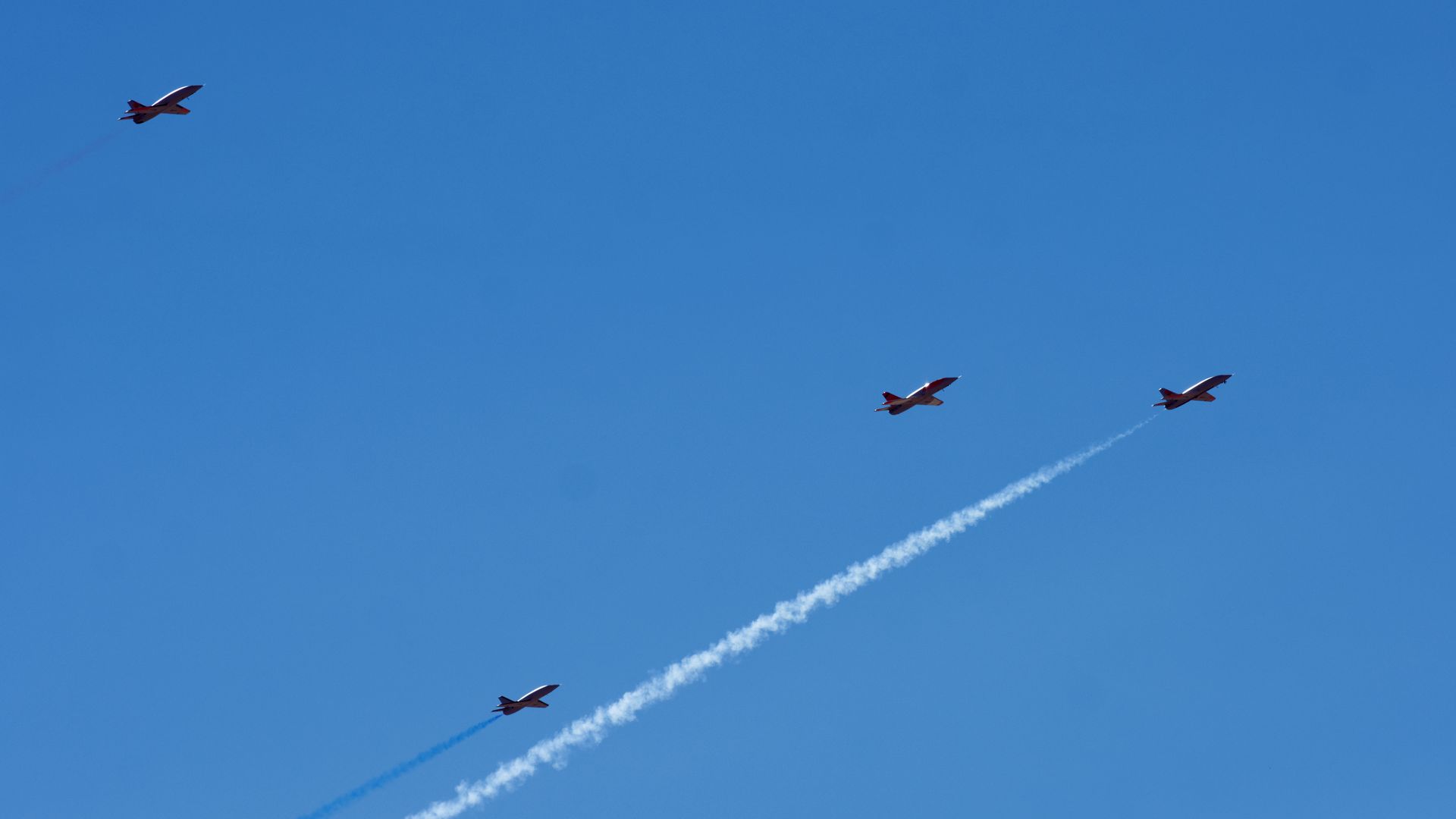
A quartet of "clay pigeon jets" streaks over the Anduril Texas Test Site. Photo: Colin Demarest/Axios
A global, high-stakes race is on to figure out not just how to build affordable autonomous weapons, but also invent ways they can fight together.
Why it matters: Today, individual drones are a tool for troops. Tomorrow, collaborating swarms will define conflict, turning battlefields into an unmanned "hellscape," in the words of America's top leader in the Indo-Pacific.
The big picture: From the Pentagon's $1 billion Replicator bet to the Air Force's collaborative combat aircraft, the Army's human-machine integrated formations and the Navy's hybrid fleet, big bets are being made.
- Mark Milley, the former head of the Joint Chiefs of Staff, in July told Axios one-third of the U.S. military will be robotic in the next 10-15 years.
- Meanwhile, China dominates the global drone market, Iran feeds Russia and extremist cells its increasingly popular unmanned arsenal, and North Korea constructs clones of America's greatest hits.
Driving the news: To get a glimpse of this future, Axios visited the Anduril Texas Test Site, a brew of Middle East forward-operating base and Burning Man geekdom near the U.S.-Mexico border.
At the dusty, remote airstrip, Anduril showed how a single person familiar with Siri and armed with a laptop could govern a clutch of jet-powered drones.
- Using the company's Lattice for Mission Autonomy software, which looks like a fancy flight tracker, the commander, "Kobe," oversaw a team of midsize drones as they took off, circled up, patrolled the area and downed a simulated enemy aircraft.
- The drones sought permission before making consequential moves, like intercepting the incoming plane and launching what was described as a "magic missile." (Nothing actually went boom.)
- During a Blue Angels-style flyby, the drones bunched together with just 20 feet of separation. Their callsign was "Mustang," a callback to the World War II-era P-51 the U.S. produced en masse.
Between the lines: The event offered a peek at how Anduril is thinking about airpower, autonomy and their digital interstice amid a competition to build the Air Force's fleet of robo-wingmen
- The service selected Anduril and General Atomics to develop CCA prototypes in April.
- Air Force Secretary Frank Kendall said both "will be flying in the near future, and at least one of them will be in our inventory in meaningful numbers in the next few years."
- Different loadouts are envisioned for different tasks: spying from afar, jamming signals, drawing fire as decoys and striking targets with their own munitions.
What they're saying: "What makes a good wingman? I want to trust them. I want them to be predictable," said Kevin Chlan, Anduril's senior director of air dominance and strike.
- "We get bored. We need a drink, a snack, go to the restroom. Whatever," added Chlan, a former fighter pilot. "The robots don't have any of that."
- The company declined to discuss government contracts during the trip.
Zoom in: To get air autonomy right, Anduril launched an internal campaign dubbed Hyperion, after the Greek titan. More than 200 live flights have been conducted.
- "The reason we're here and we live-flight test is because it allows us to do it faster," said Diem Salmon, vice president of air dominance and strike. "Doing it in simulation will get you very little in the long run, especially as you start moving toward platform integration."
Yes, but: While the routes were not planned and the showcase resembled real-world operations, it lacked the electronic harassment and general chaos of war.
- A ferocious fight over the electromagnetic spectrum would erupt in any conflict with China or Russia.
Full disclosure: Anduril flew a half-dozen reporters down for a day of demos. The 16-hour roundtrip included a stopover in Dallas and some Whataburger.
