Axios Future of Defense

April 29, 2026

Can confirm, it's Wednesday.
- I'm moderating a future-of-war panel at the Milken Institute Global Conference early next week.
- Beverly Hills? That's ... where I want ... to be!
🇦🇺 Situational awareness: Australia said it's building out a second long-range fires regiment and acquiring Lockheed Martin-made HIMARS launchers and PrSM missiles. The government pegged the spending at $1.65 billion.
Get reading: Billions for battleships, minesweeping monkeys and Stingray's first flight.
Today's newsletter is 1,855 words, a 7-minute read.
1 big thing: Call in the cavalry
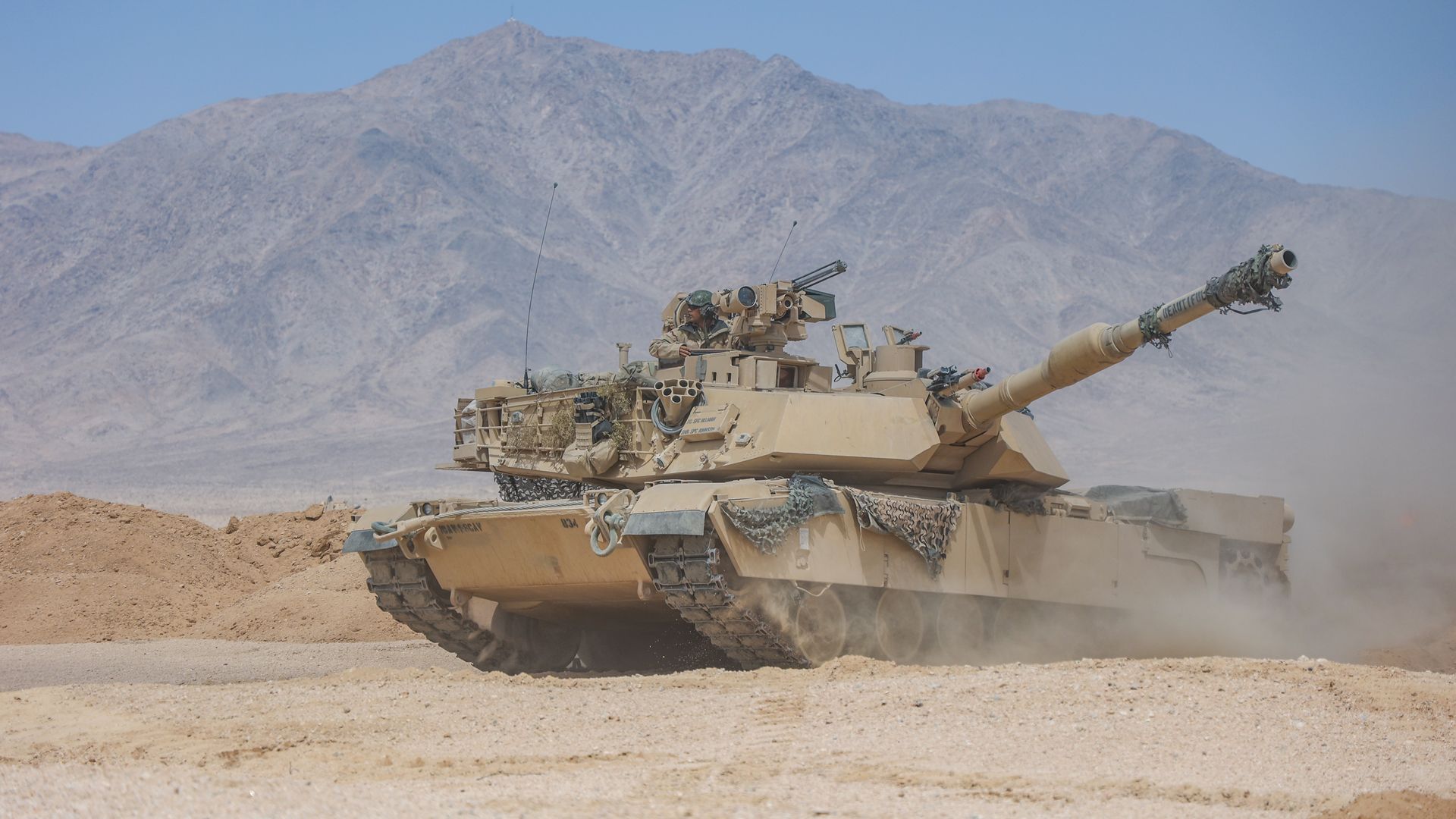
Soldiers with the 1st Cavalry Division will this fall get their hands on two of the U.S. Army's most anticipated machines: the XM30 combat vehicle and the M1E3 Abrams tank.
Why it matters: The Russia-Ukraine conflict has shown the grinding land wars of the tank's heyday are still with us in the 21st century — but also that drones are apex predators.
- Both the XM30 and M1E3 are years in the making, with lineages predating today's bloody battles.
- The Texas-based 1st Cavalry is helping plot the future of armored warfare amid this industrial and tactical upheaval.
Driving the news: "There are a lot of folks that will be like, 'Hey, the tank is dead. What good is the tank on the modern battlefield?' We're paying attention to this," Maj. Gen. Thomas Feltey, the 1st Cavalry commander, told a small group of reporters this month.
- "We've got to be able to break into no-man's land," he said, describing the deadly wastes separating entrenched Ukrainian and Russian positions.
- Speaking ahead of the prototype XM30 and M1E3 trials and after experiments with autonomous breaching alongside the 36th Engineer Brigade, Feltey said there is a need for a "new battlefield framework."
- "The problem we're trying to solve is: How do we restore mobility to the armored brigade combat team? How do we stay on the offense?"
The latest: Two platoons will receive the XM30. One platoon will get the M1E3. Around March 2027, Feltey said, the 1st Cavalry will be "using, shooting, moving and communicating" with them at the National Training Center in California.
- Trainers should arrive as soon as this summer.
- Soldier feedback will inform tweaks to both platforms.
Zoom in: The XM30 succeeds the Bradley. The M1E3 succeeds older Abrams, including the M1A2 SEPv3.
- Together, they provide "enhanced mobility" and signal "a major shift forward, in terms of technology," Feltey said. "They're not just incremental improvements."
- The M1E3, for example, is built with commercial parts in mind. It features hybrid propulsion that supports silent watch, modular sensors to contend with small drones and other incoming fire, and an auto-loader to pack a streamlined punch.
- "Everyone knows armor units — tanks — are thirsty. We use a lot of gas," Feltey said. "With these systems, we think we can halve our sustainment requirements because they're so fuel efficient."
Zoom out: The ubiquity of drones and cheap, trench-rigged munitions in Eastern Europe has forced a global rework of buying habits, training regimens and medicine.
- "There's been over a million infantry casualties in the last four years," Feltey said, "and nobody's saying infantry is obsolete just yet."
- Fighters are pimping out tanks and other armored vehicles for the circumstances, bolting on cages and hedgehog-like whips and spines.
What they're saying: "The M1 Abrams is already the most badass tank in the world — but it's getting better," Alex Miller, the Army's chief technology officer, told me.
Follow the money: The Trump administration's fiscal 2027 budget request includes $547 million to buy more than a dozen XM30s.
More from Axios:
Inside the 82nd Airborne's machine-fueled fight
Army seeks "65-year change" in weapons trying and buying
Saudi Arabia wants to buy nearly 300 U.S. tanks, White House says
2. Exclusive: We have lasers at home

Aurelius Systems is launching a manufacturing division to domestically produce industrial and defense lasers as well as their key components.
Why it matters: Directed energy weapons rely on precious pieces and materials, and supply chain concerns are top of mind following COVID-era disruptions and China's more recent throttling of critical minerals.
- "We barely have any facilities that are producing in the country — at least anything in volume," Aurelius CEO Michael LaFramboise told me.
- "The U.S. defense industrial complex has done a good job of keeping scientists and really highly educated engineers employed," he added. "We just didn't do it with the industrial space, our capacity to produce."
Driving the news: The division, announced today, will pump out high-power fiber laser source modules and precision optical assemblies.
- It will be about six months until parts roll off the line, however.
Zoom out: The Trump administration's fiscal 2027 budget blueprint included more than $2 billion for development and testing of directed-energy systems.
- "The Pentagon budget's amazing," LaFramboise said.
- "It's pretty clear that directed energy is going to be a significant part of our defense industry," he added. "I think the form that it takes and the volume that it takes are still to be determined. But, without a doubt, we don't make enough of the sources."
Context: Aurelius, based in California, makes the Archimedes laser turret. The startup raised $10 million in September.
My thought bubble: This is Aurelius becoming a one-stop shop.
Go deeper: Navy chief wants big lasers on warships ASAP
3. Big battleship bucks

The first Trump-class battleship will cost north of $17 billion, with three of them totaling more than $43 billion, according to budget documents.
Why it matters: We're finally learning a bit more about the battleship project, unveiled in December as part of the administration's Golden Fleet.
- Also included in that initiative is the future frigate, based on HII's far-more defined National Security Cutter.
Driving the news: John Phelan, who up until last week was the U.S. Navy secretary, told reporters the dollar figure is an "early, initial estimate."
- "We'll see where we really settle down, as we get through that and start to rationalize some of the costs," he said on the sidelines of the Sea-Air-Space conference in Maryland.
- "We've been talking to two different vendors ... and then it'll be a function of how we get through that design process with them and then their capacity in their yards."
Friction point: The U.S. struggles to build and maintain its current warships. Take, for example, the USS Boise, which the Navy pulled the plug on after it sat pier-side for about a decade.
- Additional demand could tax public and private yards.
- "We are looking at a couple of different ways to relieve some of the pressure that might put on the industrial base," Phelan said. "I think we have to still define that a little bit more."
The intrigue: The Navy is still debating whether to make the battleship nuclear powered.
Zoom in: Preliminary specs published by the service show the battleship armed to the teeth — laser turrets, a railgun, as well as room for hypersonic and nuclear weapons — and manned by at least 650 sailors.
What's next: Construction is expected in 2028.
Go deeper: Pete Hegseth fires U.S. Navy Secretary John Phelan
4. ICYMI: A meddling monkey

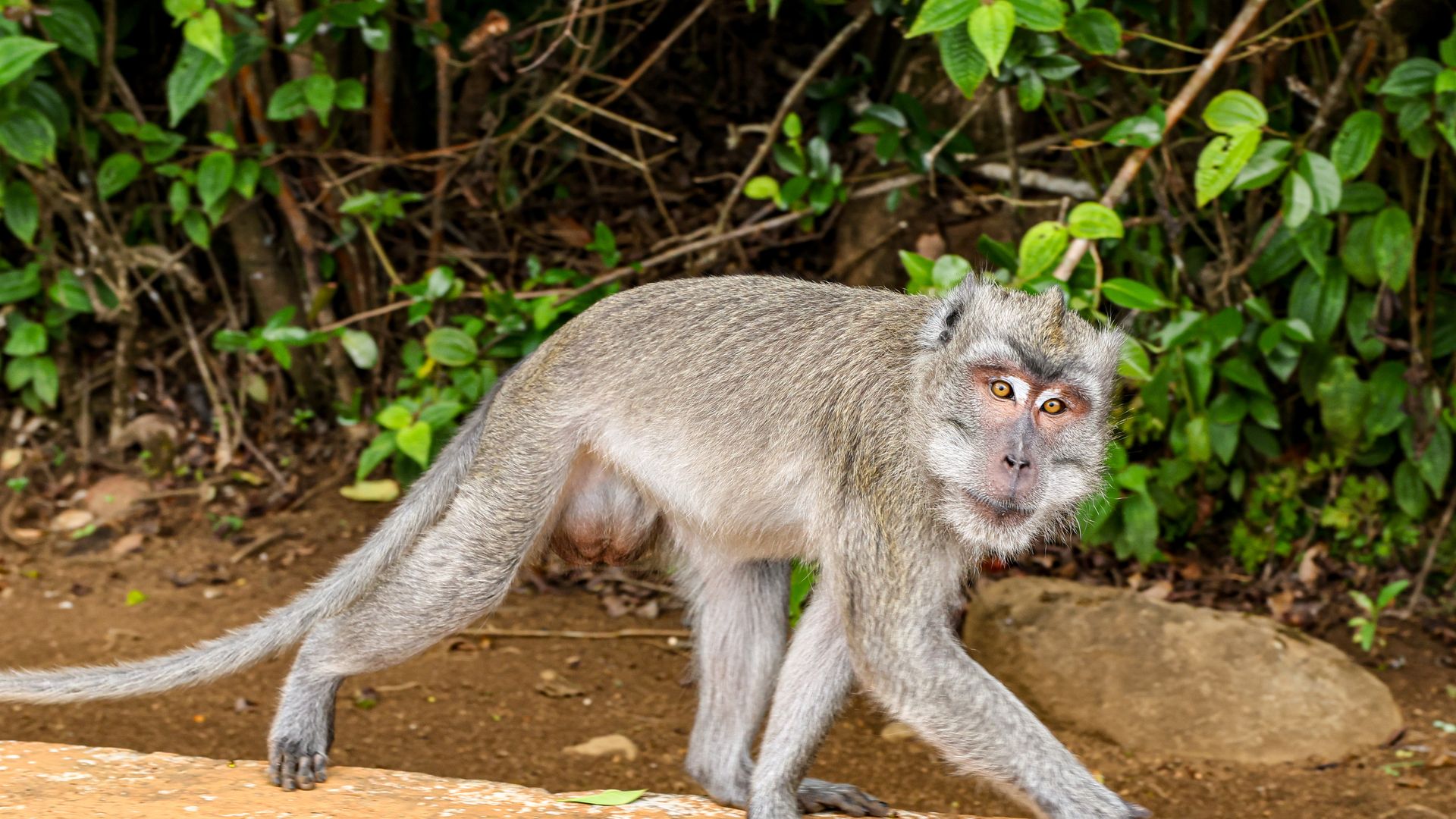
A U.S. Navy sailor assigned to a minesweeping ship headed to the Strait of Hormuz was medically evacuated to his home port after he was scratched by an Asian monkey while ashore in Thailand, officials said.
Why it matters: The Navy reported the incident did not delay the USS Chief's mission and that the sailor is OK, but officials said the attack is a reminder that military missions face unexpected troubles and disruptions that are hard to war-game.
- "Weird stuff happens," one military official said. "This was definitely an unknown unknown."
Zoom in: The Navy dispatched the Chief and the USS Pioneer in mid-April from Southeast Asia to hunt and sweep for mines that Iran laid in and around the Strait of Hormuz.
- During a stopover in Phuket, Thailand, a Navy electronics technician — whom officials did not identify — encountered the monkey on shore and was scratched. It's unclear what kind of monkey was involved, but long-tailed macaques are common in Thailand and can be particularly aggressive.
- To ensure he had adequate medical care, the sailor was evacuated to the Chief's forward base in Sasebo, Japan.
- Word of the incident spread quickly in the Navy's tight-knit minesweeping community.
Zoom out: The Strait of Hormuz, through which about 20% of the global oil supply usually passes during peacetime, has remained effectively closed because of the threat posed by Iran's mines and pirate-style attacks from its weaponized go-fast boats.
5. Quick hits
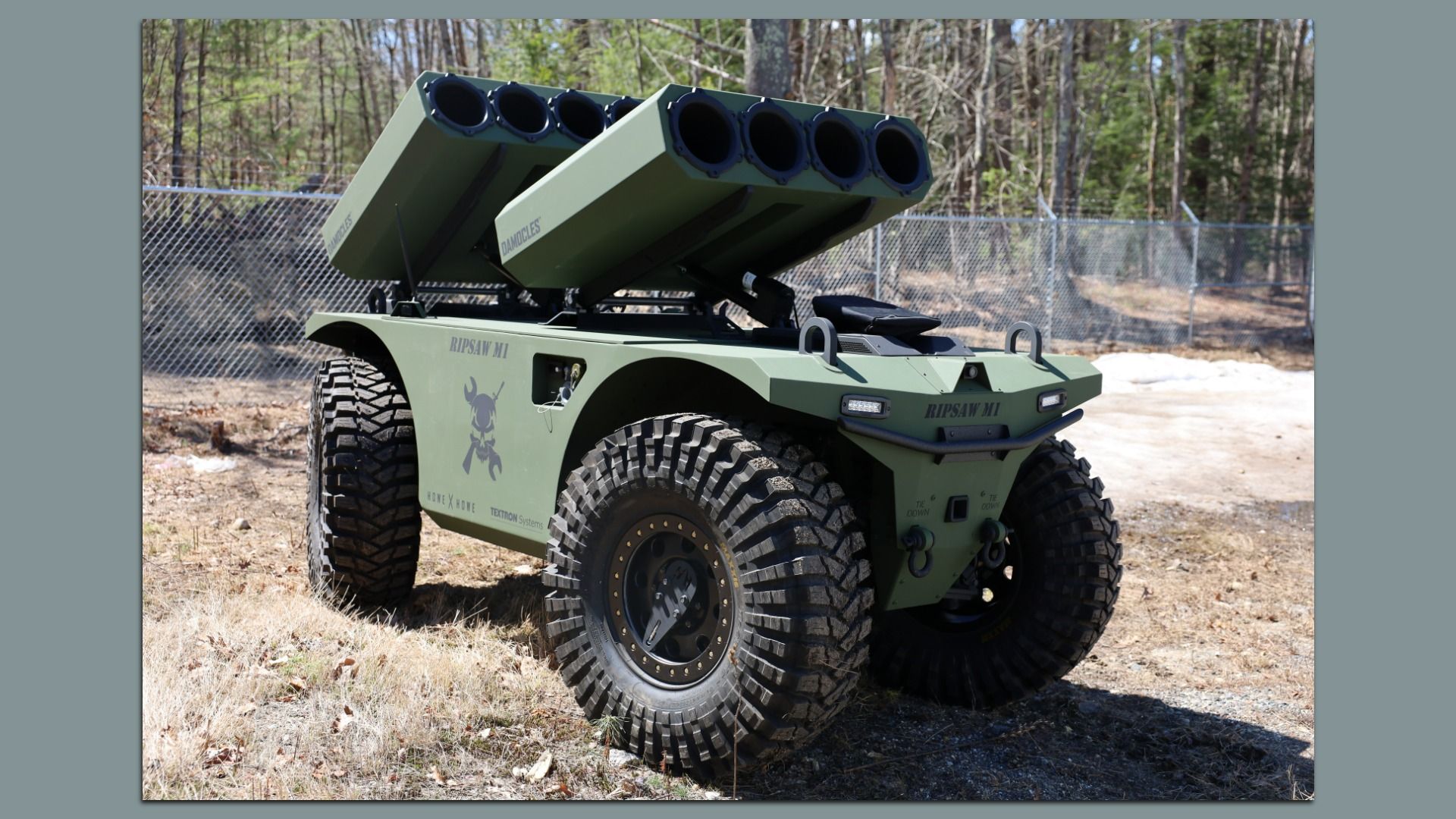
🤖 Textron Systems debuted the Ripsaw M1 unmanned ground vehicle at the Modern Day Marine conference in Washington. It can conduct counter-drone and scouting tasks, among others, according to the company.
- Why it matters: The Ripsaw is pitched as a "force multiplier" for the Advanced Reconnaissance Vehicle and the Amphibious Combat Vehicle.
- 💭 My thought bubble: You don't often hear about robotics for the Marine Corps.
💳 Three big-money investments emerged this week: True Anomaly's $650 million Series D, Firestorm Labs' $82 million Series B, and Scout AI's $100 million Series A.
- Why it matters: Forget the cash — consider the applications. Space and missile defense. Drones and contested logistics. Robotics and autonomy.
- 💭 My thought bubble: I've written about all these folks in the past. Here's True. Here's Firestorm. And here's Scout.
🪽 Boeing's MQ-25A Stingray flew for the first time. The two-hour flight demonstrated the tanker's ability to autonomously taxi, take off, fly, land and respond to commands, according to the company.
- Why it matters: The flight is "a landmark achievement for the Navy-Boeing team and a critical step toward the future of the carrier air wing," Rear Adm. Tony Rossi said in a statement.
- 💭 My thought bubble: I saw it first on The Aviationist.
🌎 U.S. Southern Command is building out an autonomous warfare organization that will, in its infancy, coordinate with the Pentagon's Defense Autonomous Warfare Group.
- Why it matters: "Our geographic area of responsibility has a wide range of conditions, varied terrain, and diverse operational environments that make it an ideal setting in which to innovate," SOUTHCOM boss Gen. Francis Donovan said in a statement.
- 💭 My thought bubble: The U.S. spent at least $4.7 billion on the Southern Spear and Absolute Resolve operations between Aug. 1, 2025, and March 31, 2026, according to a new Costs of War report.
6. Check this out

I chatted with Robert Lightfoot, president of Lockheed Martin Space, at an Axios event in Alabama a few days ago.
- Here's what stood out to me:
🌠 Lockheed still plans to conduct an on-orbit demonstration of space-based interceptors by 2028, as part of the Pentagon's Golden Dome project.
🎯 U.S. Space Command's move to Huntsville underscores the city's role as a "space hub," Lightfoot said. "If you're going into the space industry, and you want to work somewhere, why wouldn't you come here?"
✖️ Space race may not be the best way to describe the ongoing international competition. Consider America's existing edge — and the measures needed to maintain it.
🌎 The Artemis II mission "put a human face" on science and space exploration, Lightfoot said. "You put humans in the loop somewhere, and it changes the dynamic." Lockheed built the Orion spacecraft.
Go deeper: Global powers brace for space warfare
Shoutout to Dave Lawler for editing and Matt Piper for copy editing.
👋🏼 Thanks, as always, for reading and sharing. Tell your friends to subscribe here.
Sign up for Axios Future of Defense