Exclusive: Inside Firestorm Labs, where deadly drones are printed

Add Axios as your preferred source to
see more of our stories on Google.
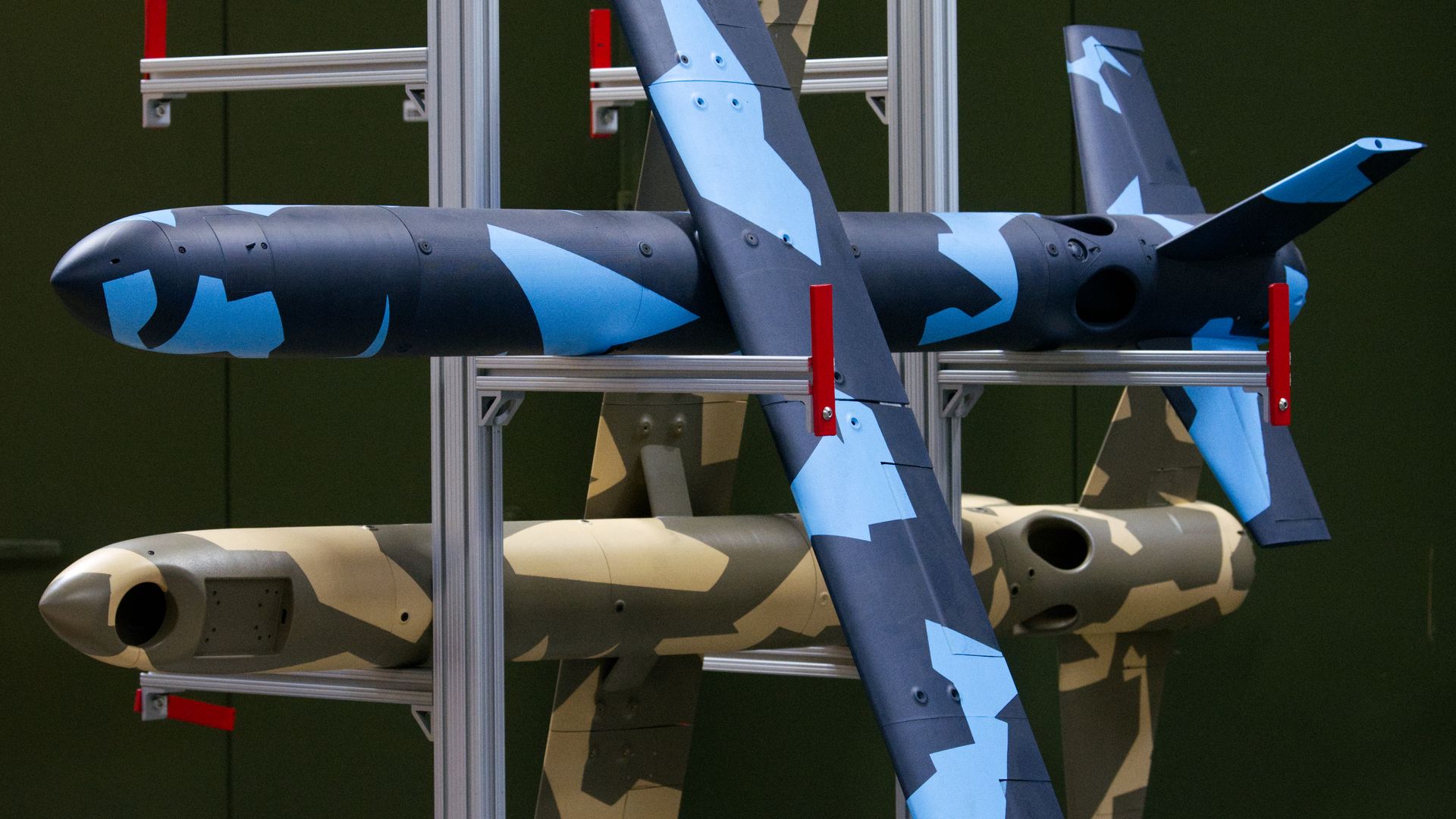
Tempest drones have a 7-foot wingspan. Pictured are a pair at Firestorm Labs. Photo: Colin Demarest/Axios
Firestorm Labs is 3D printing drones in spaces tighter than the average Washington, D.C., apartment.
Why it matters: Additive manufacturing is incredibly attractive at a time when capacity — so often held hostage by specialty parts, single producers and backorders — is king.
- Supplies win wars. It's a numbers game, and winners have size and speed. (There's a reason why folks are worried about China's shipbuilding cadence.)
Driving the news: Firestorm CEO Dan Magy gave Axios an inside look at the company's facilities that skirt Marine Corps Air Station Miramar. The roads nearby were lined with cactus and palms; an Osprey flew overhead.
- Magy showed Axios how the drones are made in a matter of hours, how finished sections snap together by hand and the assembly-line guts of xCell, the company's air-liftable containers.
- "We can go build in a jungle," he said, "or we can just build in a factory in San Diego or Texas or Ohio."
Zoom out: The California company isn't the first to 3D print for militaries. It won't be the last, either.
- GE Aerospace's powerful T901 engine, which just completed ground runs aboard a Black Hawk helicopter, has 11 printed parts. That includes a front frame that consolidates 200 pieces.
- Northrop Grumman used additive manufacturing for the experimental Model 437 aircraft, in partnership with Scaled Composites. The company boasts flying such parts since 2005.
- HII's Newport News Shipbuilding and General Dynamics Electric Boat partnered in 2023 to push 3D printing into the nuclear-powered submarine sector. The U.S. Navy has said work at the Additive Manufacturing Center of Excellence in Virginia is vital to its shipbuilding plans.
- The 101st Airborne Division at its Fort Campbell EagleWerx facility produced a mortar sight to improve direct-fire accuracy and user safety. (The Army in 2019 publicly recounted an 81 mm mortar mishap that split a soldier's hand "like a hoagie sandwich bun.")
Zoom in: Firestorm will soon move into a third warehouse, after outgrowing thousands of square feet elsewhere.
- The company raised millions of dollars and got buy-in from Lockheed Martin's investment arm.
- It also inked a $100 million contract with the Air Force, which is interested in its reconfigurable Tempest drone and manufacturing methods. A second aircraft, El Niño, is in the works.
- The deal, Magy said, "makes everything easier" for the "lean and mean" crew of mostly engineers. It ranked 57th in the Silicon Valley Defense Group's NATSEC100 report published over the summer.
State of play: Unmanned aircraft played a critical role in the global war on terror, but it is in Eastern Europe where Pandora's box opened. From ambushes to surveillance to defoliation to airstrikes, there's no going back.
- Firestorm has worked with Ukrainian troops. Magy wouldn't divulge much else.
What we're watching: How the U.S. military's appetite for weapons morphs over time, and how players like Firestorm contend. Wishy-washy thinking inside the government can doom small companies.
- The Pentagon not so long ago favored expensive and exquisite over cheap and plentiful.
- But three, four, five years is too long to wait when tech leaps ahead every other month. (This thinking is at the heart of the Army's "transforming in contact" initiative.)
The bottom line: "We believe that decentralized manufacturing is how we're going to win," Magy said.
