Axios Future of Defense

January 28, 2026

Morning, everyone. I won't say "good" because it's like 7 degrees out.
- In other news: I'm escaping to Las Vegas, San Diego and San Francisco next month. Taking any and all bar and restaurant recommendations!
⏰ Situational awareness: The Bulletin of the Atomic Scientists yesterday set the Doomsday Clock to 85 seconds to midnight, the closest it's ever been to metaphorical human extinction. "Catastrophic risks are on the rise, cooperation is on the decline and we are running out of time," said Bulletin president Alexandra Bell.
What's up: Project NYX progress, a tritium record-breaker and Applied Intuition's Golden Dome play.
Today's newsletter is 2,086 words, an 8-minute read.
1 big thing: National Defense Surprise
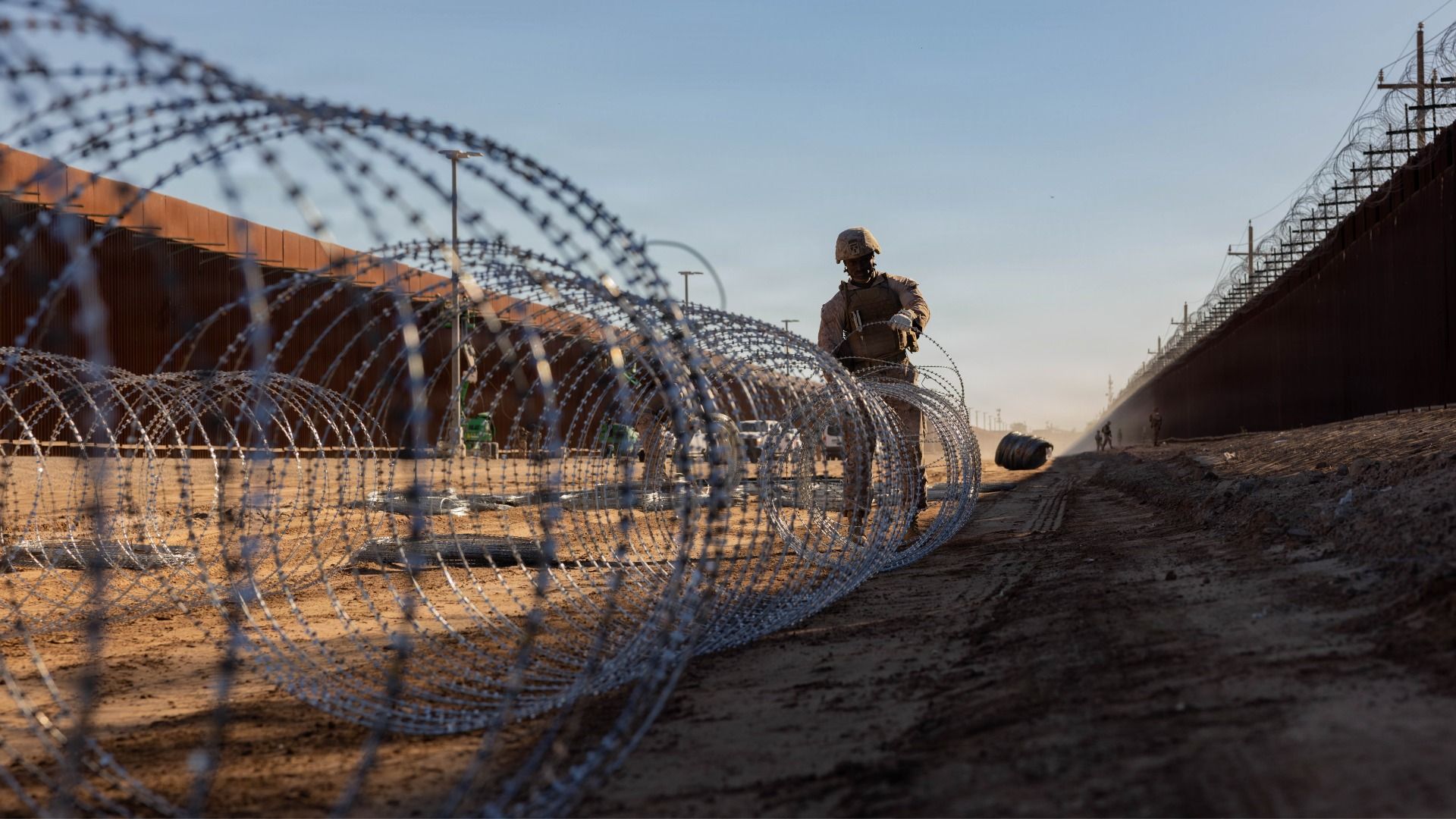
The Pentagon published its premier national-security blueprint on Friday night with little warning or fanfare, ahead of the heftiest snowstorm Washington had seen in years.
The big picture: The unclassified National Defense Strategy, some two dozen pages, is the Donroe Doctrine made manifest. The "rules-based international order" is dismissed as an "abstraction," and the emphasis is on hard power close to home.
- Inside the document, homeland defense is often perched above or before China and Russia, typically considered top threats.
- "For too long, the U.S. government neglected — even rejected — putting Americans and their concrete interests first," it begins.
- "This strategy is fundamentally different from the grandiose strategies of the past post–Cold War administrations, untethered as they were from a concrete focus on Americans' practical interests."
Here are some of the most eyebrow-raising takes in the strategy:
⛔ It denies isolationism while also promising that the military will no longer be "distracted by interventionism, endless wars, regime change and nation building."
- It's similar to the pledge Defense Secretary Pete Hegseth made at the Reagan National Defense Forum in December.
🇨🇳 It cites in one sentence the "speed, scale and quality of China's historic military buildup" and in the next notes the goal is "not to dominate China; nor is it to strangle or humiliate them." Another promises robust defenses along the first island chain, including Japan, Taiwan and the Philippines.
- Beijing is pressuring Taipei as 2027 nears. Its Justice Mission drills, involving warships, warplanes and more, followed news of an $11.1 billion arms package.
🏭 It warns that Russia, despite its demographic and economic struggles, retains "deep reservoirs" of military and industrial power.
- Moscow's invasion of Eastern Europe grinds on, buttressed by China, Iran and North Korea. European officials are rightfully worried Vladimir Putin will not stop at the edges of Ukraine.
🇰🇷 It alludes to a change in posture on the Korean Peninsula, on the heels of multiple reports that the U.S. would withdraw some of its forces there.
- South Korea, it states, "is capable of taking primary responsibility for deterring North Korea with critical but more limited U.S. support." Expect change.
➡️ It makes clear that American access to the Panama Canal and Greenland is paramount.
- Canada, it adds, can play a vital role in overhead and undersea defense. President Trump at Davos this month said the country gets "a lot of freebies" from Washington and should show more gratitude.
💣 It warns of a potential war across multiple theaters against multiple aggressors. It dubs it the "simultaneity problem."
- The bipartisan Commission on the National Defense Strategy in July 2024 warned the U.S. is unprepared for such a bloody, widespread fight.
🌍 It pins Islamic terrorism and its tendrils as the top concern in Africa.
- American troops have repeatedly bombed the Horn of Africa, targeting ISIS-Somalia and al-Shabab. However, U.S. presence in the Sahel has decreased significantly in recent years.
🏅 It praises President Trump for avoiding "a world war just a year ago" and for leading the country into a "new golden age."
- Everything is golden in Trump 2.0. The domes. The fleets. The visas.
Between the lines: Past administrations have front-run such strategy documents with background briefings for reporters and think tankers to shape the debate.
- Quietly publishing it when D.C.'s attention was elsewhere is typical of this Pentagon's bunker mentality.
Go deeper: Trump challenges where America fights and how it arms itself
2. Next up for NYX
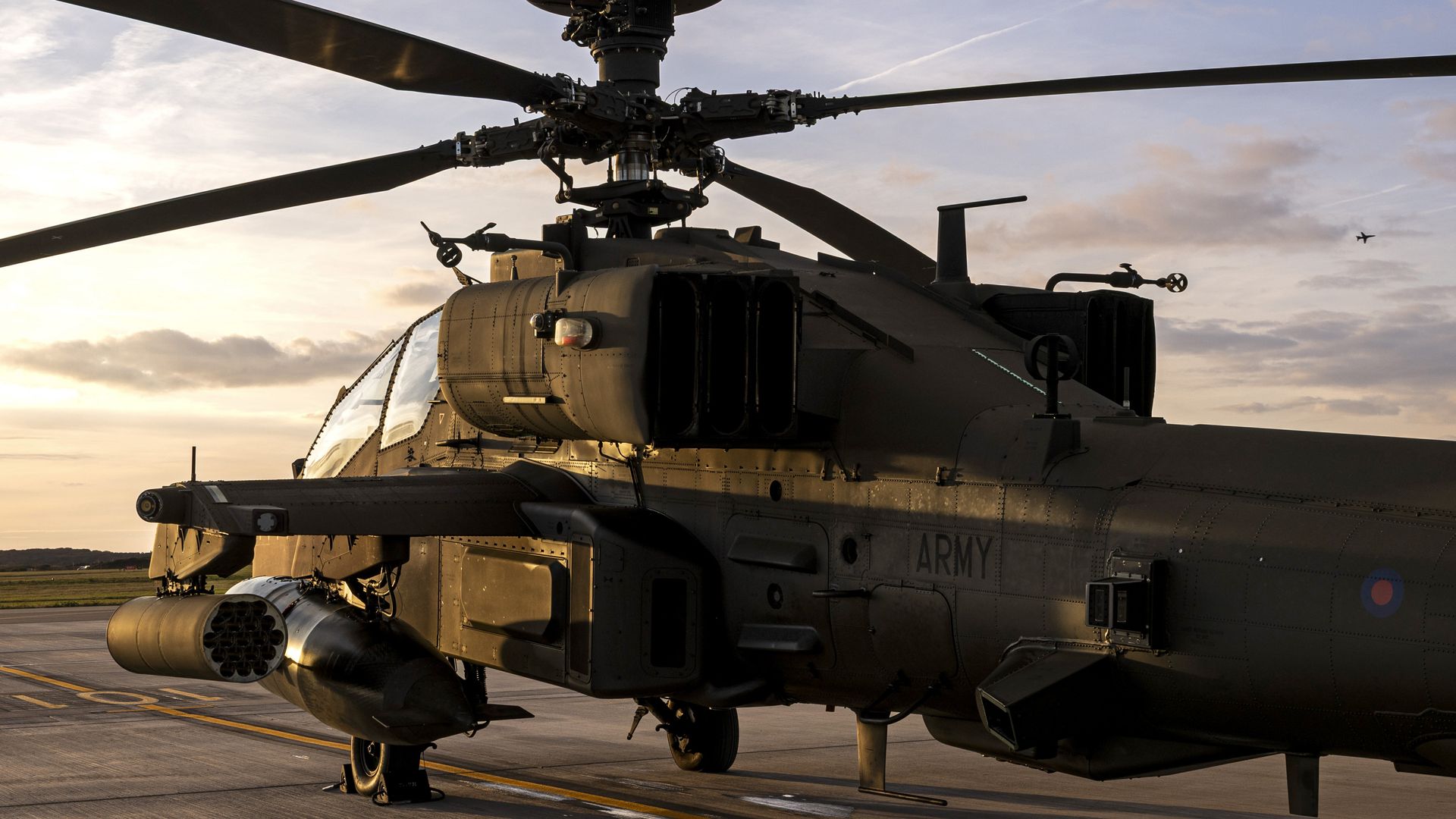
The U.K. Defense Ministry shortlisted seven companies for its pursuit of drones designed to fly alongside Apache attack helicopters.
Why it matters: Everyone wants a robo-wingman. And this could be realized around 2030.
- But rotorcraft are tricky — some would say outdated. Existing American collaborative combat aircraft and British StormShroud projects are tied to F-35s and other fighters.
Driving the news: The Defense Ministry on Jan. 24 announced Anduril Industries, BAE Systems, Leonardo, Lockheed Martin UK, Syos, Tekever and Thales were progressing through Project NYX, as it's known, and would present their designs imminently.
Context: The drones are expected to extend the reach of troops and keep them out of harm's way by collecting intelligence, conducting electronic warfare, aiding in targeting and drawing fire.
The intrigue: The potential supplier pool will again be narrowed in March, when research-and-development contracts are expected.
- "Project NYX represents the cutting edge of the Defence Industrial Strategy, working with leading British industry partners to ensure the U.K. remains at the forefront of autonomous military technology," Luke Pollard, minister for defense readiness and industry, said in a statement.
Go deeper: Russia-Ukraine war has forever changed combat, says U.K. armed forces minister
3. Tritium galore

The National Nuclear Security Administration reported a record number of tritium extractions during fiscal years 2025 and 2026.
The big picture: Tritium, an isotope of hydrogen, boosts the yield of nuclear weapons. But it quickly decays, requiring repeat harvests.
Driving the news: Thirteen tritium extractions were conducted in nine months at the Savannah River Site in South Carolina, according to the NNSA.
- That surpasses a previous benchmark of eight extractions in 12 months during fiscal years 2022 and 2023.
What they're saying: "What I think it shows is that Savannah River has been, over the past several years, in an upswing on tritium production, and that is really good for" the nuclear arsenal, Frank Rose, a former NNSA deputy and assistant secretary for arms control, verification and compliance, told me.
- "If you're going to move forward with a larger stockpile, you're going to need more tritium."
Zoom out: The National Defense Strategy commits to upgraded armaments "amidst the changing global nuclear landscape."
More from Axios:
Trump muddles nuke-testing message
Introducing Trump's puzzling nuclear-armed battleship
Energy Department orders "special" investigation of plutonium pit problems
4. Exclusive: Grid grabs $20 million

Grid Aero raised $20 million and will use the money to build more cargo-hauling drones and refine the autonomy that makes them tick, chief executive Arthur Dubois told me.
The big picture: The startup exited stealth a half-year ago — not with an explosives-laden quadcopter or flashy missile, but with Lifter-Lite, an aircraft it thinks can assuage the pains of contested logistics.
- "We've been testing almost every day; we've done a good amount of ground testing now," Dubois said. "We are aggressively working through our test program in order to build confidence in our systems and software in preparation for the first flight."
Follow the money: The Series A was led by Bison Ventures and Geodesic Capital. Stony Lonesome Group and Alumni Ventures, among others, participated.
- Grid's $6 million seed round was led by Ubiquity Ventures and Calibrate Ventures.
Zoom in: The Pentagon's chief technology officer last year named contested logistics and applied artificial intelligence as "critical technology areas."
5. Quick hits

🇦🇺 The first MC-55A Peregrine aircraft, kitted out by L3Harris Technologies, arrived at RAAF Base Edinburgh, Australia, this month. The intelligence, surveillance, reconnaissance and electronic warfare jet is based on the Gulfstream G550.
- Why it matters: Its introduction "represents a significant step forward in strengthening Australia's ability to monitor and protect its strategic interests, including key maritime approaches," according to Richard Marles, the deputy prime minister.
- 💭 My thought bubble: Read this.
📈 Northwood Space raised $100 million. Washington Harbour Partners led the Series B. (Its $30 million Series A was announced in April.)
- Why it matters: This latest raise coincides with news of a nearly $50 million U.S. Space Force contract.
- 💭 My thought bubble: As I wrote last week: The urgency and opportunity of space are felt by America's industrial players and their financiers.
💽 Applied Intuition is working with the Energy Department's Oak Ridge National Laboratory to model and simulate Golden Dome-style countermeasures against missiles, drones and more.
- Why it matters: "Golden Dome for America requires a fundamental shift in how the U.S. designs and validates missile defense," Applied CEO Qasar Younis said in a statement.
- 💭 My thought bubble: Don't sleep on DOE. They do some very cool — and consequential — national security work.
💥 BAE Systems won a $473 million contract to produce 40 more M109A7 Paladin self-propelled howitzer sets, which include the M992A3 ammo-loading vehicle. The M109A7 is built in Pennsylvania, Oklahoma and Alabama.
- Why it matters: It's big money for some big guns.
- 💭 My thought bubble: Of note, it's the first award under a five-year deal.
6. Axios interview: Dino Mavrookas

This week's conversation is with Dino Mavrookas, the chief executive at Saronic.
- We first met in Austin in 2024, as the drone-boat maker unveiled its 24-foot Corsair. (The barbecue was worth the trip alone.)
Why he matters: Mavrookas started his career in the U.S. Navy and spent years with SEAL Team Six. He has finance and investing experience, as well.
- The Navy in December revealed a $392 million deal with his company.
Q: When you hear "future of defense," what comes to mind?
A: Autonomy. It's really manned and unmanned teaming. And it's: How do you use AI, across multiple systems, to increase the efficiency of people on the battlefield and keep people safe?
Q: When will wars be waged solely by robots?
A: I don't think ever, and here's why.
- At the end of the day, for somebody to win a conflict, you have to stand on a territory and occupy land. If China is going to invade Taiwan, whether they do that 100% with robots or not, eventually they're going to have to occupy that territory, assuming victory.
- So at some point in time, people are going to have to be involved. The question is: When are people involved?
Q: What's a national security trend we are not paying enough attention to?
A: I'm actually very concerned about the fragile nature of our power grid. I think if we lose electricity for more than 24 hours nationwide, chaos would break out. I'm very, very concerned about that.
Q: How many emails do you get a day, and how do you deal with them?
A: I probably get 300-400 emails a day. I deal with them through aggressive deletion and a wildly complex foldering process.
- I sort all of my emails, and I literally work toward zero inbox. I very rarely get there, but that's my goal.
Q: What time do you wake up? What does the morning routine look like?
A: When I'm home in Austin, I'm up every morning at 5:45 — waking my kids up, making them breakfast. Then I'll get a quick workout in. My wife actually got me a cold plunge. So I start every morning with a cold plunge. I'll do an hourlong workout, and then I'm in the office by 8, 8:30.
Q: What advice would you give your younger self?
A: Stress less, especially with big swings.
- There's a healthy amount of anxiety, and then there are unhealthy amounts of anxiety.
- It took me a long time to realize that good decisions don't always have good outcomes, and bad decisions don't always have bad outcomes. So make the right decisions, work as hard as you can — but at the end of the day, be willing to live with the outcomes.
7. Check this out

President Trump on Monday told my colleague Barak Ravid that he's sending a "big armada" to Iran's doorstep. U.S. Central Command, above, concurs.
Why it matters: A carrier strike group brings with it, first and foremost, options. Fighters. Missiles. Electronic warfare. Intelligence. Intimidation.
- Trump declined to discuss game plans — or which approach he preferred in dealing with Tehran — during his chat with Axios.
Flashback: Chief of Naval Operations Adm. Daryl Caudle earlier this month said the service is, "by our very nature, mobile, expeditionary, quick-response-option available."
- "If the president needs options in the Middle East, we can build out what that looks like for him."
The intrigue: Caudle in the same conversation cautioned against further extending the USS Gerald R. Ford, which was sent to U.S. Southern Command.
- "I am a big non-fan of extensions."
Go deeper: Trump inherits a Middle East in flux
Shoutout to Dave Lawler for editing and Matt Piper for copy editing.
👋🏼 Thanks, as always, for reading and sharing. Tell your friends to subscribe here.
Sign up for Axios Future of Defense