Exclusive: How Saronic slots into the unmanned arms race

Add Axios as your preferred source to
see more of our stories on Google.
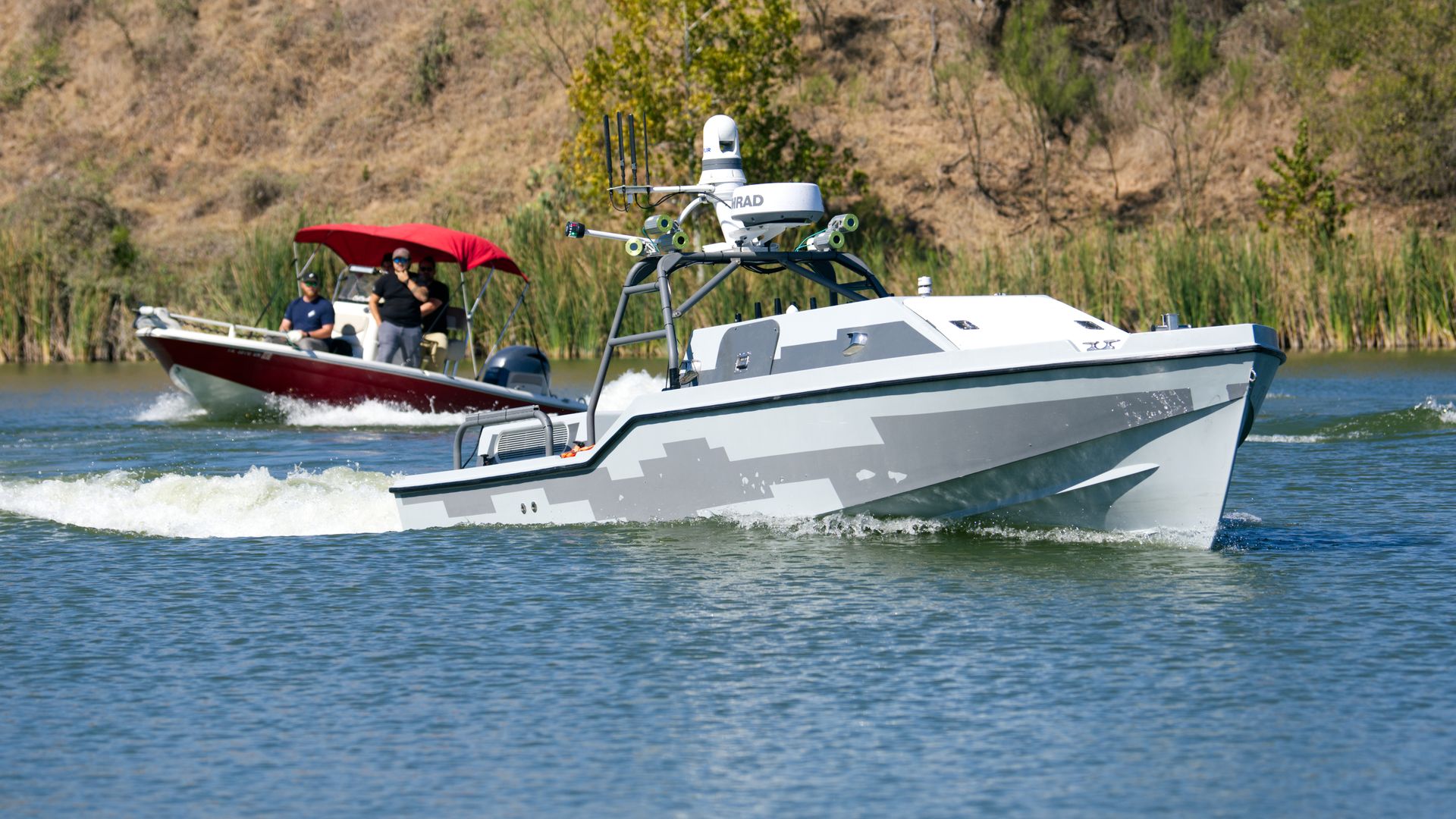
Saronic's latest autonomous vessel, the 24-foot Corsair, undergoes testing in Texas. Photo: Colin Demarest/Axios
To Dino Mavrookas, a single good boat doesn't matter.
- "At the end of the day, how you change the maritime battlefield is through scale," Mavrookas, a former Navy SEAL, told Axios during a tour of his company Saronic's facilities in Texas. "Everything we do is, 'Can we get to thousands?'"
Why it matters: The U.S. is bracing for future conflicts waged on a grand scale — "total war," as a former Pentagon official described it this month in Foreign Affairs. Resource intensive. Widespread. Grueling.
- That fight demands mounds of smart, cheap machinery. The Pentagon recognized this with Replicator, which initially sought to deploy thousands of readily available drones and now wants the weapons to knock them out.
- Companies are jockeying for attention. On and below the waves, that includes smaller firms like HavocAI and Saildrone and bigger players like HII and Northrop Grumman.
- Russia and China have taken heed, as well. Their advancements are popping up at expos as well as on social media feeds.
Driving the news: Saronic unveiled its third autonomous surface vessel, the 24-foot Corsair, earlier this month. It joins the 6-foot Spyglass and the 14-foot Cutlass, all of which are fabricated 15 minutes from the Austin airport.
- Corsair can travel 1,000 nautical miles, carry 1,000 pounds and hit speeds greater than 35 knots. The fuel onboard weighs more than Spyglass and Cutlass combined.
- Axios watched Corsair navigate a nearby lake, which Saronic uses for on-demand assessments. It cut sharp turns and skimmed the tops of waves as it zipped past an observation dock.
Yes, but: Cruising around with a view of the Austin skyline is one thing. Surviving the Black Sea is another.
- All of Saronic's boats go through "robust lake and ocean testing," Rob Lehman, the chief commercial officer, said. "That's the Gulf of Mexico, that's the Atlantic, that's the Pacific, that's on our own, that's with customers."
- The company said it has government contracts but declined to specify customers and values. (Some vessels participated in the Integrated Battle Problem 24.1 exercise.)
Friction point: The Navy has a very public shipbuilding problem. The service's priority boats are years behind schedule with few fixes in sight.
- "In this line of work, the technical overmatch is irrelevant if you can't produce it, if you can't sustain it and if you can't deliver it to the forward edge," former Chief of Naval Operations Adm. Michael Gilday said in an interview.
- Gilday is advising Saronic. While in uniform, he called for hundreds of manned and unmanned ships fighting together.
By the numbers: Saronic has raised more than $250 million.
- Its 200-plus employees include Anduril Industries, Liquid Robotics, Shield AI and SpaceX alumni.
What we're watching: Will the company's mass-production plans match Pentagon dollars? And how will Corsair, fresh off the factory floor, perform under fire?
The bottom line: There's an unmanned arms race underway. Ignoring its naval implications — off the coast of Yemen, for example — would be foolish.
