Axios Future of Defense

October 01, 2025

Hello, October! What's y'all's favorite horror movie? Mine's "The Witch" (2015).
- We've got some scary-good speakers lined up for our Future of Defense Summit this month, including Northrop Grumman CEO Kathy Warden and former Defense Secretary Leon Panetta.
- RSVP here.
💵 Situational awareness: Anduril Industries and Zone 5 Technologies secured additional funding to refine their counter-drone weaponry for the Defense Innovation Unit's Counter NEXT project. A live-fire test is expected in summer 2026.
- My thought bubble: Zone 5 exploded onto the scene this year with a missile deal for Ukraine. They're one to watch.
Over the horizon: Aventra emerges from stealth, TPY-4 interest abroad and supply-chain warfare with Carrie Wibben Kaupp.
Today's newsletter is 2,155 words, an 8-minute read.
1 big thing: Show me the (VC) money

Investors are betting billions of dollars that the world of defense tech is a gold mine, despite the Pentagon's reputation for sluggish purchases and arcane regulations.
Why it matters: That conviction is fostering fresh ideas and market competition, forcing longtime kingpins to adapt.
- Without bullish investors, there'd be no neo-primes. And every time those new players win a big contract, the excitement grows.
Driving the news: Booz Allen Hamilton is tripling its venture capital commitment, up to $300 million, with plans to make 20-25 deals over the next five years.
The intrigue: Brian MacCarthy, managing partner at Booz Allen Ventures, told me he doesn't see the other venture funds pouring into the defense-tech space as competition. "We're actually all aligned to work together," he said.
- Instead, the pressure stems from China. Scores of unmanned systems, long-range missiles and laser weapons were trotted out in early September for Xi Jinping's military procession.
- "That's the index," MacCarthy said. "They don't care about winners and losers. They're going to use their entire ecosystem to help" the People's Liberation Army.
State of play: Four areas are of particular interest to MacCarthy and Booz Allen CFO Matt Calderone, the pair told me in a recent interview.
- Frontline manufacturing, disconnected from the typical supply chain
- Command and control for the space domain
- Quantum
- Simulated worlds and digital test ranges
What they're saying: "When we announced the fund in 2022, it was unique from our vantage point because we were putting our money where our mouth was, to see if our thesis was right," MacCarthy said.
- "We saw a lot of patterns, where all these companies were building phenomenal tech," he said. "But they were still struggling to get past what we call the LRIP phase, or the low-rate initial production phase, into major programs."
Catch up quick: Booz Allen has backed more than a dozen companies since 2022, including defense-tech hotshots Firestorm Labs, Hidden Level, Second Front and Scout AI.
Threat level: Motivating the decisions and pace is an international "race for technical superiority, but not just in the lab," according to Calderone.
- "It's got to be fielded. And that is where we provide extraordinary value. We understand — deeply — the very unique mission needs and technical needs of the warfighter," he said.
- "The question is: How do you get stuff in people's hands in the next 12-18 months that's of value?"
Zoom out: The U.S. Army in September launched Fuze, a trying-and-buying model inspired by venture capitalists.
- In a past life, Army Secretary Dan Driscoll was COO at a $200 million VC fund.
Go deeper: Booz Allen CEO: Defense tech has a "three-timeframe problem"
2. Exclusive: Aventra emerges with millions

Aventra exited stealth today with $3 million in hand and plans to make dumb munitions smarter and longer-reaching. In other words: deadlier.
Why it matters: There's an international competition afoot. Not a day goes by where the military stockpiles, industrial heft and battlefield ingenuity of the U.S., Ukraine, Russia and China aren't compared.
The latest: Aventra is outfitting existing ordnance, like 81 mm mortars, with low-cost guidance systems, wings and balloons — boosting their precision and range and springing attacks from the stratosphere.
- Its first formal offering is known as Piranha.
- "It's wings and eyes and a brain, and we basically wrap that around a munition," CEO Michael Weigand told me.
- "The original idea was, 'Hey, the Ukrainians don't have long-range strike that they can use to target the Russian bombers that are launching these missiles every night," he said.
- "We thought, 'You know what? Somebody has to build the Harbor Freight of guided munitions.'"
Zoom in: The company is based in Virginia. Additional facilities out West and in the South are under consideration. And Weigand, who recently returned from Ukraine, teased coproduction in Europe during our conversation.
- "All of our allies have 81 mm mortars," he said.
Follow the money: The seed round was led by Lavrock Ventures, which also backed missile-maker Castelion and remote-sensing firm Urban Sky.
- "These guys are not amateurs — they're proven leaders," Alex Poulin, a partner at Lavrock, said of Aventra's founding team, which also includes Brian Retherford and Jessup Meng.
- "They understand both the battlefield realities driving demand for distributed fires and the engineering challenges of delivering reliable, cost-effective solutions at scale."
The intrigue: Aventra has angel investors. But Weigand declined to name them.
What's next: The company plans to use its millions to accelerate product development, expand testing and hire more people.
Go deeper: Jake Sullivan encourages Trump team to buy munitions in bulk
3. Another TPY-4 buyer
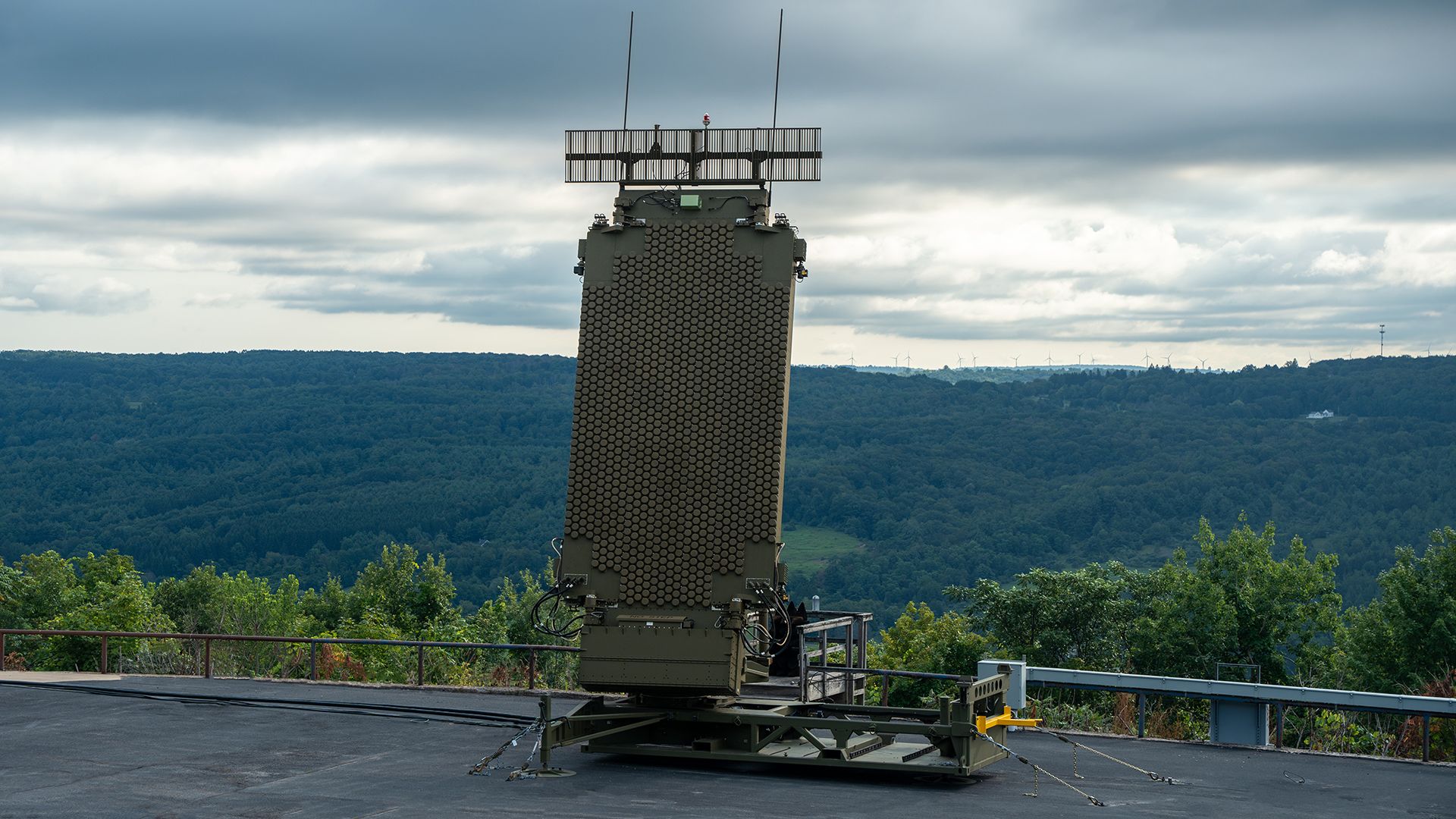
Lockheed Martin secured a third international customer for its TPY-4 radar but has so far declined to name the country.
Why it matters: Word of the arrangement comes amid increased interest in overhead defenses and a spike in NATO airspace incursions.
What they're saying: "Deterrence begins with detection, and you can't defeat what you can't see," Rick Cordaro, vice president of radar and sensor systems, told reporters during a tour of the company's facilities in Moorestown, New Jersey.
- "We actually see this sensor as a really powerful capability for any air surveillance mission, whether it's forward deployed with the Air Force or otherwise," Cordaro said.
State of play: The TPY-4 is due stateside under the Three-Dimensional Expeditionary Long-Range Radar program. Lockheed also inked deals with Norway and Sweden; the latter was announced this summer.
- The radar, set to replace the aging TPS-75, can spot everything from drones to missiles to jets.
Follow the money: Lockheed is the world's largest defense contractor by defense revenue, according to the Defense News Top 100.
Go deeper: Lockheed's $10 billion PAC-3 deal underscores "unprecedented demand"
4. Hegseth's "central casting" moment

Defense Secretary Pete Hegseth yesterday declared the U.S. military free of its "woke" shackles and presented the nation's highest-ranking military officials an ultimatum: Don't like it? Quit.
Why it matters: Trump 2.0 promised to overhaul the Pentagon, everything from axing old-school weapons programs to effecting a MAGA-friendly cultural reset. Both are underway.
- "The new compass heading is clear," Hegseth said, speaking to an auditorium full of generals and admirals whom he summoned to a Marine Corps base in Virginia.
- "Out with the Chiarellis, the McKenzies and the Milleys, and in with the Stockdales, the Schwarzkopfs and the Pattons."
Driving the news: Hegseth's speech yearned for the days of old — mentioning World War II and the First Gulf War — and put special emphasis on outward appearance: physical strength, clean-shaven faces, weight.
- "No more identity months, DEI offices, dudes in dresses," the defense secretary said.
- "If you want a beard, you can join special forces. If not, then shave. We don't have a military full of Nordic pagans."
Between the lines: This is Hegseth's central casting moment. Much like President Trump, he wants his team to look the part and take him seriously.
- "You love the War Department because you love what you do, the profession of arms. You are hereby liberated to be an apolitical, hard-charging, no-nonsense, constitutional leader that you joined the military to be," he said.
- "No more distractions, no more political ideologies, no more debris."
Zoom out: Trump himself played into Hegseth's decree, telling reporters at the White House he would fire military brass "on the spot" if he disliked them.
- He then headed to Quantico and told the assembled generals that they looked straight out of "central casting."
- "If you don't like what I'm saying, you can leave the room," Trump said onstage. "Of course, there goes your rank, there goes your future."
- The audience chuckled.
5. Quick hits
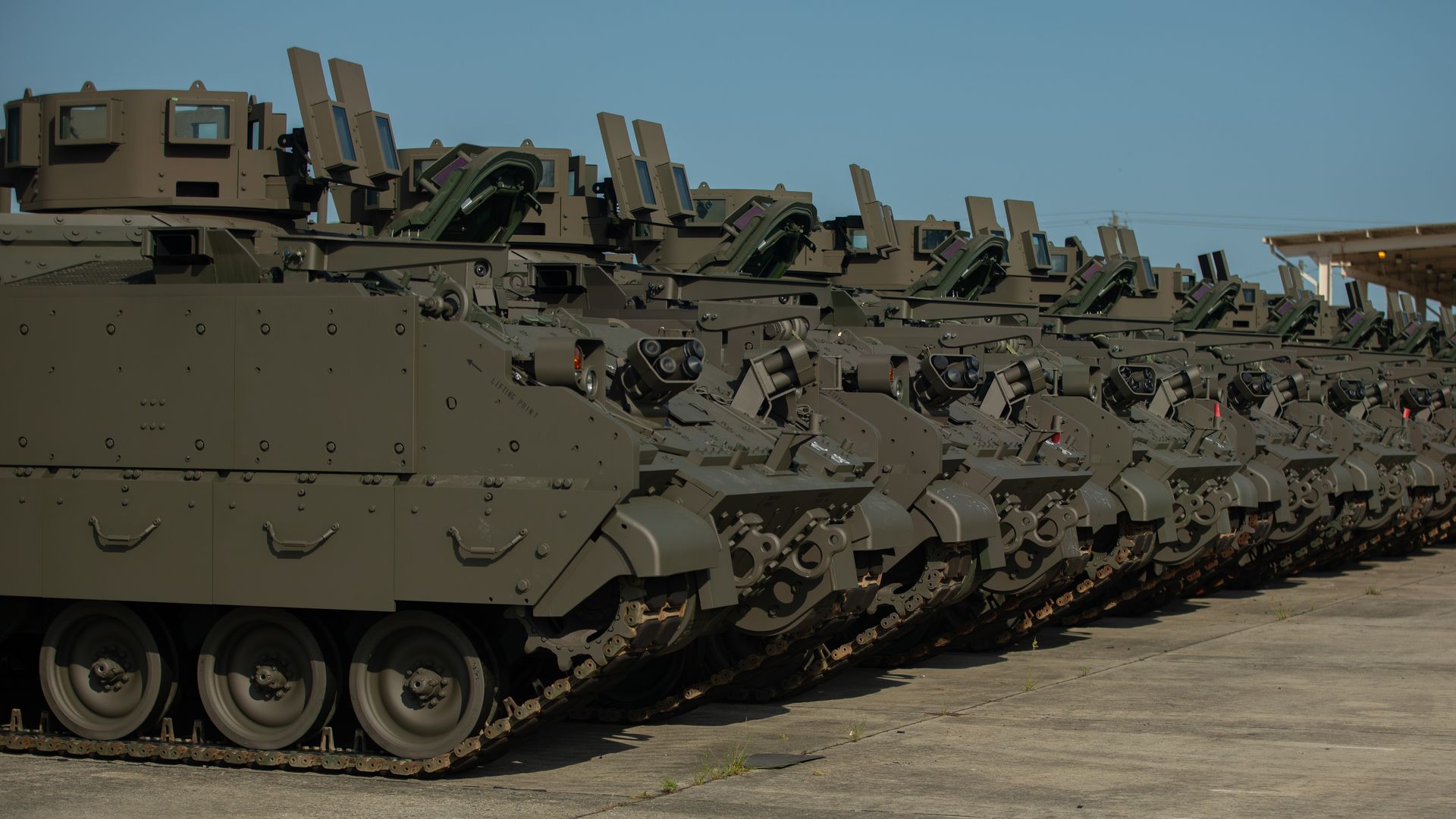
🚛 BAE Systems and Forterra are building an autonomous Armored Multi-Purpose Vehicle. It's part of BAE's "capability kit" strategy announced in August.
- Why it matters: "Working with BAE Systems to build an integrated AMPV will be another breakthrough that becomes a stronger shield for national security," Patrick Acox, Forterra's vice president of defense growth, said in a statement.
- 💭 My thought bubble: They plan to show it off in 2026? Quick turnaround.
🎁 Germany's Helsing unveiled CA-1 Europa, what it's calling an autonomous fighter jet and a "clean-slate approach to air dominance."
- Why it matters: The rollout comes just months after Helsing's acquisition of Grob, which specializes in aircraft design and manufacturing.
- 💭 My thought bubble: The War Zone's got a hot take: CA-1 is a Boeing MQ-28 Ghost Bat lookalike.
🛠️ Kratos will manufacture Elroy Air's vertical-takeoff-and-landing cargo drone, Chaparral, under a new five-year agreement.
- Why it matters: "Kratos has produced and delivered thousands of uncrewed aircraft, with a well-established and reliable supply chain for these systems," Elroy Air CEO Andrew Clare said in a statement.
- 💭 My thought bubble: Don't overlook this tidbit: Initial production will be in Sacramento, while high-rate production will eventually happen in Oklahoma City.
6. Axios interview: Carrie Wibben Kaupp

This week's conversation is with Carrie Wibben Kaupp, the president of Exiger.
Why she matters: Kaupp's a West Point graduate; a former Defense Counterintelligence and Security Agency deputy director; and was the first woman to serve as commander of the guard for the Tomb of the Unknown Soldier.
Q: When you hear "future of defense," what comes to mind?
A: A couple things.
- First, the future of defense is pretty inextricably linked to artificial intelligence. No surprise in that response, I'm sure, because it's really the only scalable response to the modern threat landscape.
- The second that comes to mind is tomorrow's battlefield isn't fought traditionally, through weapons. It's really fought through supply chains. I think supply chains are the new front lines.
- We, at Exiger, are just intensely focused on building the arsenal of tools that will help Team USA win the nonkinetic battle of the future.
Q: What's a national security trend we aren't paying enough attention to?
A: The weaponization of the periodic table. Broadening from that, it's the widespread, prolonged weaponization of economic interdependence.
- We've done countless projects for the U.S. government on strategic ports, shipping lanes, how the adversary China, primarily, can exploit them and where they have dominance in ways that we don't even appreciate or understand.
- Through that same lens — supply-chain intelligence. It really goes from an economic nice-to-have to a national-security imperative.
Q: What region of the world should we be watching? Why?
A: You'd expect me to say China, but everyone's watching it. Again, the signal's broken through the noise. I think it's really our own backyard.
- You can't defend what you can't see. Resilience begins at home, and national security really starts with knowing and protecting the ground under our feet and having full visibility into those dependencies within our supply chains.
Q: How many emails do you get a day, and how do you deal with them?
A: Like everyone, I get too many. Hundreds? I don't know if I've ever tipped the scale on 1,000. But it's a lot. I can't even tell you in the time we've been talking how many have come in.
- I quickly scan, triage, flag, respond. My team knows — my direct reports know — the threshold of things that they are to call me on immediately.
- And I always say: Don't let bad news sit.
Q: What's your secret to a successful overnight flight?
A: I actually don't do a lot of overnight flights. I really try to avoid them.
- When I do have long flights, I take full advantage of that time. It's almost a luxury to have that quiet time on the plane.
7. Check this out

Lockheed Martin's Sikorsky business won a multiyear contract from the U.S. Navy to build up to 99 CH-53K King Stallion helicopters.
Why it matters: The deal is worth nearly $11 billion. It's the largest order of the aircraft to date.
What they're saying: "The 'K' has been slowly taking over more of the factory, over the last couple years," Richard Benton, the head of Sikorsky, told me.
- "This is allowing us to take advantage of that space that we've allocated."
Zoom in: The CH-53K is billed as the Defense Department's most powerful helicopter.
- "I can carry 40, 50 Marines. Or I can carry 36,000 pounds on a swing load," Benton said. "Before, I would have to make three trips to carry that much weight. Now I can make it one."
Go deeper: Lockheed and RTX ink multibillion-dollar missile deals
Shoutout to Dave Lawler for editing and Matt Piper for copy editing.
👋🏼 Thanks, as always, for reading and sharing. Tell your friends to subscribe here.
Sign up for Axios Future of Defense