Saving a key bridge between Pentagon, Silicon Valley from the axe

Add Axios as your preferred source to
see more of our stories on Google.
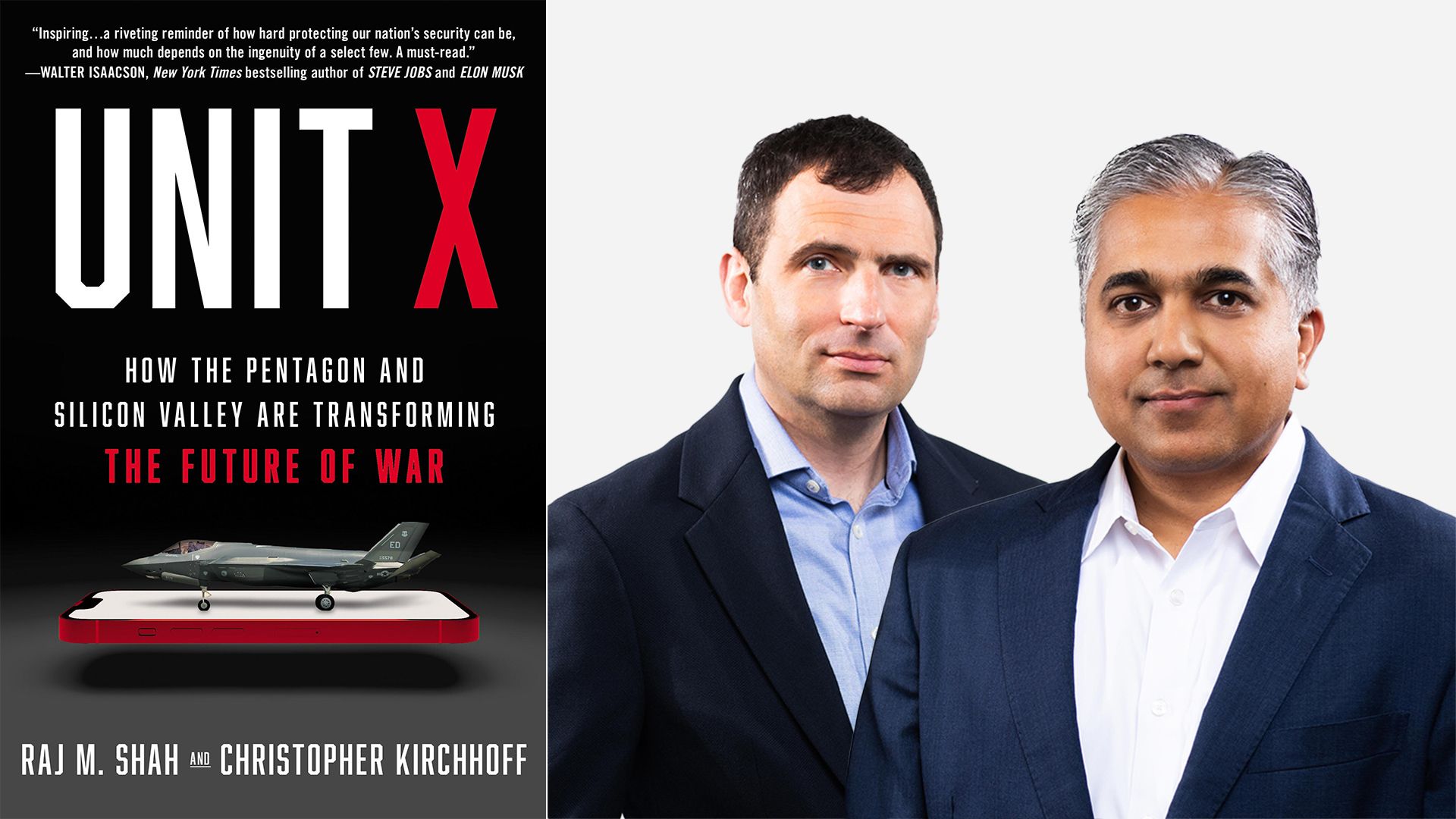
Former Defense Innovation Unit leaders Christopher Kirchhoff (left) and Raj Shah with the cover of their new book, "Unit X." Photo: Simon & Schuster
OpenAI CEO Sam Altman, along with investor Marc Andreessen, played a pivotal role in convincing the Trump administration not to kill a unit designed to foster collaboration between the Pentagon and Silicon Valley, according to details from a new book.
The big picture: Since then, the Defense Innovation Unit (DIU) has emerged as a key player in helping the military more quickly adopt technologies developed outside the government, including artificial intelligence.
On his first trip after becoming Trump's Defense Secretary in 2017, James Mattis attended a private dinner with Andreessen and Altman — then CEO of startup incubator Y Combinator.
- Andreessen argued passionately that the DIU, created under President Obama, was needed for startups to navigate their way through the Pentagon bureaucracy.
- "This is the most important and valuable thing that we've seen out of DoD in decades," Andreessen told Mattis, according to "Unit X," a new book from Raj Shah and Christopher Kirchhoff — two of the men who helped establish and shape the DIU.
The entreaties from Altman and Andreessen worked.
- At a press conference the following day, Mattis forcefully defended the unit, saying that it would not only continue, but also grow in impact and influence. "I don't embrace it; I enthusiastically embrace it," Mattis said.
Why it matters: The DIU, while only a small part of the Pentagon's budget, provides a pathway for startups to connect with the military outside of its cumbersome procurement protocols.
Flashback: The first computers and the internet were pioneered by the government and the military before moving to the private sector.
- But today's AI innovation is starting with private industry.
- That means the Pentagon must foster relationships with tech companies both large and small.
What they're saying: "We are in the first inning of an incredible convergence between autonomous systems and AI," Kirchhoff told Axios.
- "Anyone can build hardware. But only America leads in AI. The fusion of the two is our nation's greatest potential strategic advantage," Kirchhoff added.
- "The race is now on to seize it. Which will take a tighter linking of Silicon Valley and the Pentagon than ever before."
Zoom in: "Unit X" details several examples of the military adopting commercial AI technology, thanks in large part to the DIU.
- The DIU has also helped a number of startups emerge as AI unicorns, including Anduril, Shield AI, Scale.ai, Skydio, Joby and Saildrone.
- Some $70 billion in technology has been acquired by the Department of Defense through the unit, with some contracts processed in as little as two weeks.
One of the early advanced uses of AI was in 2017, in a field pilot in Kandahar, Afghanistan where marines used a system that was part of Project Maven known as Gorgon Stare: a drone loaded with 368 cameras capable of capturing 1.8 billion pixels per second, with images processed by 240 Nvidia chips.
- The unit also helped incubate an AI-powered supersonic drone at the center of an Air Force program called "Collaborative Wingman" that envisions thousands of drones flying alongside manned fighter planes.
Yes, but: The use of commercially developed AI for war has been highly controversial within the workforces of U.S. tech companies, notably at Google — where resignations and protests led the company to withdraw from Project Maven, one of the earliest Pentagon efforts to make use of privately developed AI.
- "We celebrate transparency and dissent — it's important for technologists closest to the technology [to] have a say in how it should and should not be used, especially in war, as I wrote," Kirchhoff told Axios. However, he said, "modern war is so horrifically destructive the highest goal is to avoid it at all costs — especially war between great powers."
- The key, Kirchhoff said, is to ensure that people remain in control, although he acknowledges that what that means will likely shift.
- "Safeguards will be ever-important as we move into an era of war where machines react infinitely faster than humans," Kirchhoff told Axios. "Stronger forms of pre-delegation may come to replace strict 'man in the loop' requirements now governing the Pentagon's weapons systems."
Go deeper: Axios' Colin Demarest has more on the book and the role the DIU is playing in the debut edition of his new weekly Future of Defense newsletter.
Editor's note: This story was updated to reflect that the drone was loaded with 368 cameras (not 328 cameras).
