Axios Communicators

September 19, 2024

✅ Welcome to the tail end of the week, you made it.
🌎 Hope to see you at the Axios Communicators reception on Sunday, Sept. 22, in NYC to kick off Climate Week.
- I will interview Katie Ioanilli of Ralph Lauren and Gemma Hart of Danone, plus networking and cocktails to follow. Request an invite.
Today's newsletter is 1,641 words, a 6-minute read.
1 big thing: The power of an "authentic" CEO
/2024/09/17/1726580898083.gif?w=3840)
CEOs are trading carefully crafted, milquetoast public personas for ones that are more real with the hope of forging connections with employees, customers and other key audiences.
Why it matters: The personal brands of CEOs and founders are just as important as the company's brand itself.
By the numbers: A Weber Shandwick report found that 45% of global executives tie corporate reputation to that of the CEO.
- Those surveyed also believe that 44% of market value is attributable to the reputation of the CEO.
The big picture: Access to more media channels — like social, podcasting, newsletters and vlogs — means executives have more opportunity to connect with new and existing audiences based on interests unrelated to their business.
- CEO posts on LinkedIn have surged 23% since last year, while executives like Meta's Mark Zuckerberg, Airbnb's Brian Chesky and Substack's Chris Best are participating in more personal, long-form podcast interviews.
The intrigue: As tech founder Andrew Yeung recently pointed out, "The biggest corporate brands in the world used to be distinct companies like Coca-Cola, IBM, Nokia, Disney" — now the brands of "Elon Musk, Richard Branson, Jeff Bezos and Mark Zuckerberg" are the biggest.
In response, communication teams are working to help CEOs present their authentic selves, without going too rogue.
- "It's not about letting them or stopping them," says Felicity Barber, founder of Thoughtful Communications and former speechwriter at BlackRock.
- "The really smart CEOs recognize that it's in partnership with their communication teams and are very intentional about how and when they communicate," she adds.
Yes, but: There's still risk associated with putting yourself out there, says Erin Pelton, co-founder of strategic communications firm Foretell.
- "The ones who get it right are really clear-eyed about who they are, their vision and the audiences that are most important to them," says Pelton.
- The ones that get it wrong are often trying to appeal to everyone, she added.
What they're saying: "The era of slick, packaged CEOs who don't say anything controversial, don't say anything that might get a material percentage of people upset with them or questioning what they're saying has passed," says Hani Durzy, founder of Red Dog Strategies.
- Audiences, particularly those that skew younger, can see right through it and don't trust it, says Durzy.
Zoom in: It's a bonus when the executive's persona compliments the company and its product.
- For example, Chobani CEO Hamdi Ulukaya and Patagonia CEO Ryan Gellert's commitments to sustainability support their corporate brands, while Musk's obsession with defining free speech aligns with what he's trying to do with X.
Reality check: The communications specialists Axios spoke to noted that female CEOs or executives from underrepresented communities have to be more strategic than their male counterparts with what they share.
- There can be a double standard for what is considered professional or in command, and communication teams can provide the right context and support, they say.
The bottom line: "You can run a very good business without a visible CEO ... but I think in this day and age, it makes the path to having a successful business much easier if you have a CEO that will genuinely live that company's brand" and is willing to share personal experiences, Durzy says.
2. America's institutions retreat from activism


Just a few years ago, institutions of all kinds — from multinational corporations to centuries-old universities — were routinely weighing in on the social justice debates of the day. Now, the calculus is changing.
Why it matters: Large institutions have a great deal of power to sway opinion and effect change, but many leaders are deciding that speaking up — and often angering many people on all sides — isn’t worth the trouble.
Flashback: Just a few years ago, the talk of the corporate world was that companies and CEOs had missions to serve beyond making money.
- Blue-chip brands backed the racial justice protests that followed the killing of George Floyd.
- Now, as companies find themselves in the middle of social and political debates, many are rethinking getting involved.
- Polls show fewer American consumers think businesses should take stances. In 2021, 48% said companies should speak on issues; in 2023, 41% did, according to Gallup.
Zoom in: Commentators on both sides are ready to pounce on anything that appears political — sometimes almost simultaneously.
- Consider Target, which got flack for its LGBTQ retail displays during last year's Pride Month, then drew sharp criticism from activists after it removed parts of those displays.
- "The harshest backlash is typically reserved for the folks who are inconsistent," says Bradley Akubuiro, a communications expert at Bully Pulpit International. "If you backtrack, you’re going to get absolutely skewered for it."
Reality check: Both colleges and companies are turning toward neutrality, but the consequences of staying quiet may be steeper on campuses than at corporate HQs.
- “Not saying anything speaks volumes," says Paul Argenti, a communications professor at the Tuck School of Business at Dartmouth. "It’s not not taking a position. It’s basically taking the position that you don’t really care.”
3. Case in point ...
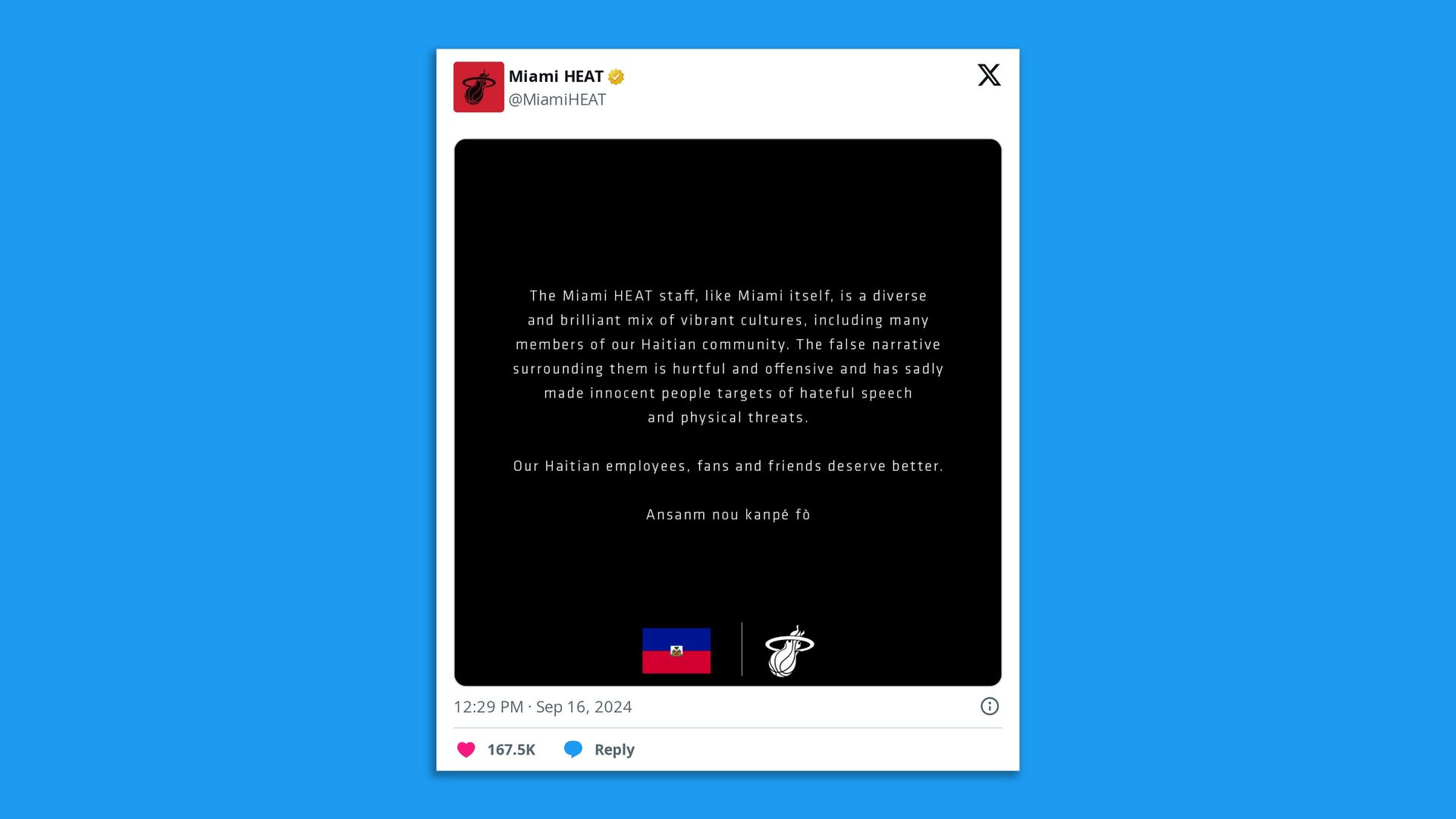
The Miami Heat issued a statement in support of Miami's large Haitian population and denouncing the "false" and "hateful speech" being spread by the Trump-Vance campaign.
Why it matters: Other major brands, companies and sports teams in Miami — as well as in Ohio, where the conspiracy began — have stayed quiet.
State of play: Axios reached out to the top corporations and employers in Ohio, including Procter & Gamble, J.M. Smucker and Kroger, all of which declined to comment.
- An Ohio-based corporate communications professional who requested to speak on background said their company was tracking the issue, but it was not feeling pressure from employees to respond.
What they're saying: Most business leaders view the conspiracy as too crazy to warrant a response, says Argenti.
- Companies, brands and business leaders "have a limited number of arrows in [their] quiver. And they must be used wisely and only if it's connected to the business in some way."
Reality check: The baseless claims are leading to threats of violence, school closures and community event cancellations amid safety concerns.
The big picture: This signals "a broader retraction from CEOs engaging politically," says Stephen Reiff, co-founder of Arvo Advisory. "I'm not surprised at all that companies don't want to touch this with a 10-foot pole."
- "Most are going out of their way not to say anything that could even be construed as political, and this would be jumping into a firestorm."
4. On my radar
A few other comms-related stories that we're watching this week:
- 🤐 The Harris-Walz campaign is seemingly hiding from the press. The Dem ticket has participated in only 7 interviews or press conferences, compared to Trump-Vance's 70 during the same time frame.
- 💸 PR firm DKC has sold a majority stake to Acceleration Community of Companies, a private equity-backed holding company.
- 🧩 The comms consolidation spree continues as Orchestra acquires public affairs firm Civitas.
- 🤖Companies that use generative AI could be taking on more legal liability than they realize.
- 🏢 RTO battle wages on as Amazon demands corporate staffers spend five days a week in the office.
- 📱More people are flocking to TikTok for news, per a Pew Research study. 52% of users say they regularly get news there, up from 43% last year and 22% in 2020.
- 🚗 Hertz names former WeWork executive Lauren Fritts as CCO.
- 📣 Lulu Cheng Meservey's "go direct" comms firm made its first hire — a former VC, Gaby Goldberg.
- 🎥 LinkedIn's TikTok-style videos are slowly making their way into feeds, and most I've seen are super cringe. Is anyone using them in creative or "authentic" ways? Let me know.
5. Communicator spotlight: Papa Johns chief corporate affairs officer Madeline Chadwick

Papa Johns chief corporate affairs officer Madeline Chadwick joined the pizza chain in 2018, as founder and CEO John Schnatter was being ousted following a string of scandals and inappropriate behavior.
- Since then, Chadwick and her team have worked to revamp the brand and rebuild the pizza delivery chain's corporate reputation.
Why it matters: The crisis caused by Schnatter put the importance of reputation and the value of clear communication into focus.
🗣️What she's saying: "I think everyone realized, wow, when something like this happens, it's not just about what the media is saying. It's what are we telling our employees? What are we telling our franchisees? How are we engaging with them? How are we engaging with our communities and other people outside of the company who can actually support you during times like this? And so out of that we saw the evolution of this role."
- Zoom in: Concerns over corporate culture were front and center, which led to a more strategic focus on internal communications and the creation of a corporate foundation, Chadwick said.
📍How she got here: Chadwick spent 15 years in the PR agency space before taking in-house communications roles at Hewlett-Packard and eBay.
- Before joining Papa Johns, she led communications for Rock Ventures, which supported the companies and investments of Dan Gilbert, founder of Quicken Loans and owner of the Cleveland Cavaliers.
- She was elevated to chief corporate affairs officer for the pizza franchise in 2023.
🏗️ How it's structured: Chadwick is based in Atlanta and oversees a team of 12 responsible for internal and external communications, corporate social responsibility and environmental, social and governance (ESG) initiatives.
💡Every CEO should know communications has evolved from "taking orders to having a seat at the decision-making table," she says.
📈 Trend spot: The efficiency AI will bring to comms.
🧠 Best advice: Know the business.
Go deeper ... read her spotlight in its entirety.
6. 📚1 excerpt to-go
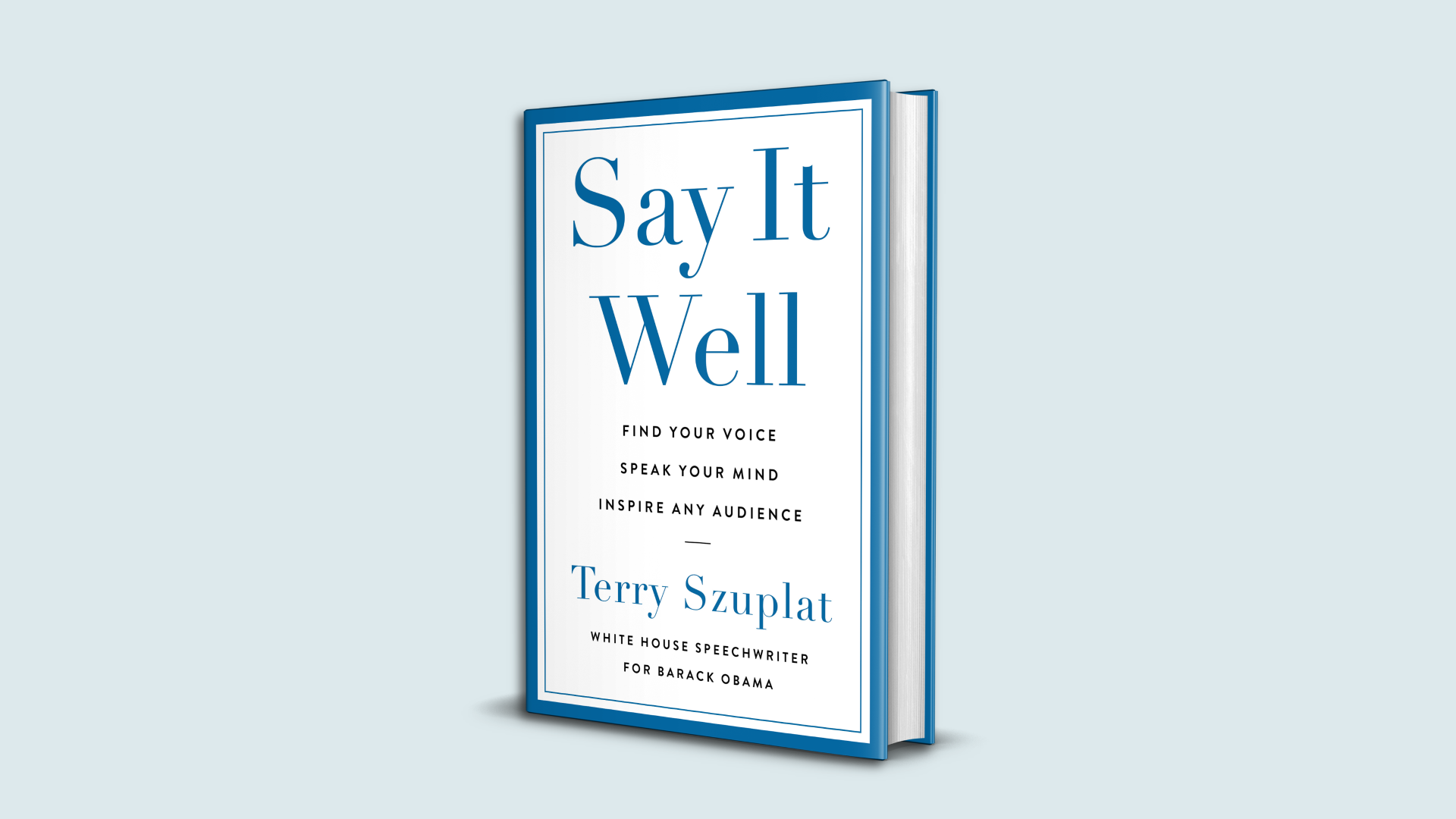
"As a CEO, you can be pretty good at running your business financially, but if you can't articulate your story, it can affect your valuation. Good messaging and good financials go hand in hand."— Longtime Obama speechwriter Terry Szuplat writes in his new book on the art of public speaking and connection, "Say It Well"
Thanks for reading! And thanks, as always, to editors Nicholas Johnston, Michael Flaherty and Kathie Bozanich.
Sign up for Axios Communicators