Axios Communicators

November 16, 2023

🥧 Welcome to your pre-Thanksgiving communications feast! We will be off next week for the holiday.
📆 Mark your calendar for our annual Axios Communicators event on Dec. 14 in NYC.
- Join us for the opportunity to network with fellow communicators and hear from speakers like Josh Earnest of United Airlines, Lulu Cheng Meservey of Activision Blizzard and more.
- Register here with code earlybird through Dec. 1.
Today's newsletter is 1,360 words, a 5-minute read.
1 big thing: Americans flock to TikTok for news
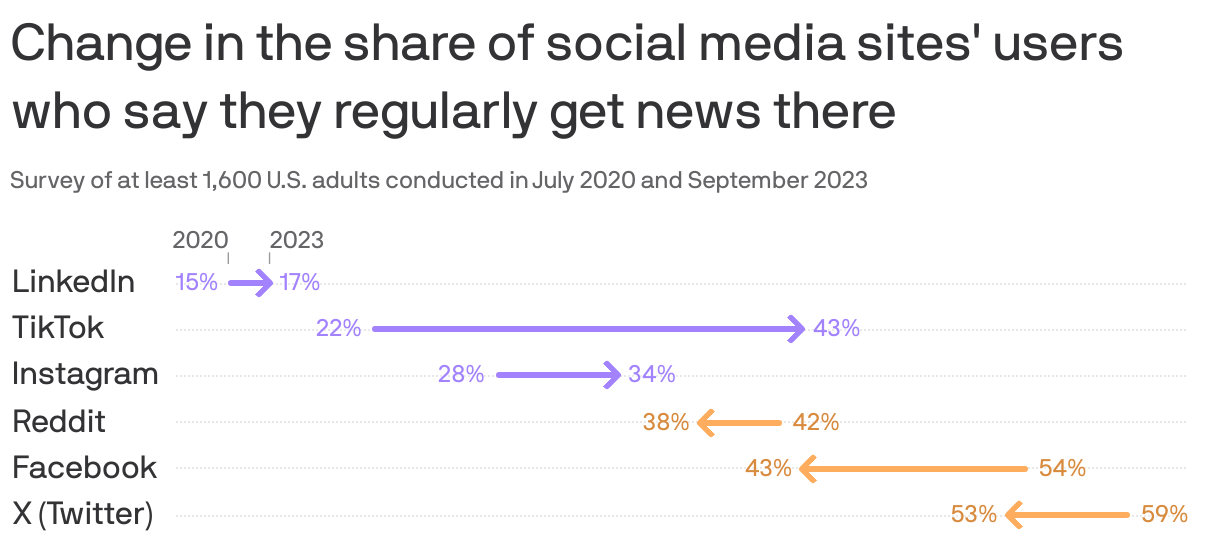
The share of TikTok users who consume news through the platform has nearly doubled since 2020, according to new Pew Research Center data.
Why it matters: News organizations, business leaders and brands are being forced to evolve and meet audiences where they are in order to break through.
What's happening: The Pew study shows that news consumers have accelerated their shift toward digital channels in the past year.
- Americans are roughly twice as likely to say they prefer getting news on digital devices (58%) than from television (27%).
- Meanwhile, audience preference for radio and print media remains roughly stagnant at 6% and 5% respectively.
State of play: Roughly half of Americans say they get some news from social media platforms.
- News audiences are increasing the most on TikTok and Instagram. Platforms like LinkedIn, Twitch and Nextdoor are also gaining traction as news sources.
Zoom in: Women make up a greater portion of regular news consumers on Nextdoor, Facebook, Instagram and TikTok, while men are more likely to opt for platforms like Reddit, X and YouTube.
Yes, but: As big social media platforms move away from supporting news links, headlines and content, users seeking news content may be leaning more heavily on search engines, traditional news sites or aggregation apps.
What to watch: The kind of news content favored by platforms like TikTok, which is all short-form video and typically user-generated, may get penalized by Google and other search engines.
- Google has long relied on a complex algorithm to prioritize content that the company views as authoritative, credible and trustworthy.
- The more Google offers search results via conversational artifical intelligence, the more likely it is to get even pickier about choosing sources.
Case in point ... 👇🏻
2. Chart: TikTok's rise
3. TikTok's counteroffensive
As TikTok draws more eyeballs, it also draws more criticism — prompting it to respond with forceful communications.
Why it matters: TikTok is the latest organization to deploy aggressive communication tactics to counter untrue or unflattering allegations as a way to influence public opinion and protect corporate reputation.
Between the lines: This is part of a broader shift toward a type of more aggressive communications, often seen in political playbooks.
- TikTok recently hired well-known political communicator and former Disney CCO Zenia Mucha to oversee brand and communications.
Catch up quick: The social media giant came under fire after news outlets pointed out the disproportionate amount of pro-Palestinian hashtags on the platform compared to that of pro-Israel hashtags.
- Elected officials have since accused TikTok of brainwashing young Americans by pushing "rampant pro-Hamas propaganda."
- TikTok then published a blog post pushing back against the "mischaracterization" of how its algorithms and hashtags work.
- "Blunt comparisons of hashtags is severely flawed and misrepresentative of the activity on TikTok," states the blog.
- TikTok used it as an opportunity to point out the disproportionate number of pro-Palestinian posts on competing platforms like Instagram and Facebook as well.
What they're saying: "There was a fast moving, false narrative that the publicly available data simply didn't support," says a TikTok spokesperson.
- "We thought it was important to set the record straight, making a clear apples-to-apples comparison. In light of misinformation about how TikTok actually operates, we thought it was important for everyone to have the facts."
Of note, TikTok has also removed more than 925,000 videos in the region since Oct. 7 for violating policies about violence and misinformation, per the blog.
The big picture: TikTok isn't alone when it comes to swiftly countering a public narrative. If an outside event or issue could threaten corporate reputation, then communications teams are increasingly stepping in.
- Coinbase, Activision Blizzard and Airbnb have publicly pushed back against regulators, while DoorDash and Oatly have pounced on misinformation or public critiques through hyper-focused comms campaigns.
What to watch: As AI-generated content becomes more easily accessible, so too will the opportunity for mass dis- and misinformation to spread, meaning social media platforms like TikTok will be under heightened scrutiny.
- TikTok's response to the Israel-Hamas hashtag issue offers insight into how the platform could respond to future criticisms.
4. Gen Z calls for more open communication in the workplace

Punctuation in messages to colleagues is out. Talking about mental health at work is in, writes Axios' April Rubin.
Why it matters: The labor force's youngest members are revamping the workplace with internet speak, attention to well-being and uncanny realness.
- Older colleagues notice "just how frank, nondeferential and empowered younger generations are in speaking their mind, calling things out" at work, said Jeffrey Sanchez-Burks, a professor of business administration at the University of Michigan. It's even motivated them to do the same.
Between the lines: The shift in young employees' openness spans everything from well-being to money.
- Unlike some older colleagues, Gen Z workers have embraced salary sharing, said Christine Cruzvergara, the chief education strategy officer for career platform Handshake. They use this information to hold their employers accountable.
- Younger employees seek out salary audits and data based on gender, race or location from their employers, she said.
- "All of those things are now just expected," she said.
5. Spotlight: Margaret Richardson, GoFundMe's chief corporate affairs officer
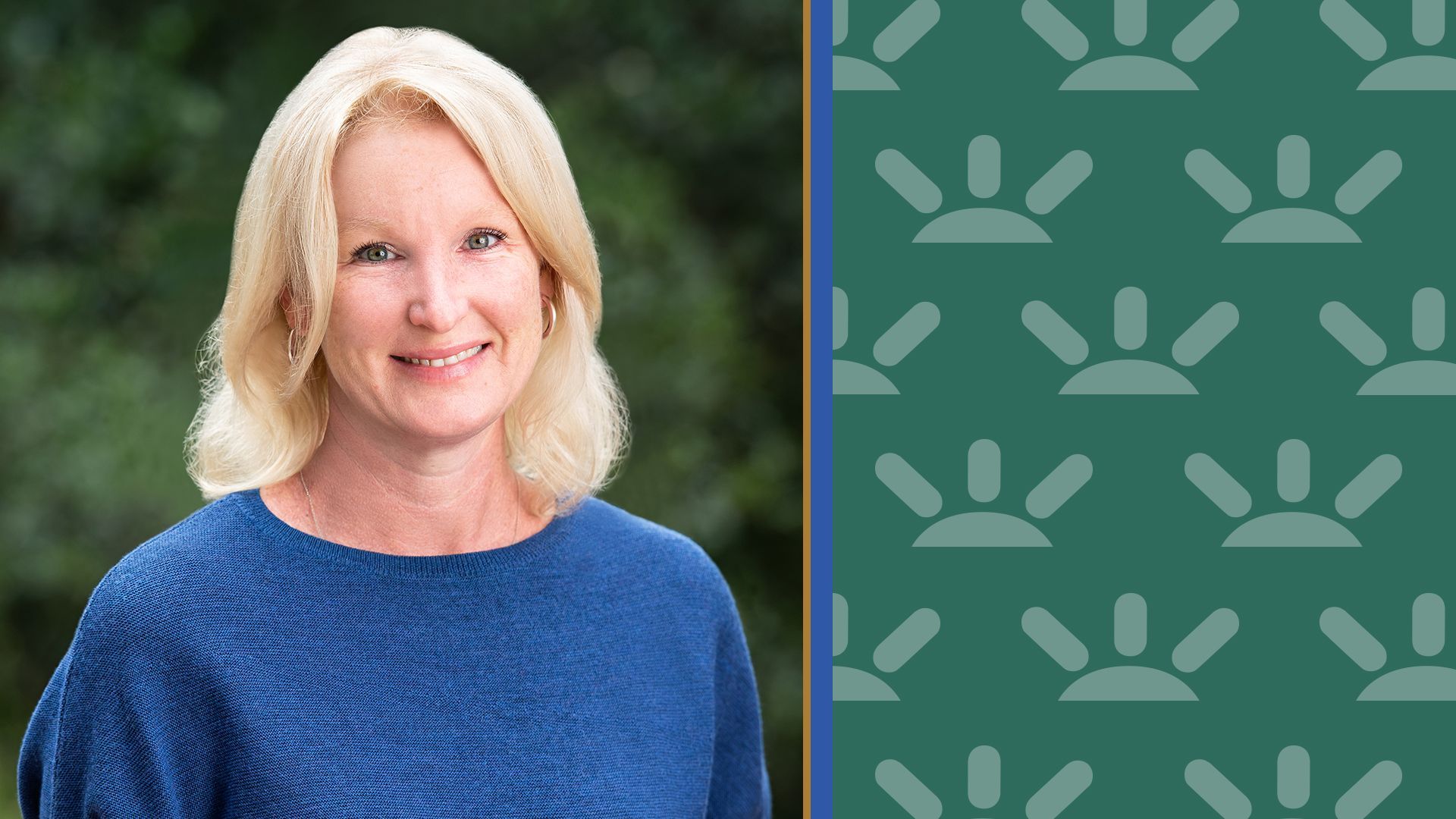
Margaret Richardson joined GoFundMe as chief corporate affairs officer to help explain the crowdfunding platform's purpose and impact.
Why it matters: Richardson is the company's first corporate affairs hire, and she was brought on to amplify the stories, causes and people found across GoFundMe, while also advancing the corporate narrative.
📍How she got here: Richardson started her career as an attorney before joining the U.S. Department of Justice, where she served as chief of staff and counselor to Attorney General Eric Holder.
- From there, she joined Airbnb to help build its global policy team, and most recently led Apple's trust and safety team before joining GoFundMe in 2022.
🗣 What she's saying: "Corporate affairs is kind of like a Rorschach test — it can look different at different places," Richardson told Axios.
- "At GoFundMe, it's about amplifying the stories on our platform and really bringing to light the very best of what our platform does in a thoughtful, authentic, locally relevant way. And then in those very rare cases where something goes wrong, responding as quickly as we can and making sure that we learn from it and build that capacity internally."
🏗 How it's structured: She reports into the CEO and oversees a team of 54 who manage government relations, public policy, corporate communications and marketing.
👀 What she's watching: Richardson is monitoring the impact of local, digital storytelling.
- "Local media continues to be a trusted source for people, especially when there are crises or disasters. There's a relationship established — often many years of feeling trust and confidence. We are focused on extending our approach with local media to [include] the online space, so really trying to understand and engage with local voices who are persuasive and relevant to new generations."
- Zoom in: This includes amplifying stories like that of GoFundMe Hero, DeJuan Strickland, who started a fund that has helped eliminate nearly $10,000 of lunch debt in his school district. The community caught wind and raised thousands of dollars to further support his cause.
- "That story was one that was picked up, and it really is at the center of so many policy issues, but also this idea of who we are as a community," Richardson said.
- "Being able to lift up stories like that where people are coming together and really defining their communities in ways that they're proud of are the kinds of things that we're doing every day."
🌊 Destress routine: To unwind on the weekends, Richardson visits the local Bay Area beaches with her husband and three kids, ages 11, 8 and 6.
📚 Reading list: "Black Cake" by Charmaine Wilkerson and "A Constellation of Vital Phenomena" by Anthony Marra.
🧠 Best advice comes from Holder: "You have to keep your sense of purpose and keep your sense of humor."
6. 🐦1 stat to go
To the surprise of many, Twitter's rebrand to X is sticking, according to a recent Pew survey.
- Seven in 10 U.S. adults say they are aware of Twitter's new name.
🦃 Thanks for reading and sharing Axios Communicators!
And special thanks for editors Nicholas Johnston and Kathie Bozanich for making this newsletter possible each week.
Sign up for Axios Communicators