Melvin Carter on his legacy, loss and plans

Add Axios as your preferred source to
see more of our stories on Google.
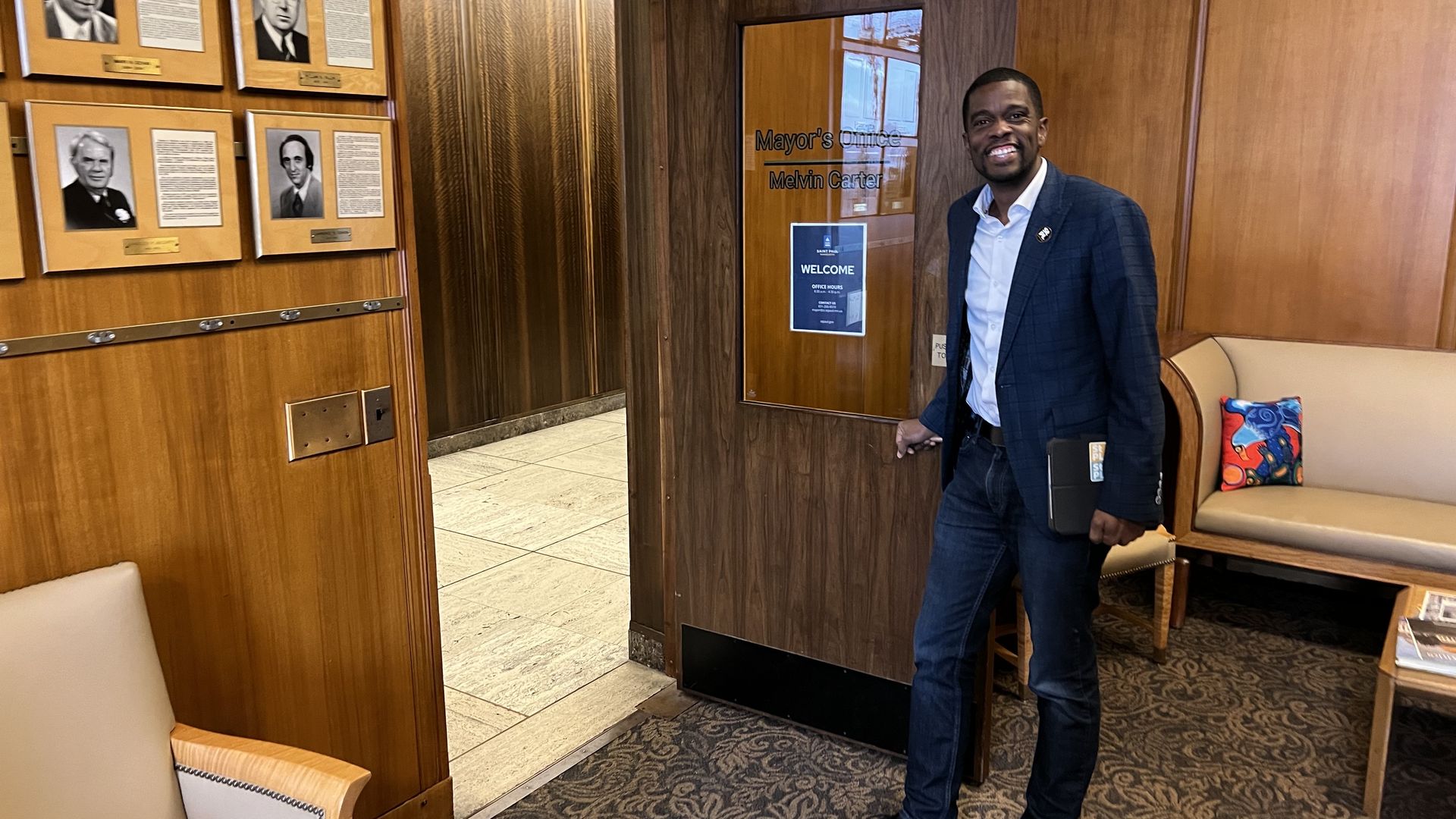
Outgoing St. Paul Mayor Melvin Carter poses for an on-the-nose portrait as he leaves his City Hall office. Photo: Kyle Stokes/Axios
Outgoing St. Paul Mayor Melvin Carter isn't ruling out a future bid for elected office — but "doubts" he'll be running "anytime soon," he told Axios in an exit interview.
Why it matters: Many local politicos had penciled in Carter as a logical successor to longtime Democratic U.S. Rep. Betty McCollum, who is running for reelection.
What he's saying: Carter said he supports McCollum — and sounded unenthused by Congress, framing it as behind the times and saying he'd prefer a "fast-paced work environment."
- Carter also said he's "never discussed" joining the DFL gubernatorial ticket with Gov. Tim Walz.
Catch up quick: As recently as August, Carter was on a glide path to a third term — but state Rep. Kaohly Her's entry into the race in August, and her upset victory over her former boss, caught much of the city by surprise.
Here are highlights from Axios' conversation with the outgoing mayor:
Why Carter thinks he lost
For starters, July's crippling cyberattack prevented Carter from pivoting into campaign mode by August, as he said he originally planned.
- Carter didn't have a paid campaign manager when Her launched her bid on Aug. 4 — though he said volunteers were making calls and knocking on doors.
Carter also acknowledged Her's central argument — that his administration was disengaged, unresponsive, and beset by malaise — was "successful."
- Was it a fair critique? "It's politics," Carter told Axios. "'Fair' isn't promised in politics."
- "If the critiques of our administration are not about outcomes … but nuanced process complaints — I'll take that," he added.
Carter on his legacy
By contrast, Carter said his tenure will be defined by how the city engaged with problems that once seemed unsolvable.
- He's most proud of raising the minimum wage, securing funding to fix the city's potholed streets, curbing gun violence and instituting new approaches to policing.
- He said infrastructure has improved so much that it "eliminated potholes as a political hot button."
Friction point: These accomplishments came at a price as operations costs rose — "property tax fatigue was a powerful force" in November's election, Carter said.
Carter is also pleased with initiatives aimed at low-income residents: eliminating library late fines, making youth sports free, wiping out medical debt and experimenting with a guaranteed income program.
- Yes, but: Despite these programs' low cost, Carter acknowledged the perception they diverted the city from "core" priorities was pernicious — but said the definition of a city's "core" mission must also evolve.
"Cities are laboratories for democracy," Carter argued, "and there are a whole lot of folks who would like us to be a laboratory that never experiments."
The future
What we're watching: Downtown St. Paul's well-publicized struggles contributed to Carter's defeat — but he believes his administration laid the groundwork for a turnaround.
- "I do believe that St. Paul is on a course to fundamentally shift the conversation about downtown," he said.
What's next: After Carter leaves office on Jan. 2, "My future plan is to chaperone kindergarten field trips," he said. (Carter has six kids, including a 5-year-old.)
- He also aims to run the fastest marathon of his life.
Go deeper: Kaohly Her prepares to take office