Seattle police contract undercuts civilian response teams

Add Axios as your preferred source to
see more of our stories on Google.
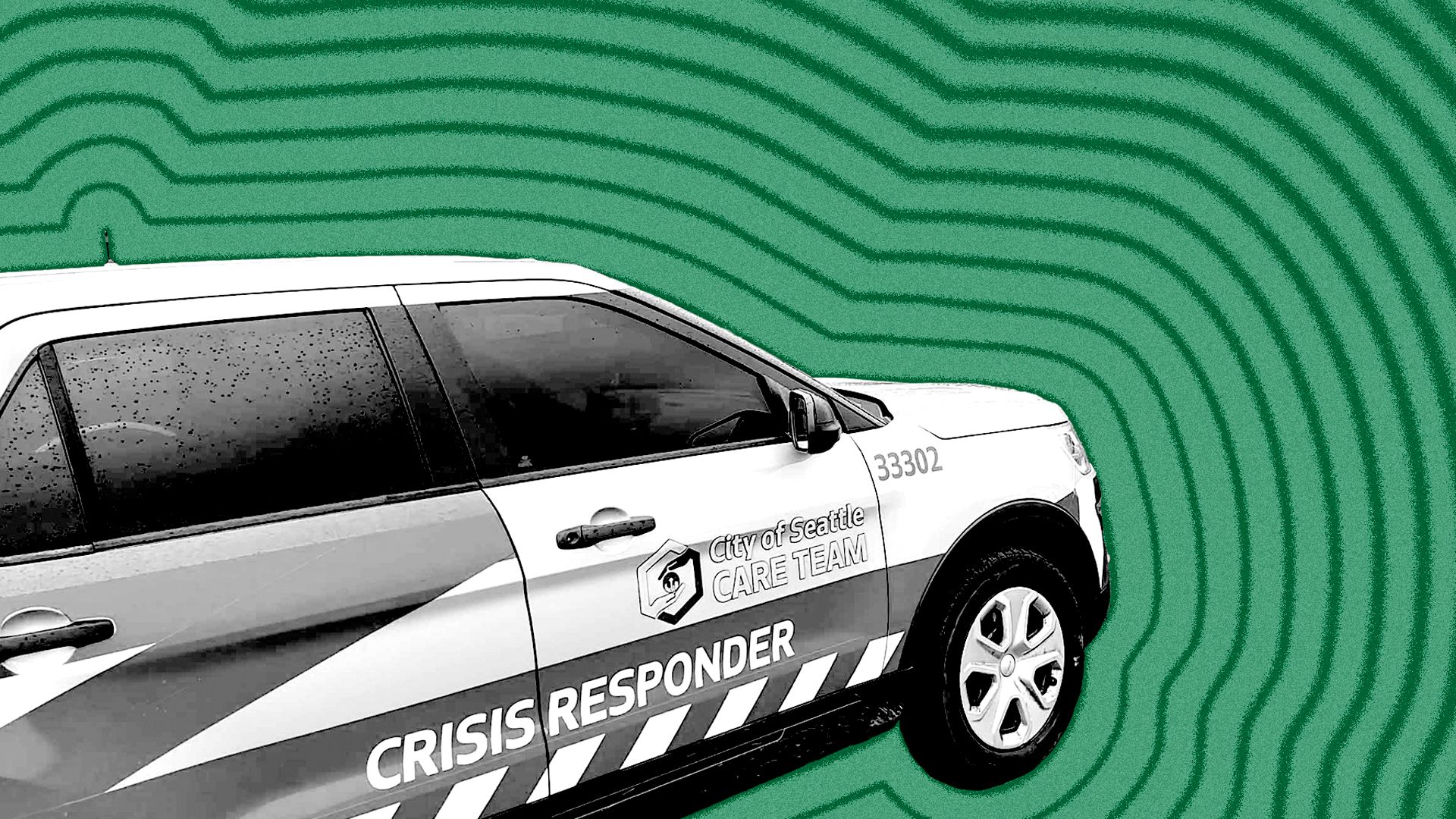
Photo illustration: Axios Visuals; Photo: City of Seattle
Editor's note: This is part three of a three-part deep dive into Seattle's contract with the Seattle Police Officers Guild. Go here to read part one, and here for part two.
Seattle's new police guild contract allows the city to grow its civilian crisis response teams — but sharply limits when and where they can operate.
Why it matters: The limits blunt one of Seattle's main alternatives to traditional policing, even as the city works to grow the program.
Zoom in: The new contract prevents the city's Community Assisted Response and Engagement (CARE) teams from responding on their own to many 911 calls involving drug use, mental health issues or homelessness — some of the very issues they're designed to address.
- Allowing civilian teams to handle many of those calls instead of armed officers became a central part of Seattle's push to reform public safety after the 2020 Black Lives Matter protests.
What they're saying: "It's five years later, and it's not right that we're still not able to dispatch this alternate response to appropriate calls," CARE department chief Amy Barden told Axios after the contract's approval in December.
The Seattle Police Officers Guild didn't respond to requests for comment.
Catch up quick: The city's new contract with the guild lifts a cap on CARE responders, allowing the city to move ahead with plans to double the number from 24 to 48.
- It also lets the civilian CARE teams handle some 911 calls — such as welfare checks — without police, rather than always being dispatched alongside officers.
Yes, but: The contract restricts when and where CARE teams can respond independently.
- They cannot respond alone to incidents at homeless encampments — defined as four or more tents — or to scenes with visible drug paraphernalia.
- They're also restricted to public spaces and barred from entering private homes or businesses.
- Even privately owned, open-air spaces like grocery store parking lots are off limits, Barden said.
The teams can handle some mental health calls, such as a person yelling delusional statements in public that aren't directed at anyone. But they cannot respond to situations like someone yelling in the middle of the street in traffic or throwing objects on the sidewalk.
- In some cases, a person in crisis who is naked in public may also fall outside CARE's scope under the contract.
- "It basically says CARE can't go to emergencies," Barden said, calling the limits "completely arbitrary."
The restrictions also limit the CARE teams' ability to proactively help people on the street — outreach they used to do without receiving a 911 call.
- "We can no longer do that, because legally, if we approach someone and then we see foil on the ground, we're supposed to call law enforcement," Barden said, referring to signs of possible drug use.
- "There's actually a disincentive for them to do core work that they've been doing."
Stunning stat: Of the roughly 2,400 calls that come into Seattle's 911 center each day, Barden estimates CARE can currently respond on its own to about 10–20.
- Seattle's 24 existing CARE responders are now operating at just 28% of their capacity, she said.
The other side: When voting yes on the guild contract in December, City Councilmember Dan Strauss said expanding CARE was a key reason he supported the deal.
- City Councilmember Bob Kettle, who chairs the council's public safety committee, previously called the agreement crucial to advancing the city's public safety reforms, specifically with CARE.
- He didn't respond to requests for comment from Axios.
What's next: With CARE teams limited in the calls they can handle, Barden said she's looking at additional ways to deploy them — such as by helping people exiting Harborview Medical Center and the King County Jail.