How Seattle's surveillance could threaten its safe haven promises

Add Axios as your preferred source to
see more of our stories on Google.
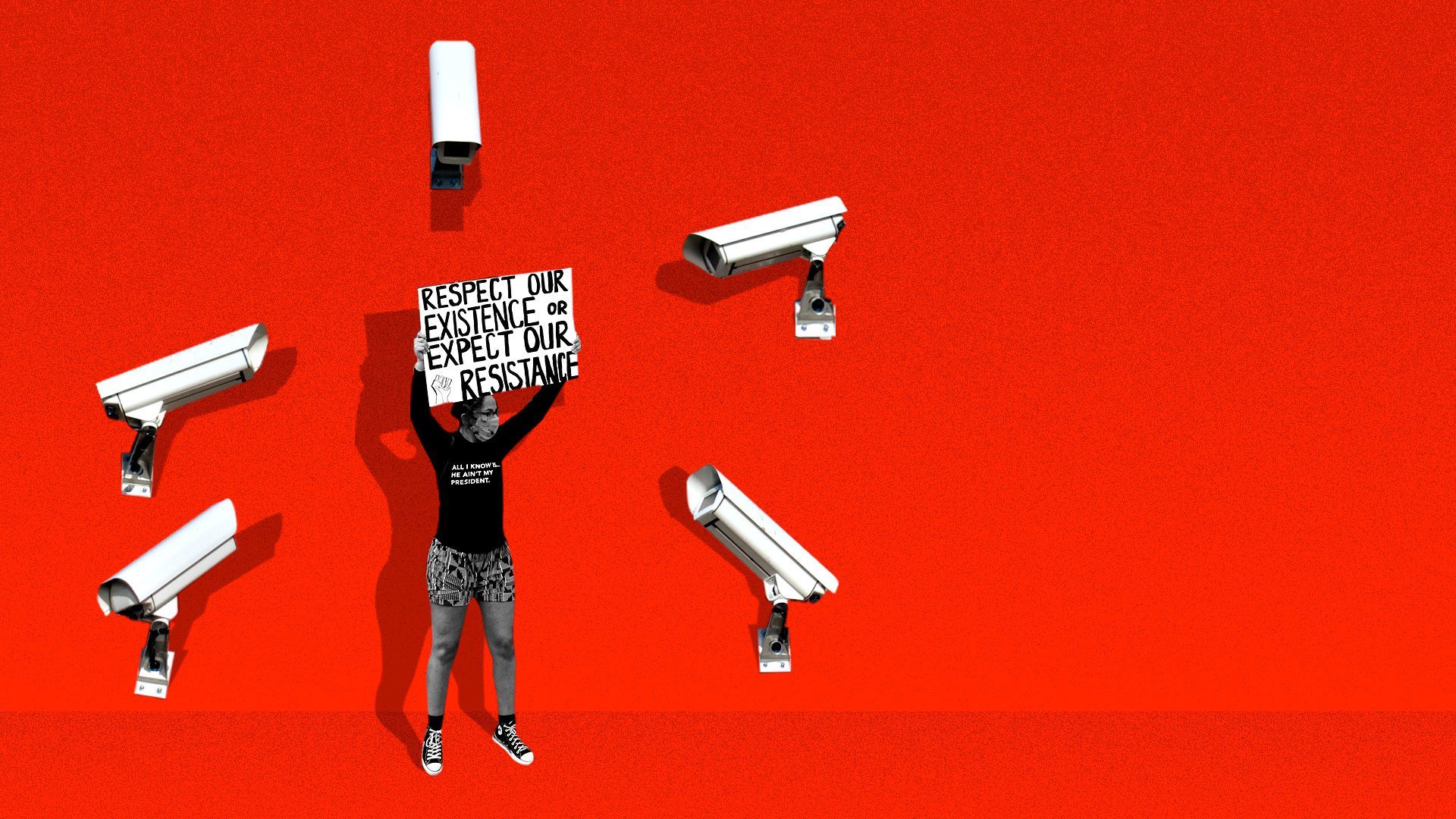
Illustration: Aïda Amer/Axios
Seattle's beefed-up surveillance networks track far more than stolen cars or suspected criminals — they create databases civil liberties advocates warn could put certain groups in danger.
Why it matters: Washington has positioned itself as a safe haven for immigrants, abortion patients and those seeking gender-affirming care.
What they're saying: The state's protections could falter if state surveillance data is tapped by federal or out-of-state agencies, Tee Sannon, the technology policy program director for ACLU-Washington, told Axios.
- Without a statewide law, each department or agency sets its own rules on how long to keep data and who can access it.
- That patchwork leaves the door open to informal sharing, subpoenas or misuse, Sannon said.
- UW's Center for Human Rights found that Washington police agencies share license plate reader data with hundreds of agencies nationwide — including Immigration and Customs Enforcement — creating a back door around the state's "safe haven" protections for abortion and immigrant rights.
Cases in point: Federal agencies have already tapped Washington databases, despite privacy laws meant to block unauthorized access — including by federal authorities.
- The Department of Homeland Security — including ICE — accessed the state's Medicaid data, prompting Washington to sue the Trump administration this summer.
- A KING 5 investigation this summer found Washington's Department of Licensing was allowing Homeland Security access to driver and vehicle records, despite state law barring information sharing for deportation purposes.
- The Department of Justice recently asked Washington for access to its voter database, which includes names, addresses, birthdates and partial Social Security numbers.
The big picture: Because Seattle's surveillance systems collect indiscriminately, the vast majority of scans are of people not suspected of any crime. But once pooled into massive databases, the data can be mined to reconstruct daily routines, visits to clinics, or political activity, according to UW's Center for Human Rights.
- "These are not just hypothetical risks," Sannon said. "It's all very real now."
- Voting against a CCTV expansion last month, Seattle City Council member Alexis Mercedes Rinck pointed to the federal government accessing San Francisco's license plate reader database, in likely violation of California law.
- "Surveillance that can be subpoenaed at any moment by the federal government is deeply problematic," Rinck told Axios.
Zoom in: In its 2024 annual review, the City Auditor found the transportation department only in partial compliance with surveillance regulations — citing missing camera-placement documentation, incomplete access logs, and inconsistent data retention.
- SDOT told Axios it's automating deletions to ensure strict compliance, strengthening user-access controls so every login is tied to an individual, and maintaining documentation of new camera placements for annual review.
Zoom out: In Denver, audit logs revealed more than 1,400 immigration-related searches of Automated License Plate Reader (ALPR) data, despite city assurances it wouldn't be used that way.
- In Texas, authorities reportedly used license plate data to track women suspected of seeking abortions.
- Seattle now has its own ALPRs that scan thousands of plates an hour.
Behind the scenes: Academic researchers have struggled to assess Washington's surveillance data access and guardrails, and whether they're enforced.
- "Even for researchers, it's very hard to verify who can see this information or whether policies on paper are carried out," Phil Neff, research coordinator at UW's Center for Human Rights, told Axios.
What we're watching: Whether Olympia lawmakers will propose strict data limits and sharing bans — like New Hampshire's law requiring ALPR data deletion within three minutes — when the session begins in January.