What to know about the fed kratom crackdown


Add Axios as your preferred source to
see more of our stories on Google.
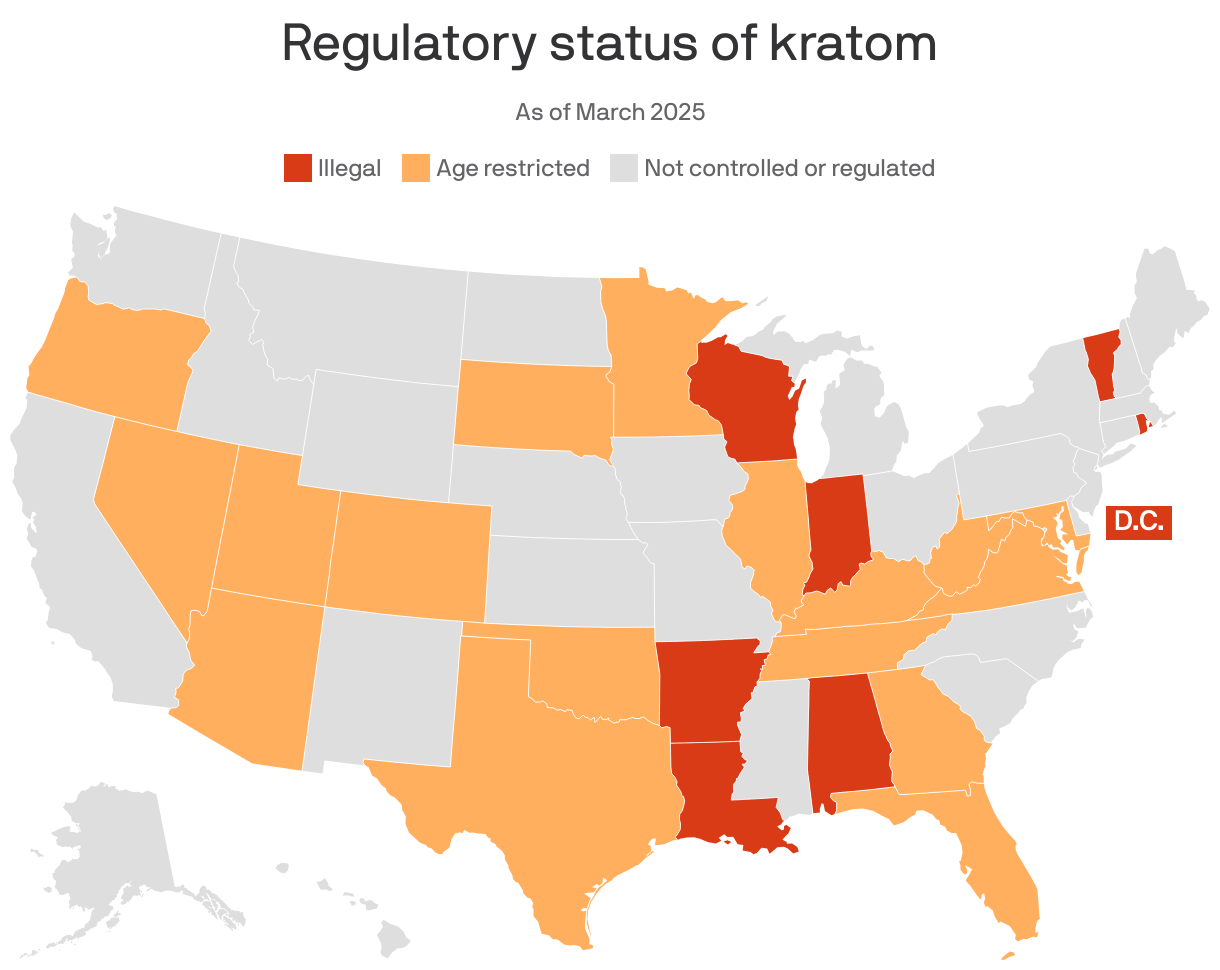
Federal health officials are cracking down on 7-OH, a potent kratom compound marketed as "legal morphine."
Why it matters: The move could limit access to kratom products in Washington, where they remain legal and widely available.
- Products derived from the kratom tree, which have been used for centuries to treat pain, fatigue and other ailments, can be purchased at smoke shops, gas stations and convenience stores in the Seattle area.
- But FDA Commissioner Marty Makary said at a recent press conference that research shows 7-OH — a derivative of mitragynine, the primary alkaloid of kratom — can be 13 times more potent than morphine.
Catch up quick: The FDA on Tuesday recommended more regulation of 7-OH products and warned consumers about their risks.
- The FDA sent a letter last month to companies about the illegal marketing of 7-OH products, calling them potentially dangerous and unproven.
By the numbers: Federal survey data from 2021 suggests around 0.7% of Americans 12 and older use kratom products, but recent estimates from the American Kratom Association and Journal of Psychoactive Drugs put usage at 9.1%, or over 20 million people, per Axios' Carly Mallenbaum.
State of play: Federal officials said they are not targeting the herbal supplement kratom, just 7-OH.
- "7-OH is not just 'like' an opioid…it is an opioid," Makary said. "Yet it is sold in vape stores, in smoke shops, in convenience stores, in gas stations…and no one knows what it is."
Yes, but: Based on a survey of more than 2,700 kratom users, researchers at Johns Hopkins found that kratom likely poses less harm than prescription opioids when used for pain, anxiety, depression, or addiction treatment.
Behind the scenes: Earlier this year, Washington state regulators withdrew a proposal to classify kratom as a controlled substance, concluding it did not meet the criteria for a Schedule I designation.
- Advocacy groups like the Kratom Literacy Project support regulation — not prohibition — arguing that guardrails like age limits, product testing, and labeling can protect consumers while preserving access.
What's next: The Drug Enforcement Administration will now decide whether to schedule 7-OH under federal drug laws, which could trigger broader state-level bans, the Associated Press reported.