Feds launch crackdown on kratom byproduct

Add Axios as your preferred source to
see more of our stories on Google.
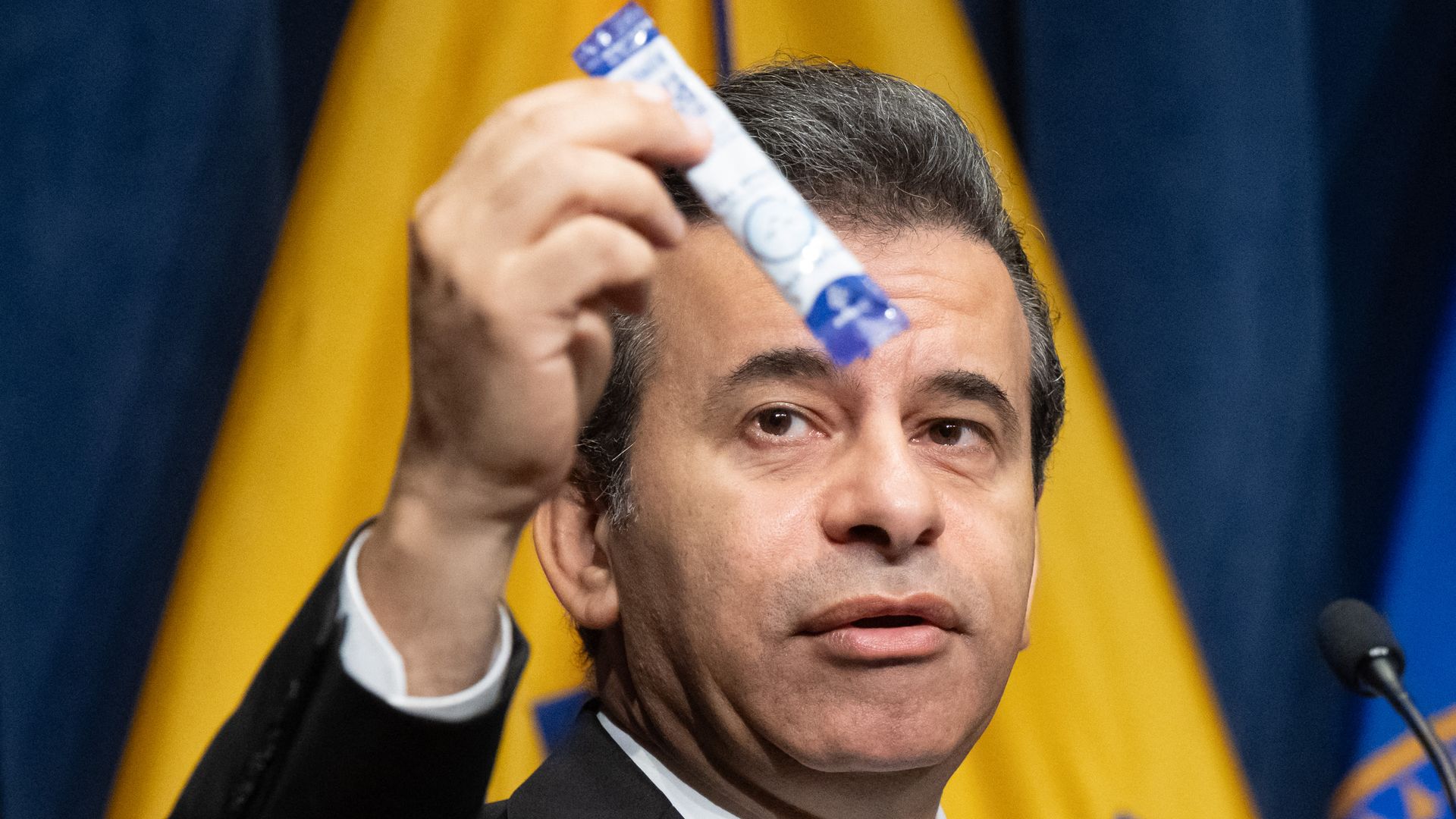
FDA Commissioner Marty Makary holds up an example of a 7-OH product. Photo: Saul Loeb/AFP via Getty Images
Federal health officials are launching a new campaign to control the distribution of an opioid substance derived from the kratom plant known as 7-OH that's sometimes referred to as "legal morphine."
Why it matters: The compound, 7-hydroxymitragynine, is commonly sold online and in smoke shops and has been found in dangerous concentrations in tablets, gummies and drink mixes.
Driving the news: FDA and Drug Enforcement Administration officials said Tuesday they are taking steps to schedule the compound as a controlled substance and released a report on its risks to educate the medical community, schools and parents.
- The FDA has also issued warning letters to seven companies for illegal marketing products containing 7-OH. The products advertise the compound as an added ingredient, or being included at enhanced levels.
- Distributors claim products with the substance act as "unapproved new drugs with unproven claims such as relieving pain and managing anxiety," the agency said.
HHS Secretary Robert F. Kennedy Jr. referenced his own history with heroin addiction at a Tuesday event promoting the crackdown, during which he described the importance of cracking down on the easily available synthetic opioid.
- "I became an addict because [heroin] was so available, but I had to go to the South Bronx or the Lower East Side. But now you can go to any gas station," Kennedy said.
- "They're putting them around schools, putting them in our poorest neighborhoods and now they are putting them in every gas station," he continued. "They're marketing them to children, they're gummy bears, they're bright colors, they're candy flavored. This is really a sinister, sinister industry."
Officials said they are not targeting the herbal supplement kratom but the byproduct.
- Research has shown 7-OH can be 13 times more potent than morphine, FDA Commissioner Marty Makary said.
- "7-OH is not just 'like' an opioid ... it is an opioid," Makary said. "And yet it is sold in vape stores, in smoke shops, in convenience stores, in gas stations that are popping up around the United States. And no one knows what it is."
- He declined to weigh in on the safety of kratom products, which have intoxicating effects and have been the target of new and proposed restrictions in Colorado and Louisiana.
- "Lets not let another wave of the opioid epidemic catch us blind-sided again," Makary said.
The move was cheered by some kratom proponents who say the agency's action differentiates what's illegal from legitimate products.
- "For too long, the conversation around kratom has been polluted by bad actors and misinformation," said Paula Brown, director of Natural Health & Food Products Research at the British Columbia Institute of Technology.
- "FDA's data now supports what pharmacognosists have known for years: kratom is not a narcotic, and 7-OH is not a natural constituent of the plant. Differentiating them is both scientifically necessary and ethically urgent."
The other side: "Over half a billion doses of 7-OH have been used without a single confirmed death. That's not a threat to public safety—that's a success story," said Jeff Smith, National Policy Director of the Holistic Alternative Recovery Trust (HART). "This compound deserves to be regulated like any responsible product."
- But Makary told reporters a dearth of data about death and injuries from 7-OH comes from poor record keeping and low awareness among doctors about the substance.
