Washington public media faces funding challenges


Add Axios as your preferred source to
see more of our stories on Google.
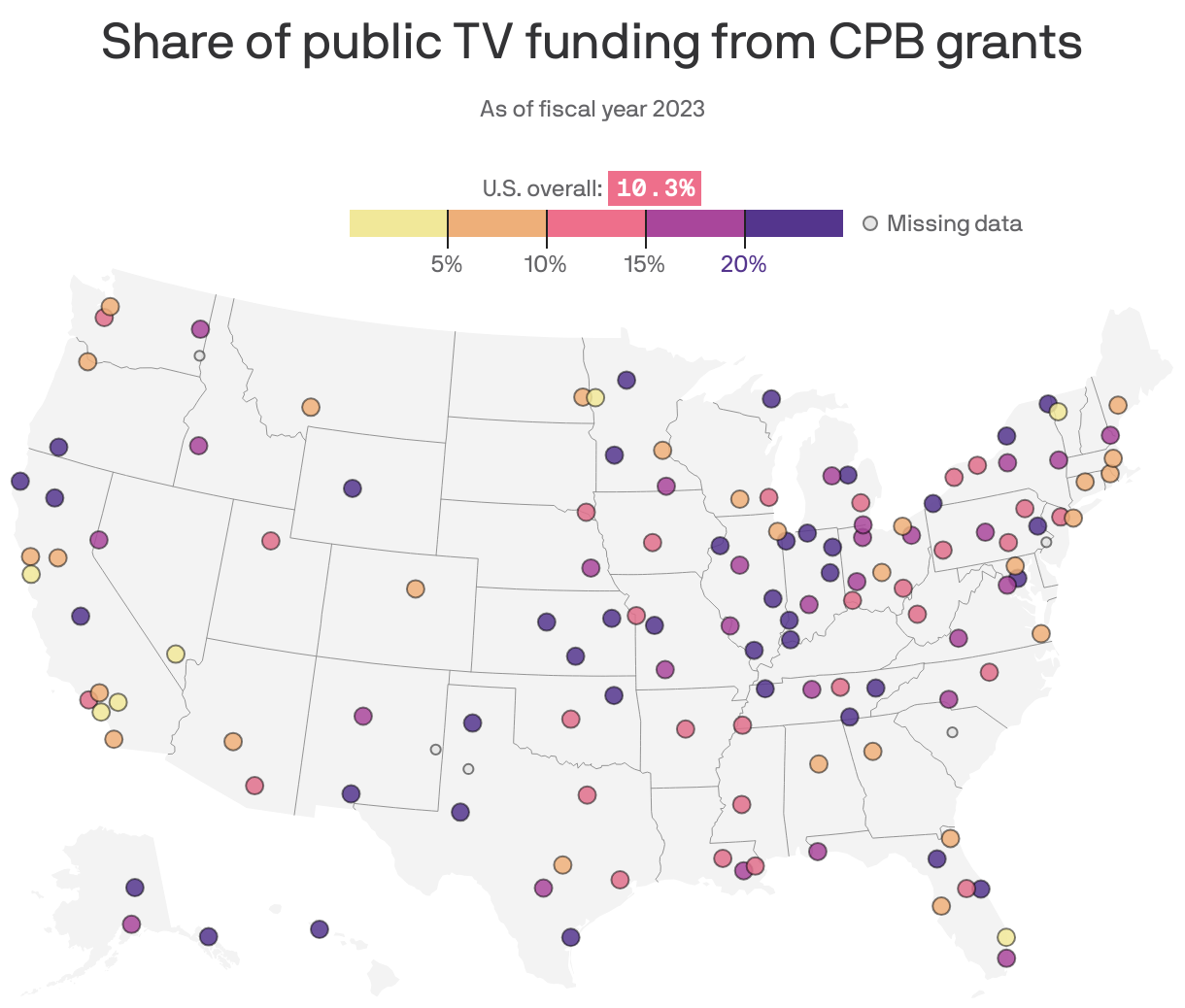
Seattle's local public media stations pull in millions of dollars in donations a year, but farther out, other Washington outlets rely more heavily on federal support, according to new data.
Why it matters: Public media outlets like KUOW, KCTS and KEXP play vital roles in community journalism and emergency alerts, but the Trump administration and others on the right have long accused them of left-leaning bias — and federal funding cuts could threaten their viability.
By the numbers: Federal CPB grants made up just 10.3% of public TV revenue and 4.1% of radio revenue in fiscal 2023 — and an even slimmer slice for some of Seattle's biggest stations, per data compiled by former NPR staffer Alex Curley on his blog, Semipublic.
Yes, but: They're a lifeline for smaller stations across Washington.
- In Seattle, CPB covers 7.6% of KCTS' budget, 4.2% for KUOW, and 3.5% for KEXP.
- Outside the metro area, CPB funds cover 34.3% of KSVR's $299,000 budget in Mount Vernon, 19.6% of KSPS's $6.8 million in Spokane, and 14.3% of KBTC's $5.8 million budget in Tacoma.
How it works: The funding breakdown is based on 2023 data collected from station websites by Curley.
- Location and financial data comes from station filings with the CPB. Some may be physically located elsewhere in Washington, or operate as part of a larger regional group.
What's happening: Amid uncertainty over federal support, several stations like KUOW, KCTS, and KSPS have ramped up fundraising campaigns.
What they're saying: "Imagine what it would be like if there were no more 'Sesame Street,' no more 'Masterpiece,' and no more 'NewsHour,'" Gary Stokes, president and GM of KSPS PBS in Spokane, wrote in a letter to viewers. "If ever there was a time to rally around a cause, this is the time — and this is the place.
- "The future of public media will depend on you," KUOW urges listeners.