Pacific Northwest cities swelter as summer nights get hotter

Add Axios as your preferred source to
see more of our stories on Google.
The Pacific Northwest is bracing for a short but intense heat wave that will bring some of the hottest temperatures of the year so far.
Why it matters: Even the nights will stay warm, prolonging the potential health effects of extreme heat.
Driving the news: Much of western Washington and Oregon — including the Seattle and Portland metro areas, the Willamette Valley, and the Columbia River Gorge — are under a heat advisory through Wednesday night as unusually high temperatures sweep the region.
- In Portland, as of Monday afternoon temperatures are expected to hit 92°F on Tuesday and a sweltering 97°F on Wednesday before dipping back into the mid-80s this weekend, according to the National Weather Service.
- Seattle's daytime highs are forecast to hit 86°F on Tuesday and 91°F on Wednesday before dropping below 80 over the weekend, according to NWS meteorologist Dev McMillian.
- The overnight low in Portland Wednesday morning is expected to stall at 67 degrees — 10 degrees hotter than average — while Seattle's low is forecast to be about five degrees hotter than usual at 62, per the weather service.
What's happening: A strong high-pressure system is settling over the region for a couple of days, Jon Liu of NWS Portland tells Axios.
Between the lines: Higher daytime temperatures can create an "urban heat island" effect, where concrete and buildings absorb heat during the day and release it at night, pushing overnight temperatures far above normal, McMillian tells Axios.
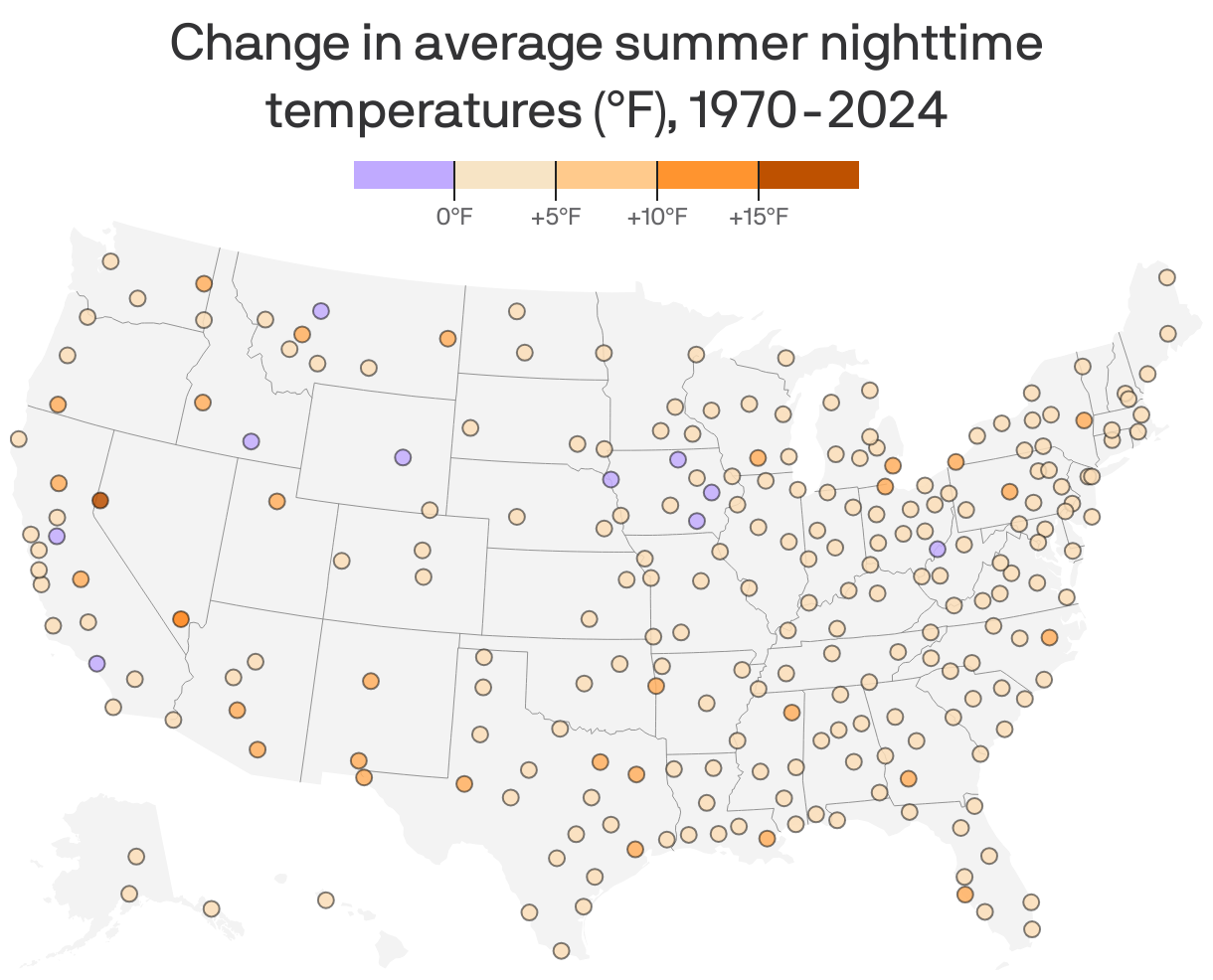
By the numbers: Portland and Seattle are among hundreds of U.S. cities experiencing warmer-than-usual summer nights in what a recent report from Climate Central says is a clear sign of climate change.
- The report found that between 1970 and 2024, the average summer nighttime temperatures increased in 96% of 241 locations analyzed, writes Axios' Alex Fitzpatrick.
- They rose on average by 3.1°F among cities with an increase, per the report.
- The number of warmer nights also increased, with cities on average logging about 27 warmer-than-normal summer nights as of 2024 compared to one such night each year in the 1970s, per the report.
Zoom in: In the Northwest, Seattle's average summer low jumped by 2.9°F, Portland's by 3.7°F, Yakima's by 4.3°F, and Spokane's by 5.1°F. Eugene saw a smaller increase of 1.7°F.