New REAL ID rules for plane travel set to take hold in May

Add Axios as your preferred source to
see more of our stories on Google.
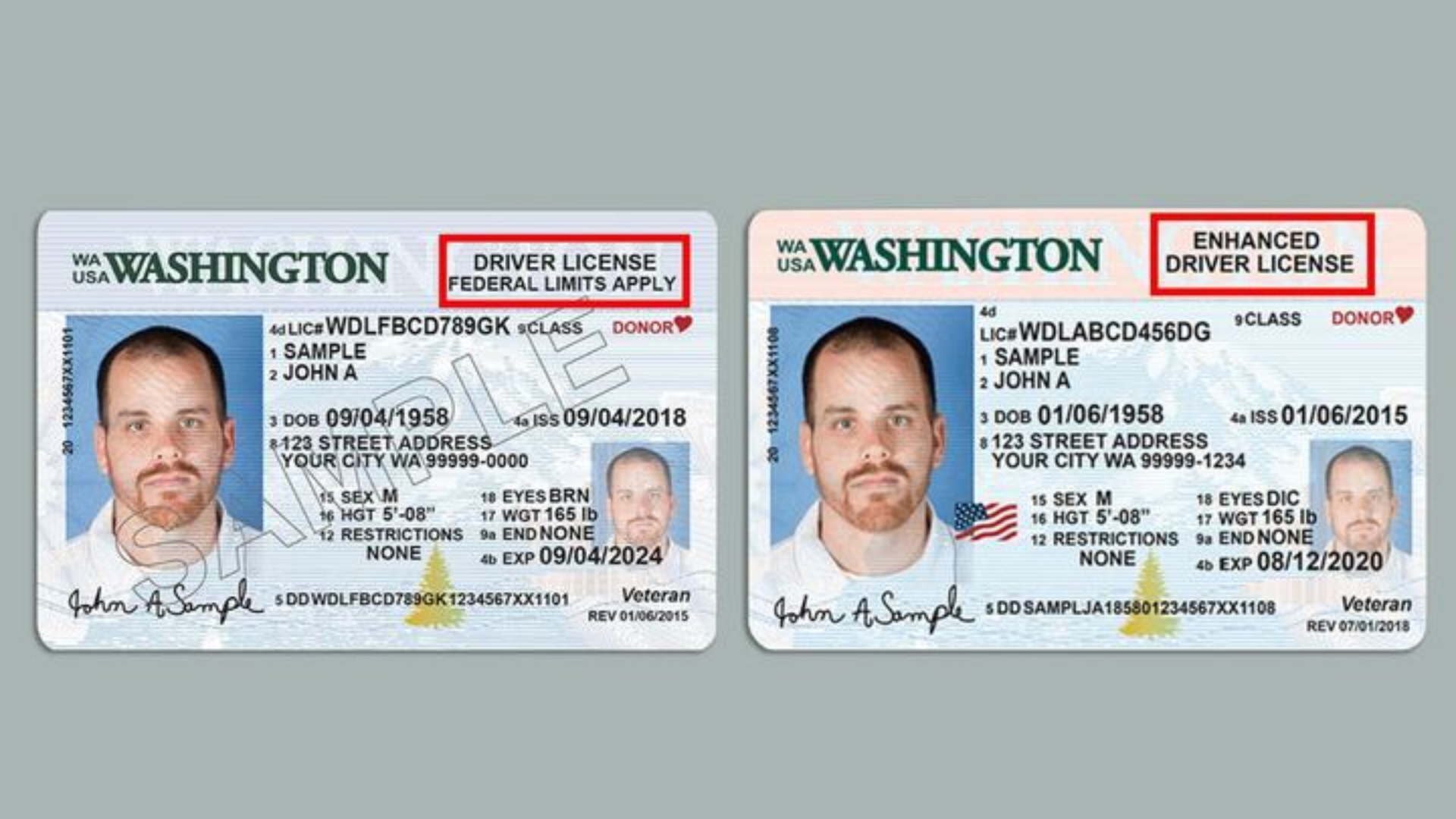
A sample standard-issue Washington driver's license (left) versus one that meets REAL ID requirements. Courtesy of state Department of Licensing
If you plan to travel in the U.S. by plane this year, you may need to upgrade your ID to meet new federal requirements.
Why it matters: New rules that prevent you from using a standard state-issued driver's license to board a domestic flight will take effect May 7, federal officials say.
- State and federal officials are urging people in Washington state and around the country to upgrade their IDs now so that they're prepared for the deadline.
The fine print: If you want to use a state-issued ID for plane travel, you'll need to have an enhanced driver's license, an enhanced ID card or another type of state ID that is compliant with the federal REAL ID Act, per the Department of Homeland Security.
- REAL ID-compliant licenses — typically denoted by a star on the license or the word "enhanced" — can only be issued to people who can prove they are legally in the United States.
- Passports, green cards, military IDs and certain other documents also will be accepted for air travel between U.S. states, DHS says.
Catch up quick: Congress passed the REAL ID Act in 2005 after the Sept. 11, 2001, terrorist attacks, seeking to beef up security surrounding IDs used at airports.
- The upgraded IDs will also be necessary to visit military bases and secure federal buildings like courthouses after May 7, per DHS.
Zoom in: Since 2018, Washington has printed "federal limits apply" on its standard-issue state driver's licenses, indicating they don't meet REAL ID requirements.
- Those needing an ID they can use to board a plane can make an appointment at a Department of Licensing office to get an enhanced driver's license or an enhanced ID card, or arrange to get a passport.
- Either will require proof of citizenship, such as a certified birth certificate or certificate of naturalization.
Flashback: The REAL ID Act was originally supposed to take effect in 2008.
- But the Department of Homeland Security delayed enforcement for more than a decade to give states more time to comply and residents more time to get compliant IDs.
- After the COVID-19 pandemic hit, the federal agency delayed the enforcement deadline another three times, to account for closures of driver licensing offices and other changes in licensing operations.
- Those closures created backlogs that "significantly hindered" progress toward widespread adoption of REAL ID licenses, per DHS.
Between the lines: There's a chance the May 7 deadline could be relaxed — but you shouldn't count on it.
- A rule adopted last month allows the Transportation Security Administration to implement a "phased enforcement plan," under which it could accept standard state IDs through May 2027.
- As of last week, however, the TSA had not decided to go that route, the agency told Axios in an emailed statement.
What we're watching: Nathan Olson, spokesperson for Washington's Department of Licensing, told Axios people should schedule appointments to get enhanced licenses now, to avoid potential difficulty getting an appointment slot close to the May 7 deadline.