Why manufacturing recovery lags in Washington


Add Axios as your preferred source to
see more of our stories on Google.
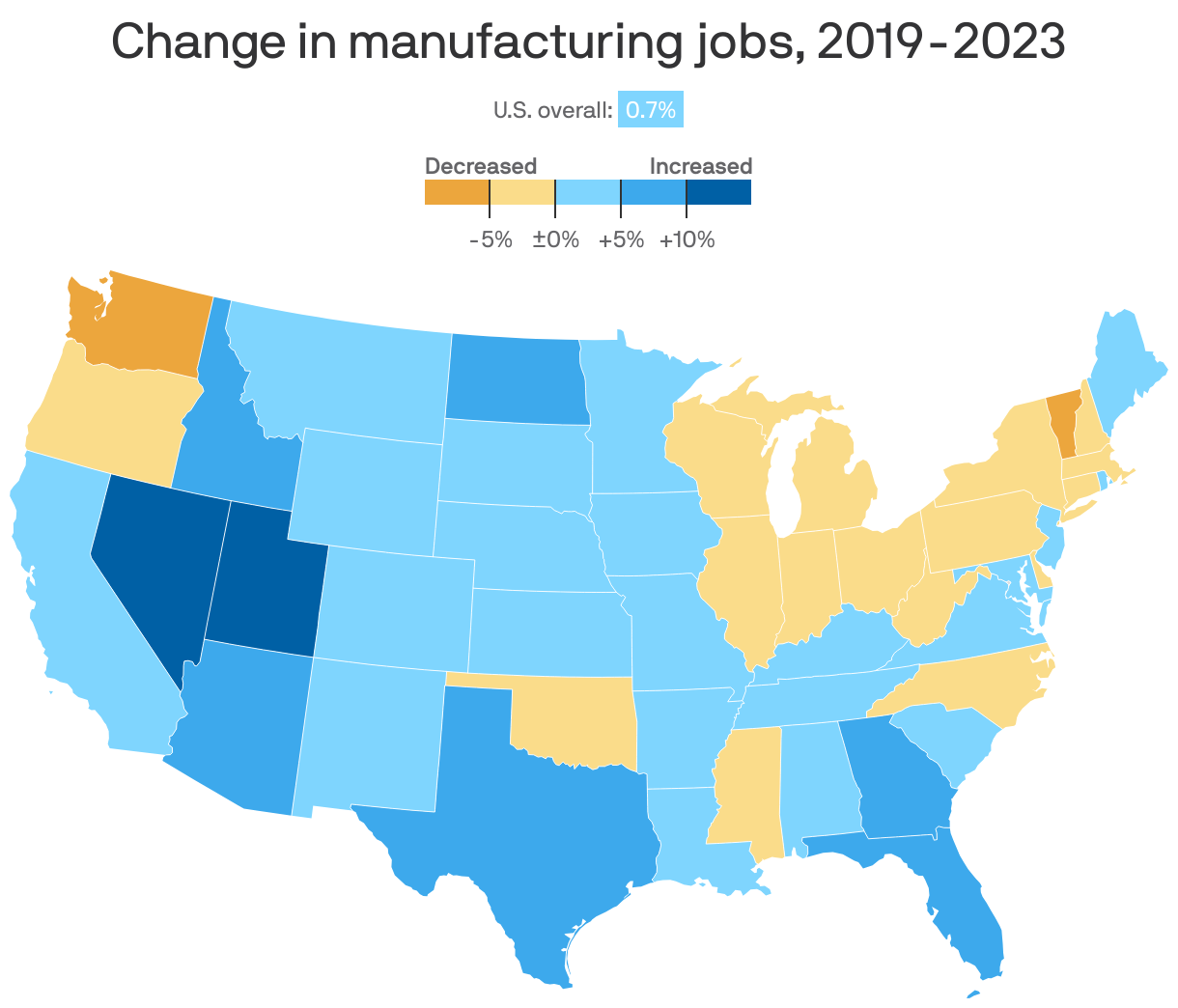
Washington's manufacturing sector, particularly aerospace, is still struggling to recover pre-pandemic job levels, lagging behind the national trend.
Why it matters: Washington saw the steepest drop in manufacturing jobs in the nation in recent years, per a new analysis of government data by the Economic Innovation Group (EIG).
- Boeing's pandemic-related setbacks, compounded by earlier production issues, continue to weigh heavily on the state's economy and job recovery.
The big picture: Manufacturing jobs are back across much of the U.S., especially in the Sun Belt, where employment in the sector is now slightly above pre-pandemic levels,
- For the first time since the 1970s, the U.S. manufacturing industry has recovered all the jobs lost during a recession, but it's been uneven and rather concentrated.
- Just five states accounted for two-thirds of the sector's job growth: Texas, Florida, Georgia, Arizona and Utah.
- Transportation and food accounted for much of the growth. Another bright spot was electronics, spurred on by the Biden administration's efforts to bolster domestic chip making.
By the numbers: Meanwhile, Washington lost 6.7% of its manufacturing workforce — more than 19,000 jobs — between 2019 and 2023, per EIG.
- The manufacturing workforce in the Seattle metro area dropped from roughly 183,000 in 2019 to about 163,000 in 2023, an 11% decline, according to EIG.
- In Washington, the aerospace manufacturing workforce, which is largely concentrated in the Seattle area, was down 8% in September 2023 compared with February 2020, according to Anneliese Vance-Sherman, the chief labor economist for the Washington Employment Security Department (ESD).
Zoom in: Aerospace manufacturing is a critical component of Washington's economy, representing over 30% of the state's manufacturing jobs, Vance-Sherman tells Axios.
- Boeing, a central player, has faced a litany of problems in recent years, including the grounding of the 737 MAX following crashes in 2018 and 2019 that killed 346 people.
- The company laid off about 30,000 people in 2020.
The latest: Boeing's recovery has been further disrupted by an ongoing machinists' strike.
State of play: The state has made strides in other manufacturing subsectors: Food and wood products have shown growth, increasing by 1% and 6.3%, respectively, since the pandemic, according to ESD.
What's next: Washington is investing in specialized training programs through technical colleges and community partnerships aimed at preparing workers for diverse manufacturing roles, reducing reliance on aerospace and building a more resilient manufacturing base, per Vance-Sherman.