Super active sunspots could bring auroras to Seattle

Add Axios as your preferred source to
see more of our stories on Google.
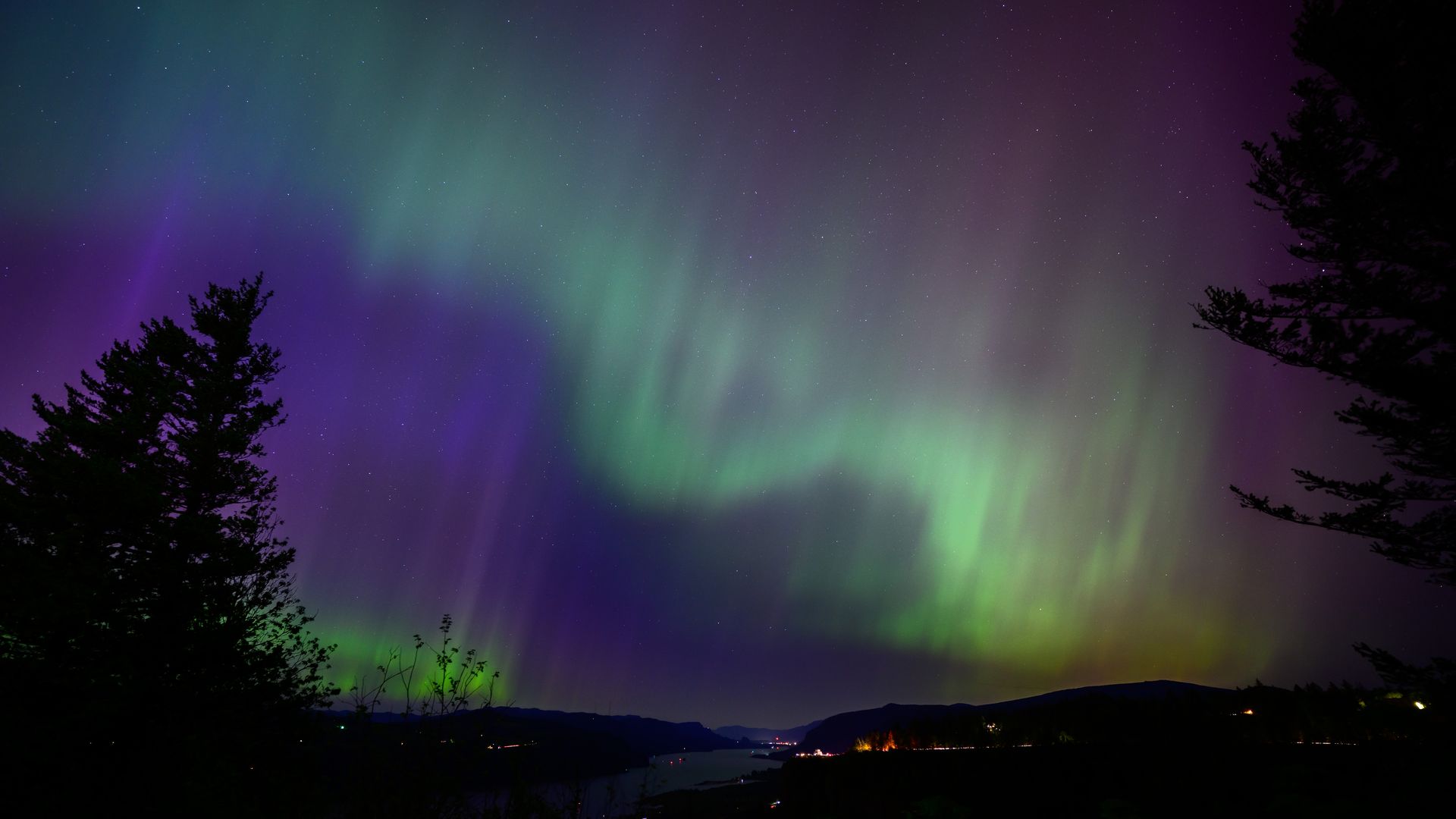
The aurora borealis over the Columbia River Gorge on May 11. Photo: Mathieu Lewis-Rolland/Getty Images
An extra active solar cycle this year and heightened sunspot activity this week means Seattle-area aurora seekers should be on alert for upcoming shows, one expert recommends.
Why it matters: One of the strongest solar flares in decades produced jaw-dropping views throughout the continental U.S. in May.
Driving the news: Three of the eight sunspot regions currently visible — AR3774, AR3777 and AR3780 — have the potential to produce the kind of solar flares and coronal mass ejections (CMEs) that can extend the northern lights far beyond the usual perimeters.
- Because there has been a lot of activity on the Sun this week and last, next week will be a good time to start watching the Space Weather Prediction Center's aurora forecast, said Don Hampton, a research associate professor at the Geophysical Institute at the University of Alaska Fairbanks.
- The aurora was visible in Seattle on Sunday following an Aug. 1 CME that resulted in a G3 magnetic storm.
What they're saying: "Seattle could get a good display anytime," Hampton told Axios.
State of play: AR3780 is particularly active, has a high level of magnetic complexity and appears to be growing as it rotates toward Earth.
- It can even be seen without magnification from Earth, according to EarthSky.
- "Put on your eclipse glasses and take a look at the Sun, and you'll see a sunspot region that could be bringing us some major activity in the coming days!" EarthSky reports.
What's happening: The Sun is approaching the peak, or solar maximum, of its roughly 11-year cycle, when it reverses its magnetic field, gets more active and produces loads of sunspots, solar flares and CMEs, said Hampton.
- That heightened activity results in more energetic charged particles, traveling to Earth by solar wind.
- When these particles penetrate Earth's magnetic field and collide with atoms and molecules in the upper atmosphere, kinetic energy is transformed into visible light, creating the aurora, according to NASA.
Yes, but: It usually takes several days for activity on the Sun to translate into auroras on Earth and it's almost impossible to predict exactly when and where they'll be visible, said Hampton.
What's next: This solar peak cycle has been a lot more active than the last one, with July seeing some of the highest amounts of solar activity on record, and it could just be getting warmed up, NASA solar system ambassador Brenda Culbertson told KSNT.
- The next 6–18 months could bring "some really nice auroras" to Seattle and beyond, said Hampton.