Washington sees human smuggling spike, feds say

Add Axios as your preferred source to
see more of our stories on Google.
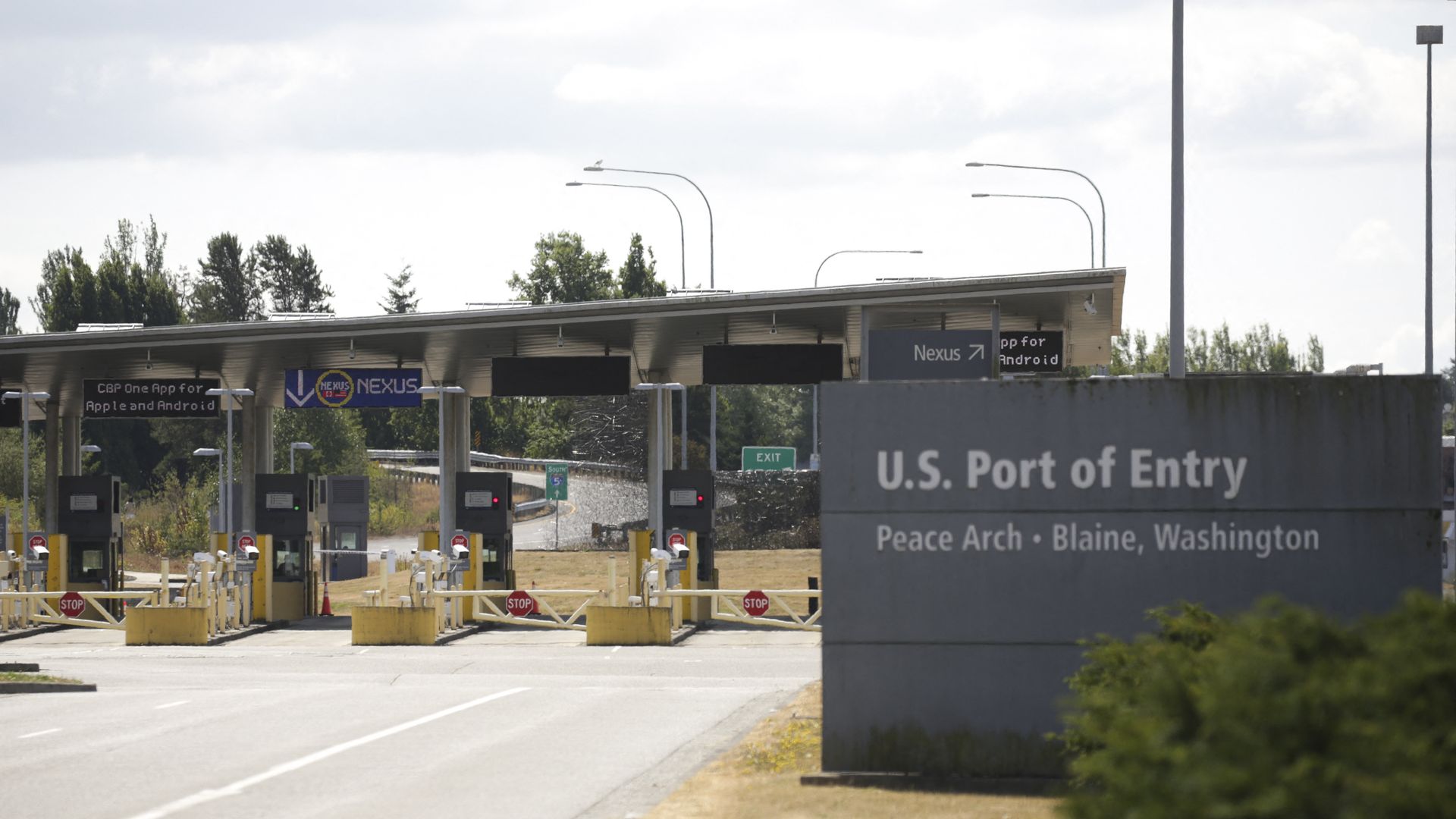
The U.S. Port of Entry at the Canadian border in Blaine, Washington. Photo: Jason Redmond/AFP via Getty Images
Editor's note: This story has been corrected to reflect accurate numbers throughout and the chart has been removed. The story has also been updated with comments from Canada's consul general to the Pacific Northwest and Alaska.
Human smuggling has become a primary focus for federal authorities in Washington state as the number of illegal migrant crossings from Canada into the U.S. reaches record highs, local officials say.
Why it matters: With so much attention on the U.S. southern border, the "historic" amount of activity on the northern border may be overlooked, Homeland Security Investigations special agent in charge Robert Hammer told Axios.
- "We need to know who is coming into the country and why and know they are not a threat," he said.
By the numbers: In fiscal year 2023, U.S. Customs and Border Protection (CBP) recorded 10,021 encounters of people trying to enter outside the official ports of entry along the northern border — compared to 2,238 in 2022 and 916 in 2021. Official "encounters" include all people found entering the U.S. illegally, including some who are assisted by smugglers.
- In Washington, the Border Protection sectors and offices in Blaine, Seattle and Spokane reported 1,662 encounters in 2023, compared to 494 in 2022 and 166 in 2021.
- Washington's reported encounters for fiscal 2024 has already passed last year's total, at 2,094 as of May 31, per CBP.
- 12,859 encounters between official ports of entry have been reported nationally by CBP in fiscal year 2024.
What they're saying: The "staggering spike" in those encounters is of great concern, U.S. Attorney Tessa Gorman told Axios.
- The boom in northern border crossings between points of entry may be linked to networks and smuggling organizations that earn thousands of dollars per transported person, according to Gorman and Hammer, who said they are seeing the highest numbers of smuggling investigations and prosecutions in their decades-long careers.
Yes, but: Adam Barratt, Canada's consul general to the Pacific Northwest and Alaska, told Axios that the lower numbers from 2021 and 2022 reflect a period when the U.S-Canada border was essentially closed due to COVID and global migration was dramatically reduced.
- "As migration trends rise around the globe, illegal migration is a challenge faced by both the U.S. and Canada," Barratt said in an email. "It is important to note, however, that the vast majority of people traveling between our two countries do so legally."
Between the lines: Those smuggled face potentially deadly risks as they may be dropped in the woods on foot at night, stuffed into vehicle trunks or packed in commodity shipments in a locked freight container.
Case in point: A Romanian citizen pleaded guilty in U.S. District Court in Seattle in March to conspiracy to transport people who were not legally in the U.S.
- Prosecutors allege he picked up 12 illegal migrants in a vehicle that had seats for eight, with two children found unrestrained in the trunk. He was sentenced in June to time served, Assistant U.S. Attorney Thomas M. Woods told Axios.
- Last June, a California man was sentenced to three years in prison after pleading guilty to smuggling more than 800 people into Washington state from Canada using 17 Uber accounts, per the Department of Justice.
- Many smuggled in by the California man's network paid $11,000 each to make the journey, federal prosecutors said.
"There are, no doubt, humanitarian reasons for people coming into the country," said Gorman, "but we have also seen people smuggled in to commit crimes."
What's next: The U.S. Attorney's Office for the Western District of Washington, HSI Pacific Northwest and Border Patrol are working to understand the reasons behind the spike in smuggling and prosecute the organized crime networks behind it, said Gorman.
- "These organizations don't care about safety," said Hammer. "They put people in danger every day."