Walking in Seattle is way down from 2019


Add Axios as your preferred source to
see more of our stories on Google.

A man walks past Pike Place Market in Seattle. Photo: Genna Martin/San Francisco Chronicle via Getty Images
There's been a significant decline in the number of trips Seattle residents take by foot since the pandemic, a new report shows.
Why it matters: Walking is good for us.
- That's true both for the human body (thanks to the many health benefits it confers) and the environment, since it's the original form of zero-emissions travel.
Driving the news: The number of annual average daily walking trips per 1,000 people in the Seattle area dropped more than 35% between 2019 and 2022, according to a new StreetLight Data report.
- There were 220 annual average daily walking trips per 1,000 people in 2022, compared to 340 in 2019.
How it works: StreetLight measures travel behavior based on anonymized data from mobile devices, vehicle GPS systems and more.
- For this analysis, one "walking trip" is any trip taken by foot that is more than 250 meters — about 820 feet — from start to finish.
The big picture: Nationally, the number of annual average daily walking trips dropped a whopping 36% in the contiguous U.S. between 2019 and 2022.
- "In every metro and state that StreetLight analyzed, walking trips declined over the three-year period by at least 20%," per the report.
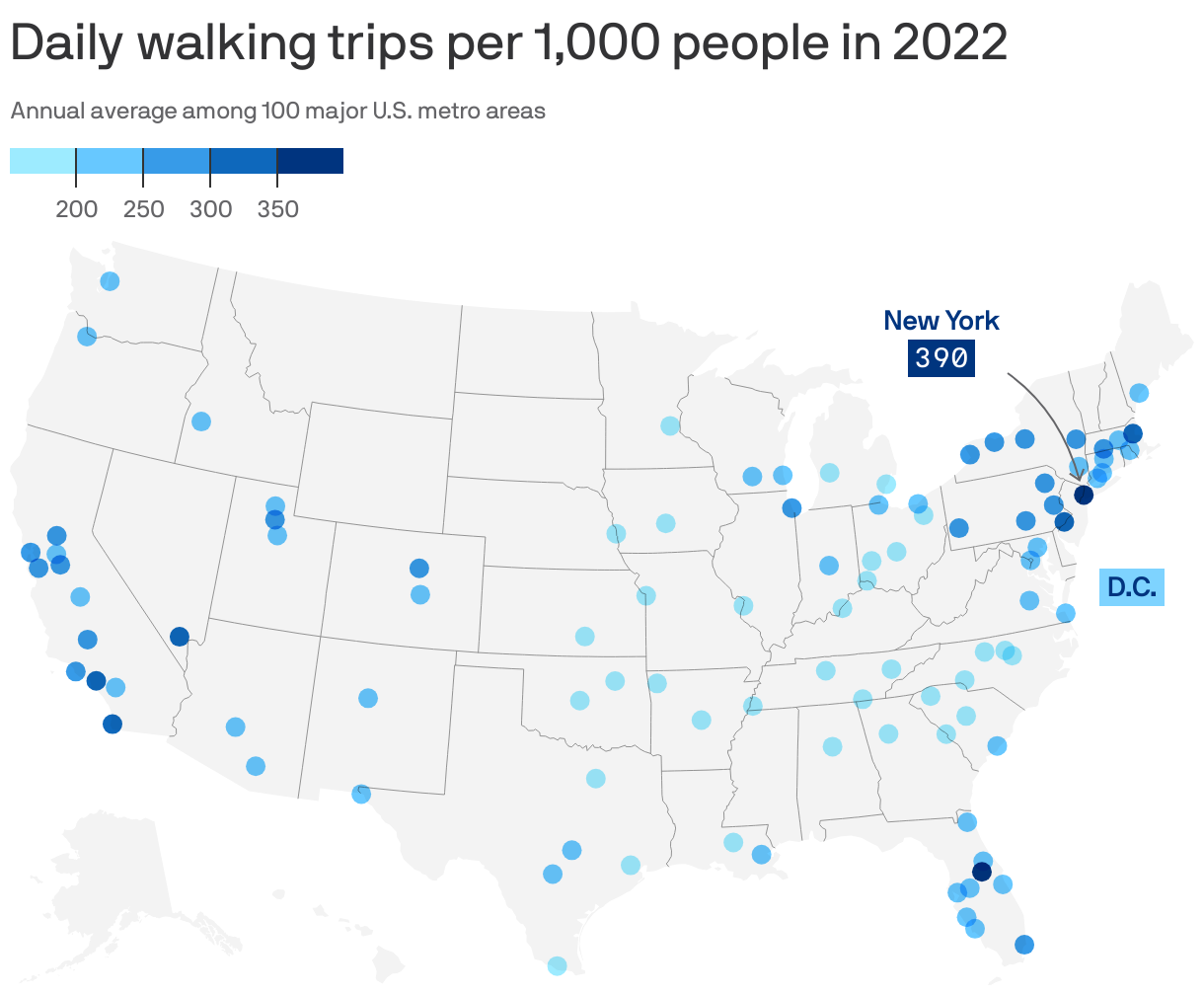
Zoom out: New York City ranks highest among the top 50 U.S. metro areas for annual average daily walking trips per capita in 2022, at 390 per 1,000 people — no surprise to anyone who's ever lived there and racked up a few miles of walking every day in the normal course of life.
- Seattle, Portland and Boise are all near the bottom of the list with just 220 trips per 1,000 people.
Bucking the trend: Los Angeles (+19%), San Diego (+14%) and Modesto, California (+13%) all saw an increase in annual average daily walking trips from 2021 to 2022.
The intrigue: Some of the decline could be due to remote work, which can make it easy to become overly sedentary.
- And it could be part of each city's downtown recovery story; if there are fewer restaurants and shops, there's less reason for locals and visitors to have a walkabout.
Zoom in: Despite being renowned for its outdoor culture, Seattle's streets are not always safe for people on foot, with the city noting recent increases in traffic fatalities among pedestrians and bicyclists.
- It's best to walk in well-lit areas and wear clothing that is reflective or has lights so that cars and other people can see you, said Dr. Cindy Lin at the University of Washington School of Medicine.